Is NetSuite reshaping ERP as we know it?
NetSuite SuiteWorld 2026 is challenging the idea that your team should spend hours operating software before it can make one useful decision.
Click through menus. Export the report. Find the problem. Chase the answer. Repeat. For too many finance and operations teams, that routine has become an accepted part of the working day. It deserves to be challenged.
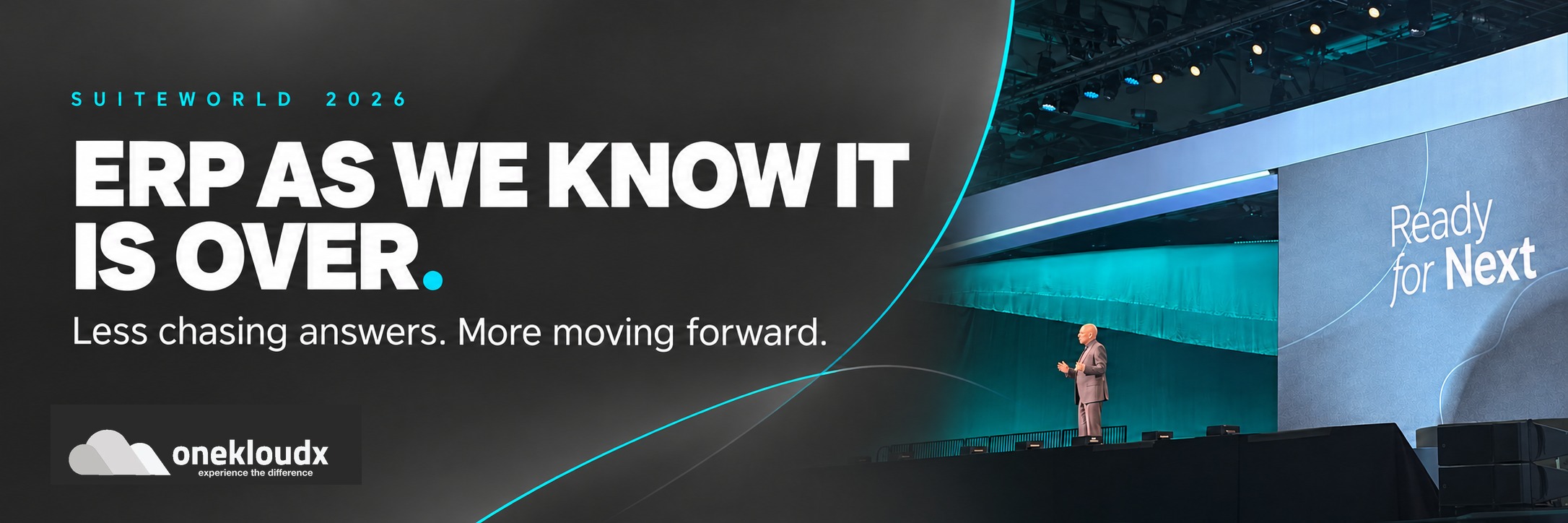
“ERP as we know it is over,” Evan Goldberg told the SuiteWorld audience, according to Computer Weekly’s keynote coverage. It is a bold statement. The frustration behind it is familiar: your system holds the information, but your team still has to do so much work to make that information useful.
Think of a satnav that shows where you are but leaves you to calculate every turn. That is how business software can feel when it records everything yet leaves people piecing together what to do next.
OneKloudX’s Robert Jurcec and Ross Johnstone are attending SuiteWorld in Las Vegas this week. With NetSuite Next and Ask Oracle beginning to roll out across Australia and New Zealand, the conversation has immediate relevance for local businesses.
What could your team do with that time back? That is the question worth bringing home from SuiteWorld.
The next chapter is Ready for Now
A bold declaration gets attention. Showing how the work changes is what makes it matter.
NetSuite followed its opening keynote with Product Keynote: Ready for Now. In its SuiteWorld On Air email, NetSuite described demonstrations of Ask Oracle, SuiteAgents and NetSuite Next focused on simplifying the financial close, tackling operational challenges and automating everyday tasks. The programme also included a customer panel with MCNC.
NetSuite’s message for that session was direct: “Everything you’ll see is available today, with you in control.” That statement applies to the demonstrations in the session; it does not mean every feature announced during the event is enabled in every customer account.
For anyone tired of another distant technology promise, a session built around capabilities already in use is a reason to lean in. The questions become much more practical: what can the system take off our plate, where do we make the decision, and how soon can we test it?
Why does getting an answer still take so much work?
Consider a typical Monday morning at a distributor. A customer wants to know why an order is late. Sales checks the order, the warehouse checks availability, purchasing checks the supplier and finance checks whether a hold is involved.
Everyone is busy. The customer is still waiting.
Or consider a finance manager explaining a margin change. The figures are available, but extracting them, comparing periods and tracing the transactions consumes the time that should go into deciding how to respond.
In these everyday scenarios, information may be connected in the system while the work of interpreting it remains scattered across people, reports and conversations. The team becomes the link between knowing something is wrong and understanding what to do about it.
That is the gap NetSuite’s announcements are targeting. The ambition is to make the system more active in the work between spotting a problem and resolving it.
What changes when you can ask your ERP a question?
Ask Oracle is NetSuite’s conversational AI assistant. Oracle’s documentation describes asking for overdue invoices or a chart of sales by item, then refining the response through follow-up questions.
For a busy team, the significance is the starting point. You begin with the information you need, rather than remembering which screen or report will get you there.
Imagine preparing for a collections meeting. Instead of rebuilding the same spreadsheet, you start by asking for the overdue invoices you need to review. The team can then examine the result, check the relevant records and decide which conversations to prioritise.
The opportunity is to arrive at the meeting ready to discuss the customer and the next action, with the supporting records already in view. That is a more valuable use of a finance team’s experience than another round of spreadsheet preparation.
Oracle also describes introducing NetSuite Next by role, without a data migration or reimplementation. That creates room for a measured transition: a small team can explore the experience before the business expands its use. Existing customisations and critical workflows still deserve testing in your own environment.
Can AI help find the work that deserves attention?
Finding information is only part of the story. At SuiteWorld, NetSuite introduced more than 45 SuiteSkills, prebuilt business capabilities that combine AI reasoning with NetSuite process knowledge.
Three examples deserve particular attention from finance and operations leaders.
The Revenue Leakage skill is designed to distinguish potential underbilling and unbilled delivery from accounting exceptions. The Variance and Flux Analysis skill helps separate recurring changes from timing effects and one-off items. Inventory Movement Insights and Fulfillment Performance Insights help investigate stock imbalances and fulfilment delays.
For teams carrying a growing workload, a useful starting point can make a difference. Knowing which exception deserves investigation helps someone move the work forward instead of checking everything with equal urgency.
For a finance manager, the opportunity is a more focused investigation. A potential billing gap still needs checking, but finding it sooner creates a chance to act. For an operations manager, a useful explanation of an exception could reduce the back-and-forth before someone decides what happens next.
This is where the excitement becomes tangible. An overlooked invoice, a delayed shipment or an unexplained variance is something a team already cares about. AI earns its place by helping with that work.
Will dashboards start doing more of the work?
NetSuite also announced AI Portlets and AI Workspaces. AI Portlets generate dashboard analysis and charts from natural-language requests. AI Workspaces bring people, agents, information and approvals together around business processes.
The broader direction is an autonomous suite that can coordinate and execute more work within defined controls. That raises expectations of a dashboard: it should help move the work forward as well as show where the business stands.
For a business leader, the opportunity goes beyond a new-looking dashboard. A useful workspace should help people understand what requires attention, who needs to make a decision and how the work progresses afterwards.
That is also a useful evaluation standard. If a demonstration looks impressive, ask to see the exception. What happens when information is missing, an approval is declined or a recommendation is wrong? Those moments reveal how well the capability will fit a working business.
What could this mean for an ERP implementation?
The work of implementing ERP is also coming under scrutiny. NetSuite introduced SuiteExpress, an AI-supported implementation toolset and methodology that combines customer-specific information with NetSuite expertise.
Its announced scope includes organising requirements, preparing and validating migration data, mapping business needs to configurations and testing workflows. Consultants guide key decisions and handle exceptions. The context gathered during implementation is intended to support later changes too.
For ANZ manufacturers and distributors, SuiteExpress is a development to watch. Its launch scope is covered below. The larger question it raises is already relevant: how much repetitive preparation should an implementation still require from your team?
The idea is compelling because implementation asks a great deal of the people who also have a business to run. Reducing repeated discovery or manual preparation could ease that burden. A faster project, however, still needs clear requirements, meaningful testing and people who understand the operation.
What is available to ANZ teams now?
The ANZ rollout of NetSuite Next and Ask Oracle has begun, as reported in current regional coverage. Oracle’s documentation makes clear that account access is phased, with in-application notifications when an account becomes eligible.
A regional announcement therefore does not mean every account has every feature today. Before planning a change, confirm your account’s access and the availability of the specific capability you want to use.
SuiteSkills, AI Portlets, AI Workspaces and selected industry-specific agents are available in markets where NetSuite Next is available, according to NetSuite’s announcement. Other autonomous-suite capabilities are planned for future releases. SuiteExpress has a separate initial scope: software businesses in the United States and Canada. Confirm account eligibility, feature access and applicable commercial terms with your NetSuite team.
Make the next conversation specific: here is the task we want to improve, here is the functionality we can access, and here is how we will evaluate it. That gives the excitement somewhere useful to go.
What should your team do first?
Choose a task that is repetitive enough to measure and important enough that improving it would matter. Preparing an overdue-invoice review or investigating a recurring reporting question may be a better starting point than trying to automate an entire department.
Record how the task works today. How long does it take? How many people get involved? What checks prevent errors? Then compare the AI-supported process against the same requirements.
Oracle’s readiness guidance recommends reviewing account data, access and the way information is organised. Test using the role of the person doing the everyday work. A demonstration with broad administrative access will not necessarily reflect that person’s experience.
Before committing to wider adoption, ask:
- Is this capability available in our account and region?
- What licensing, usage limits or consumption charges apply?
- Which records and connected systems does it use?
- What can it change, and where is human approval required?
- Can we inspect the evidence and trace actions afterwards?
- How will we measure improvement and handle exceptions?
Keep the first evaluation small enough that someone can review the results properly. Expand when the evidence supports it.
Frequently asked questions
Does this mean ERP is obsolete?
No. The argument is that the way people interact with ERP is changing. Financial records, operational processes and controls remain essential. NetSuite’s direction is to make more of the work around those foundations conversational and AI-supported.
Will Ask Oracle replace finance and operations teams?
The announced capabilities support analysis and execution within defined permissions. People still need to judge recommendations, handle exceptions and take responsibility for decisions. For adoption planning, focus on the tasks that could change rather than assuming whole roles disappear.
Do we need to replace NetSuite to use NetSuite Next?
Oracle describes NetSuite Next as an evolution of the existing platform, with no data migration or reimplementation required to switch. Access is phased, and your administrator should review eligibility, role access and compatibility before introducing it.
Can Australian customers use everything shown at SuiteWorld?
Availability depends on the capability and your account. Check the ANZ availability section above, then confirm access before building a business case around a particular feature.
Which frustration could your team leave behind?
The strongest takeaway from SuiteWorld is that we can raise our expectations of business software. A team should be able to spend more of its expertise on the decision and less of its energy getting ready to make it.
For manufacturers and distributors, that could mean a clearer explanation for a delayed order, a billing issue investigated sooner or less preparation before a finance meeting. Those are outcomes worth pursuing.
Bring OneKloudX one process that takes too much effort today. We can help assess the relevant NetSuite capabilities, the readiness of your account and a practical way to test the improvement.
Talk to the OneKloudX team and let’s work out what your team could do differently.