Only 30% of small firms in regions including Australia have a business continuity strategy, compared to 54% of mid-sized organisations, while unplanned downtime can cost between USD $137 and $16,000 per minute, and 34% of small businesses lack confidence they could survive a major disaster, according to business continuity statistics referenced by Revenue Memo. For a CFO, that should change the conversation immediately. This isn’t an IT side project. It’s a revenue protection issue.
In manufacturing and distribution, the practical question isn’t whether disruption will happen. It’s whether your finance, warehouse, production, payroll, and customer fulfilment processes can keep moving when a supplier fails, a flood closes a site, an integration breaks, or your ERP team loses access to a critical service.
What Is Business Continuity Planning Really?
Business continuity planning(BCP) is the operating model for keeping the business functional under stress. It’s broader than disaster recovery, and it matters because businesses rarely fail from one technical outage alone. They fail when orders stop flowing, dispatch teams lose visibility, finance can’t invoice, payroll is delayed, and nobody is clear on who makes decisions.
A useful way to frame it is this: disaster recovery restores systems, business continuity planning protects the business. In a cloud ERP environment, that means preserving the processes wrapped around the ERP, like Oracle NetSuite, Epicor Kinetic, or MYOB Acumatica, not just restoring logins and backups.
For an Australian mid-market organisation, a proper plan usually covers these questions:
- Revenue continuity: How will you keep taking orders, shipping goods, receiving stock, and invoicing customers?
- Financial control: How will you protect approvals, payment runs, reconciliations, and statutory reporting?
- Operational fallback: What happens if a warehouse system, MES link, EDI feed, or supplier portal becomes unavailable?
- Leadership response: Who declares an incident, who owns communication, and who signs off on workarounds?
Practical rule: If your BCP starts and ends with server recovery, you don’t have a business continuity plan. You have an IT recovery note.
This matters well beyond cyber risk. Physical security, site access, contractor management, and facility shutdown procedures often sit outside ERP conversations, even though they affect operational continuity directly. For organisations reviewing these exposures, GM GROUP Services has a useful piece on managing venue security risks and vulnerabilities that complements a wider resilience program.
The board-level shift is simple. Stop asking, “How fast can IT recover?” Start asking, “Which business processes must continue, at what service level, and with what manual fallback if the system is impaired?”
Why BCP Is a Strategic Imperative in Australia and New Zealand
For Australian and New Zealand manufacturers and distributors, continuity failures usually hit revenue before they show up in an IT report. A delayed dispatch run, a blocked approval queue, or a warehouse outage can push cash receipts out by days while costs keep landing on time. That is why business continuity planning has moved from an operational safeguard to a board and CFO issue.

Compliance pressure is operational pressure
In this market, compliance obligations are tied directly to system availability and process discipline. If the ERP is down, degraded, or feeding bad data across connected applications, finance teams can lose visibility over BAS support, approval histories, inventory valuation, audit evidence, and reporting cut-offs. The exposure is not limited to missed transactions. It extends to control failure, delayed lodgements, and weak documentation when regulators, auditors, or insurers ask for proof.
That is why mature organisations increasingly connect BCP to a broader governance, risk management, and compliance software strategy. The goal is to establish a clear chain from identified risk to control owner, response playbook, test record, and retained evidence.
For a CFO, this is a practical design issue inside the ERP environment. Which approvals can move to delegated limits if a manager is offline? Which reports need an offline export retained daily? Which integrations carry compliance-relevant records that cannot be recreated later? Those decisions belong in continuity planning before an incident forces the business into ad hoc workarounds.
Supply chain fragility is now a finance problem
Australian and New Zealand firms operate across long freight corridors, concentrated warehousing, imported inputs, and tight labour pools. A disruption at one point in that chain can create a financial problem within hours. Orders stop shipping. Receipts are delayed. Stock accuracy falls. Customer service teams start making promises without current availability data. Margin erodes fast when expediting, rework, and credit claims follow.
Generic disaster recovery falls short. Restoring access to the ERP matters, but it does not answer the harder question. Can the business still execute order to cash, procure to pay, warehouse dispatch, and financial control at an acceptable service level while systems, sites, or suppliers are impaired?
For manufacturing and distribution firms, the answer depends on process design inside the ERP architecture. If planning, inventory, carrier booking, EDI, customer portals, and finance approvals are tightly integrated, continuity planning has to cover the whole transaction flow, not just the core platform.
| Business area | What continuity planning must address |
|---|---|
| Order to cash | Manual order capture, credit approvals, dispatch prioritisation, invoice catch-up |
| Procure to pay | Alternate suppliers, receiving controls, urgent spend approvals |
| Warehouse and logistics | Alternate site dispatch, carrier communication, stock accuracy checks |
| Finance and compliance | Payment authority, bank access, close priorities, audit evidence retention |
Resilience can improve commercial performance
Well-run continuity capability protects more than downside risk. It helps firms hold service levels during disruption, defend customer relationships, and make better commitments in tenders and contract reviews. Lenders, insurers, and major customers increasingly test whether a business can continue operating under pressure, especially where a cloud ERP sits at the centre of manufacturing, fulfilment, and financial control.
I have seen the pattern repeatedly in ERP programs. Companies invest in a modern cloud platform, automate workflows, and improve reporting, but leave fallback procedures, alternate site arrangements, and integration failure playbooks unresolved. The result is a more efficient business in normal conditions and a more brittle one in abnormal conditions.
Tested BCP closes that gap. It gives management a basis for deciding which processes must stay live, which can degrade temporarily, and what financial impact is acceptable. In the Australian and New Zealand market, that level of process-centred resilience is part of protecting revenue, preserving compliance, and keeping the ERP program commercially credible.
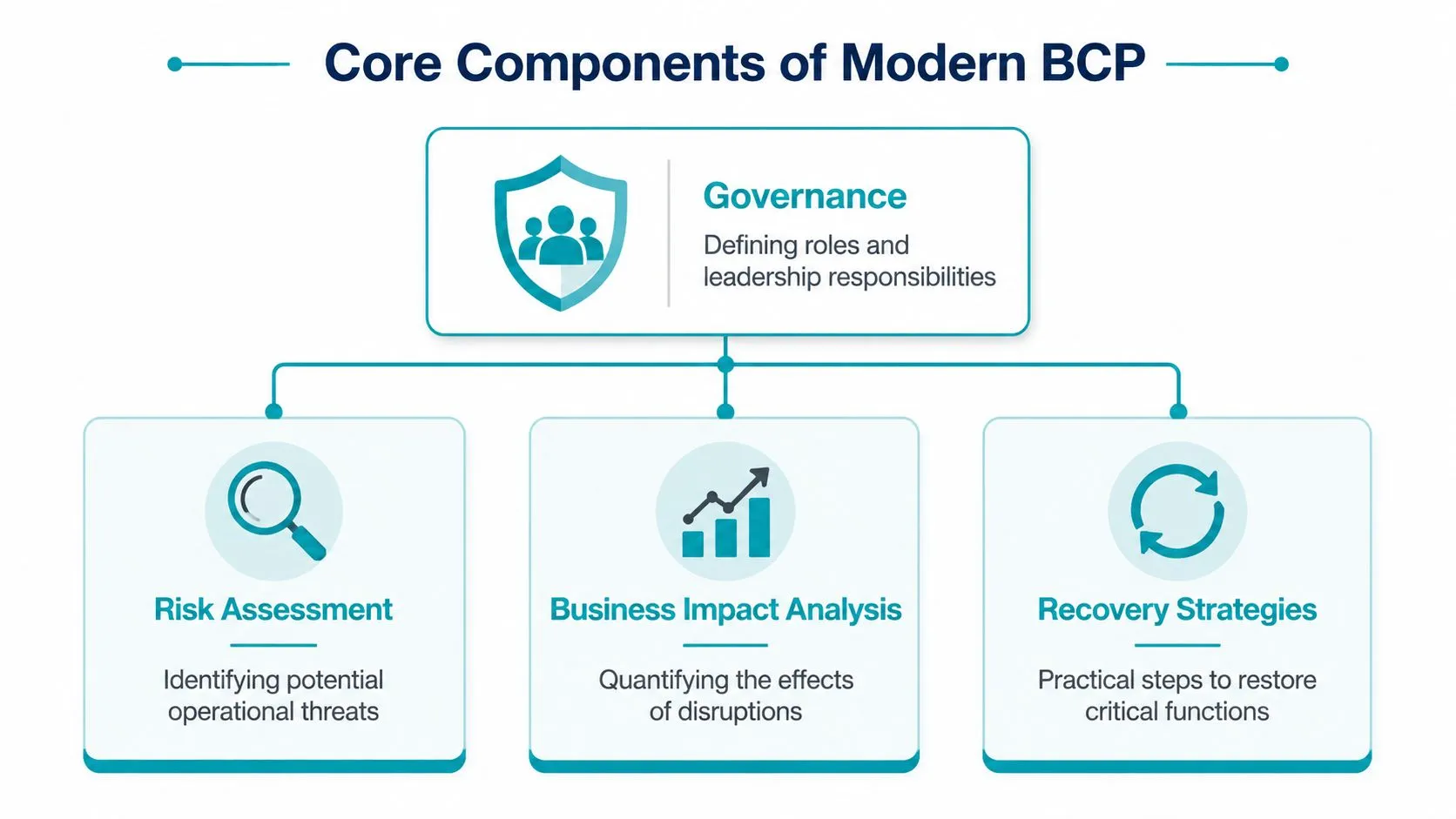
The Core Components of a Modern Business Continuity Plan
A workable BCP isn’t a thick document. It’s a set of decisions, priorities, and playbooks that people can use when operations are under pressure.
Business impact analysis is your triage tool
The business impact analysis, or BIA, is where most organisations either get clarity or expose confusion. It identifies which processes matter most, what they depend on, and how long the business can tolerate downtime before damage becomes unacceptable.
For manufacturers, the ERP usually sits at the centre of that exercise. A benchmark study of Australian mid-market manufacturers found 68% identified their ERP as the top critical function, with average RTO targets of 2 to 6 hours to mitigate revenue losses exceeding AU$50,000 per hour from disrupted operations.
That tells a CFO two things straight away. First, criticality is already concentrated. Second, recovery targets should be tied to financial exposure, not IT preference.
A practical BIA in a cloud ERP environment should map:
- Core finance processes: general ledger access, approvals, receivables, payables, bank file generation
- Operational dependencies: warehouse scanning, inventory updates, production transactions, freight bookings
- Integration points: EDI, payroll, expense tools, WMS, CRM, planning platforms, supplier portals
- Fallback options: spreadsheets, manual forms, staged approvals, offline stock allocation rules
Risk assessment should expose real failure points
A lot of plans fail because the risk assessment stays too generic. “Cyber attack”, “natural disaster”, and “supplier outage” are categories, not operating insights. What matters is which exact dependencies break and what that does to a business process.
In ERP programs, the weak points often look familiar:
- Single integration owners: one person understands a Boomi, Celigo, Workato, or Jitterbit workflow
- Undocumented handoffs: warehouse staff know the practical workaround, but finance doesn’t
- Third-party blind spots: a transport API, EDI connection, or payroll file dependency has no contingency path
- Approval bottlenecks: spend, credit, and payment approvals rely on unavailable people or devices
What works: Map the process, the system, the integration, the owner, and the fallback in one place.
What doesn’t: Keeping separate documents for IT recovery, operations manuals, and finance controls that nobody reconciles.
Recovery strategy and communication decide the outcome
Recovery strategy is where theory becomes usable. This includes alternate sites, substitute workflows, delegated authority, contact trees, supplier escalation paths, and customer communication templates. It also includes practical sequencing. Which process resumes first, and what has to be true before the next one starts?
For example, there’s no point restoring dispatch visibility if inventory status is unreliable, and there’s no point reopening approval queues if roles and limits haven’t been reassigned.
A sound communication plan should answer four simple questions:
- Who can declare an incident
- Who joins the response team
- Who communicates with staff, customers, and suppliers
- Where the current version of truth sits
That’s the structure CFOs need. Not abstract resilience language, but a coordinated plan that protects transactions, reporting, and service continuity.
A Practical Framework for Implementing Your BCP
A business continuity plan fails in practice when it sits outside day-to-day operating decisions. For Australian manufacturers and distributors running cloud ERP, implementation needs the same discipline as an ERP rollout, finance transformation, or warehouse redesign. That means accountable owners, documented tolerances, tested workarounds, and evidence that critical transactions can still move when a site, supplier, or integration drops out.

Start with governance and decision rights
Continuity work stalls fast without clear authority. In my experience, the CFO and COO usually need to sponsor it together. Finance sets the loss tolerance, cash priorities, and control boundaries. Operations defines what has to keep shipping, receiving, producing, and invoicing.
Set three decisions early and put them in writing.
- Executive accountability: one sponsor with authority to resolve scope, funding, and priority conflicts
- Incident authority: named decision-makers, alternates, approval limits, and escalation triggers
- Plan scope: the entities, sites, processes, systems, suppliers, and customer commitments covered by the plan
A structured delivery model helps here. FlexSafe, for example, treats continuity as part of process design, role design, data readiness, and cutover planning. That is a better fit for ERP-led businesses than writing a static document after go-live and hoping teams use it under pressure.
Build the plan around revenue and cash movement
The practical starting point is not a list of threats. It is a list of business processes that protect revenue, margin, cash, and compliance. For a distributor, that usually means order capture, available-to-promise, pick-pack-ship, invoicing, collections, purchasing, and supplier receipts. For a manufacturer, add production scheduling, material availability, quality release, and maintenance coordination.
That process view matters because ERP disruption is rarely total. More often, one approval flow stops, one integration fails, one warehouse goes offline, or one data set becomes unreliable. The cost comes from transaction delay, not just system outage.
Data quality belongs in this stage. If item masters, supplier records, customer terms, or inventory locations are inconsistent, fallback procedures break down fast and finance loses confidence in the numbers. Work on data cleansing and standardisation supports continuity because it makes substitute workflows usable, reporting defensible, and manual interventions easier to reconcile later.
Document the fallback model for people, sites, and suppliers
Many plans become too generic to use. A workable BCP, however, sets out exactly how the business will continue at an acceptable service level if a warehouse is inaccessible, a carrier network is disrupted, a key approver is unavailable, or an integration into the ERP stops feeding data.
For Australian firms, site disruption is not theoretical. Floods, bushfires, transport interruptions, and regional power issues regularly affect warehouses, plants, and supplier networks. The right response is not always a duplicate facility. It is a realistic fallback model with costed options and clear trigger points.
Key questions to answer include:
- If a warehouse is unavailable: which alternate site can receive, pick, pack, or cross-dock priority orders, and what volume can it absorb?
- If a supplier fails: which approved substitute can meet specification, lead time, and commercial terms?
- If a finance approver is offline: who can authorise payments, credits, and emergency spend within policy?
- If integrations fail: which transactions move to batch upload, spreadsheet control, or temporary manual entry, and who reconciles the backlog?
Test the plan at the points where margin is lost
A plan is only credible after teams have run it. Technical failover tests matter, but they do not tell a CFO whether orders can still be dispatched, invoices can still be raised, payroll can still run, or month-end controls can still hold.
Test the handoffs that create financial exposure.
Use a mix of exercises with different depth and frequency:
- Leadership simulations: incident declaration, authority checks, customer communications, insurer notification
- Process rehearsals: order entry, dispatch substitution, invoice generation, payment runs, credit approvals
- ERP and integration tests: access recovery, workflow rerouting, interface failure handling, reporting continuity
- Supplier and logistics scenarios: carrier outage, inbound stock delay, EDI interruption, outsourced payroll disruption
The result should be measurable. Track time to restore priority processes, order backlog growth, delayed invoicing, manual transaction volume, reconciliation effort, and policy exceptions raised during the test. Those measures show whether the plan protects revenue and control, or just looks complete on paper.
Review the plan whenever the operating model changes. A new entity, warehouse, 3PL, bank file process, approval workflow, or ERP integration changes the continuity profile straight away. If the plan is not updated with the architecture, it stops being an operating safeguard and becomes shelfware.
Integrating Business Continuity into Your ERP Ecosystem
For most mid-market manufacturers and distributors, the ERP is the operational centre of gravity. That’s why business continuity planning should be embedded directly into the architecture, integrations, workflows, and control model of the ERP estate, not bolted on afterwards.

A cloud ERP can improve resilience, but only when its surrounding ecosystem is designed with continuity in mind. Oracle NetSuite, Epicor Kinetic, and MYOB Acumatica can all support a strong continuity posture. The risk usually sits in the surrounding process chain, not in the platform name.
Map resilience across the full stack
A finance leader should be able to see continuity at four layers:
| ERP layer | Typical continuity question |
|---|---|
| Core platform | Can finance, inventory, purchasing, and order management continue at an acceptable service level? |
| Integrations | What happens if integrations like Workato, Celigo, Boomi, or Jitterbit workflows stop syncing data? |
| Specialist apps | Are all the specialist app like Netstock, CartonCloud, 3DLogistiX, KeyPay, ELMO, ProSpend, Coupa, Avalara, or HubSpot aligned to the same recovery priorities? |
| Controls and reporting | Can BlackLine, Kyriba, Medius, Zudello, Lightyear, or expense platforms still support close, payment, and approval controls? |
Many projects become fragile at this stage. Teams modernise the ERP, but they leave continuity assumptions buried in old manual processes or undocumented integrations. A warehouse can’t dispatch, because the stock status hasn’t synced. Payroll stalls because the file handoff was known by one administrator. Customer service can’t provide order updates because CRM and ERP queues have diverged.
A useful financial lens on this architecture choice sits in this guide to cloud vs on-premise ERP for financial leaders. The continuity issue isn’t just where the software sits. It’s how dependencies are designed, controlled, and tested.
Design for controlled degradation
A resilient ERP ecosystem doesn’t need every connected tool to stay perfect during an incident. It needs the business to degrade in a controlled way. That means identifying which functions must stay real-time, which can run in batch, and which can pause temporarily without causing unacceptable financial or operational damage.
Examples in practice include:
- Inventory planning tools: Netstock can support replenishment decisions, but teams still need a fallback rule set if demand data is delayed.
- Warehouse and logistics platforms: CartonCloud or 3DLogistiX should have a documented manual dispatch pathway for priority orders.
- Finance automation: Medius, Zudello, Lightyear, BlackLine, and Kyriba workflows should include delegated authority and exception handling if approvals or feeds are interrupted.
- People systems: KeyPay and ELMO need continuity considerations around payroll cycles, approvals, and access to employee data.
Use automation and AI carefully
Automation can reduce disruption, but only if it’s governed. Integration platforms such as Workato, Celigo, Boomi, and Jitterbit can reroute, retry, alert, and queue transactions. AI tools such as Cauzzy AI can help identify anomalies, surface likely bottlenecks, and support earlier intervention.
What doesn’t work is assuming automation itself is the continuity plan. If a process owner doesn’t know how to verify exceptions, approve alternate workflows, or reconcile delayed records, the business still stalls.
The strongest ERP continuity models balance three things. Clear priority processes, transparent integration dependencies, and rehearsed business workarounds.
Measuring BCP Success and Proving ROI
Continuity planning keeps losing budget when leaders can’t prove whether it works. Measurement fixes that. It shifts the conversation from “we have a plan” to “we know which processes recover, how quickly, and where the gaps are”.
The hard truth is that many plans don’t stand up under pressure. Globally, 33% of disaster recovery plans prove inadequate during an actual outage, 35% of all DR tests fail, and businesses without tested plans see 34% take six months or more to recover from a major disruption, according to Invenio IT’s business continuity statistics roundup. That’s why a CFO should ask for evidence, not assurances.
The KPIs that matter
A useful BCP scorecard usually includes a mix of operational, financial, and governance measures.
- Recovery test success rate: Did the team restore the required process within the agreed target?
- Mean time to recovery: How long did core functions take to resume?
- Plan currency: Are contact lists, supplier details, delegation rules, and playbooks still accurate?
- Training coverage: Do named incident owners and alternates know their roles?
- Exception volume during incidents: How many transactions required manual repair, override, or reconciliation?
- Control retention: Which finance controls remained intact during the workaround period?
Board lens: A continuity metric is useful only if it supports a decision about funding, risk acceptance, or process redesign.
What ROI looks like in practice
ROI from business continuity planning usually appears in avoided loss, faster stabilisation, and stronger control retention. It’s rarely dramatic on a quiet day. It becomes obvious when something goes wrong.
For example, a distributor with a documented alternate dispatch workflow can keep priority orders moving while a logistics integration is repaired. A manufacturer with delegated finance approvals and tested payment contingencies can keep suppliers paid during a site outage. A multi-entity group with clean master data and clear ownership can reconcile delayed transactions without losing confidence in inventory or margin reporting.
What doesn’t prove ROI is a policy signed once a year. What proves ROI is a test record, an incident review, a faster recovery path, and fewer control failures when the pressure hits.
The financial case is straightforward. If your ERP and operating processes are critical to revenue, continuity capability isn’t overhead. It’s part of protecting the return on your technology investment.
OneKloudX helps Australian and New Zealand organisations build more resilient ERP environments across Oracle NetSuite, Epicor Kinetic, and MYOB Acumatica. If you’re reviewing business continuity planning as part of an ERP project, integration redesign, health check, or optimisation program, our team can help you align architecture, process, and risk controls so continuity is built into the way the business runs.
Connect with us today, and get started.