If you’re a CFO or COO in an Australian or New Zealand mid-market business, there’s a fair chance your risk and compliance picture still lives in too many places at once. Finance has one spreadsheet, operations has another, IT tracks incidents in a separate tool, and payroll or procurement controls sit inside the ERP with limited visibility outside that team. That setup works until the business grows, an auditor asks for evidence, or a breach forces everyone to prove what happened and when.
That’s where governance risk management compliance software stops being a specialist tool and becomes a business control layer. It gives leadership one place to track obligations, map controls, assign accountability, and spot issues before they turn into penalties, delays, or avoidable audit costs. In practice, the value isn’t the dashboard itself. The value is reducing manual effort, tightening decision-making, and getting a reliable line of sight from policy to transaction.
The Modern Risk Landscape for Australian Businesses
Australian businesses are dealing with a sharper compliance environment than many ERP vendors acknowledge in their global playbooks. The pressure isn’t theoretical. In the Australian region, 68% of mid-market organisations faced at least one compliance-related cyber incident, with average remediation costs of AUD 2.5 million per breach, and 74% invested in integrated GRC platforms by 2024 for automated breach detection and reporting; the same market summary also notes that the ACSC recorded over 94,000 cyber incidents reported under the Notifiable Data Breaches scheme in 2023 in this Australian GRC market overview.
For most finance leaders, the problem starts well before any major incident. It starts with weak visibility. A supplier risk issue sits in procurement. A privacy obligation sits with legal or IT. A payroll exception sits in HR. An inventory control gap sits in operations. Nobody sees the full chain fast enough to act with confidence.
Where manual methods break down
Spreadsheets fail in three predictable ways:
- Ownership gets blurred, because one team updates the register and another team owns the control.
- Evidence goes stale, because screenshots, exported reports, and policy acknowledgements live in inboxes or shared folders.
- Escalation arrives late, because exceptions are reviewed monthly when the business needs daily or continuous monitoring.
That’s why a working risk model has to be operational, not just documented. A useful reference point is the Australian Risk Management Framework, which helps leadership think in terms of structure, accountability, and decision discipline rather than isolated compliance tasks.
Practical rule: if the board pack says the risk is under control, but the business still relies on manual collation before every audit, the risk isn’t under control. It’s being assembled after the fact.
Why this matters to ERP-led businesses
Mid-market manufacturers, distributors, and multi-entity groups usually already have the system footprint that should support stronger governance. Oracle NetSuite, Epicor Kinetic, and MYOB Acumatica contain financial, operational, inventory, and workflow data that can feed a proper GRC program. The issue usually isn’t a lack of software. It’s a lack of integration and design.
That’s the gap governance risk management compliance software fills when it’s implemented properly. It turns scattered obligations into managed controls, and it gives finance and operations leaders a way to make risk visible in the same rhythm as the business.
Understanding Governance Risk and Compliance as a Unified Strategy
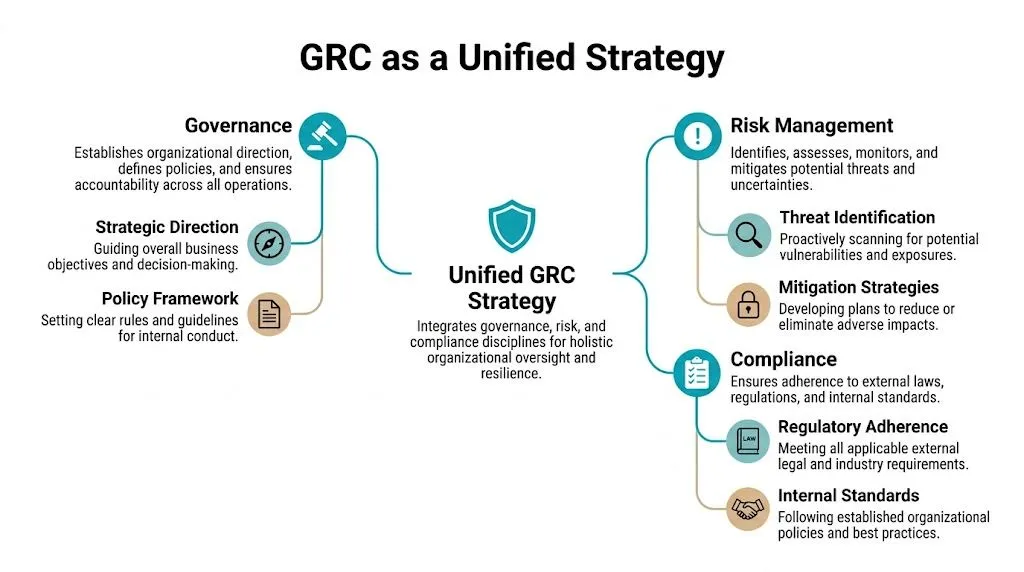
Most organisations still treat governance, risk, and compliance as separate disciplines. Governance sits with leadership and policy. Risk sits with finance, operations, or IT. Compliance sits wherever the latest regulator or auditor has created the most pressure. That split is one reason GRC programs stall.
A better way to think about it is the dashboard of a modern vehicle. You don’t drive with separate, unlinked gauges taped to the windscreen. You rely on one dashboard that shows speed, fuel, warnings, route, and engine health in context. Business oversight works the same way.
Governance sets direction
Governance answers the question, who decides, by what rules, and with what accountability. In an ERP-led business, that means policy ownership, delegated authority, approval paths, segregation of duties, and board or executive oversight all need to align.
Without governance, software just automates inconsistency. The wrong policy gets enforced faster.
Risk management deals with uncertainty
Risk management isn’t a static register. It’s the discipline of identifying where uncertainty can stop the business from achieving its objectives, then deciding what to monitor, what to tolerate, and what to fix.
For a distributor, that may involve supplier concentration, warehouse process exceptions, cyber exposure, or inventory valuation controls. For a manufacturer, it may include production quality, third-party access, ESG evidence, and system changes that affect financial reporting.
Compliance proves adherence
Compliance is the evidence layer. It proves the business is meeting external obligations and internal standards. In practical terms, that means documented controls, testing, issue management, attestations, remediation tracking, and audit trails.
When these three areas stay separate, leaders get conflicting versions of the truth. When they operate through one model, the business can see policy, control, incident, and impact in one place.
- Governance asks, are the rules clear and enforced?
- Risk asks, what could stop us from hitting our objectives?
- Compliance asks, can we prove we are operating as intended?
A strong ERP program depends on that unity. The same is true of a strong GRC program. The two should reinforce each other, which is why effective project leadership matters as much as platform choice. This is also the reason many ERP transformations succeed or fail on governance quality rather than software fit alone, a point explored well in how effective governance drives ERP project success.
Connected GRC works best when leadership stops treating policy, controls, and risk events as separate reporting streams.
Core GRC Software Capabilities and Your Business Benefits
A GRC platform should do more than store policies and generate tasks. If that’s all it does, you’re paying for an administrative layer. The better platforms connect obligations, controls, incidents, workflows, and evidence so finance and operations can act before problems become expensive.
In the Australian context, that matters because modern GRC software enables automated monitoring of ASIC and APRA requirements, where non-compliance fines averaged AUD 1.2 million per breach in 2024. The same Australian-focused review notes that AI-driven features can detect regulatory changes 45% faster than manual processes, and mid-market firms using those capabilities saw a 30% drop in audit findings in this GRC tools analysis.
The modules that matter
Not every business needs every module on day one. But most mid-market firms should evaluate the following capabilities against real business pain points.
| GRC Module | Core Function | Tangible Business Benefit for AU/NZ Firms |
|---|---|---|
| Risk management | Maintains risk registers, assessments, ownership, treatment plans, and issue escalation | Gives executives a current view of operational, cyber, financial, and third-party risk rather than relying on periodic spreadsheet updates |
| Policy management | Controls policy creation, review cycles, acknowledgements, and version history | Reduces disputes over which policy is current and makes staff attestations easier to track |
| Compliance management | Maps obligations to controls and evidence | Helps teams prove adherence to obligations across privacy, payroll, tax, and financial reporting |
| Audit management | Plans audits, captures evidence, records findings, and tracks remediation | Cuts audit friction by centralising evidence and reducing rework across finance, IT, and operations |
| Regulatory change management | Tracks regulatory updates and maps them to affected processes and controls | Improves response speed when rules change and reduces dependence on manual interpretation |
| Third-party risk management | Assesses vendors, suppliers, and service partners against defined controls | Strengthens procurement and supply chain oversight, especially where outsourced services affect compliance exposure |
| Incident and case management | Logs breaches, exceptions, investigations, and remediation actions | Gives leadership a traceable path from issue identification to closure |
| Continuous control monitoring | Uses integrations and rules to watch transactions, user activity, and exceptions | Detects control failures earlier and reduces reliance on month-end review cycles |
What works in practice
The best results usually come from starting with controls that already affect cash, reporting, or regulatory exposure. In ERP terms, that often includes:
- Finance controls, such as approval limits, journal review, month-end close tasks, and vendor master changes
- People and payroll controls, including onboarding, STP-related checks, superannuation workflows, and role-based access
- Procurement and supplier controls, especially where Coupa, Medius, Zudello, Lightyear, ProSpend, Webexpenses, Expensify, or Avalara add process and compliance touchpoints
- Operational controls, such as warehouse exceptions, inventory adjustments, customer credit approvals, and manufacturing process deviations
A GRC platform also becomes stronger when it doesn’t operate alone. AI-enabled tools can improve classification, change monitoring, and anomaly detection. In a practical stack, that might mean combining governance workflows with ERP data and decision-support tools like Cauzzy AI, while using integration services from Workato, Celigo, Boomi, or Jitterbit to move evidence and event data where it belongs.
What doesn’t work
Two patterns usually underperform.
First, businesses buy a large enterprise platform and load every framework into it before they’ve agreed on ownership, control design, or reporting needs. The software becomes a filing cabinet with notifications.
Second, teams try to manage compliance entirely outside the ERP. That creates duplication. Controls get “documented” in the GRC platform but are still executed manually in finance, HR, or operations.
A good GRC platform should reduce decisions made from memory. It should not create another place to upload PDFs.
The business case becomes much stronger when each module is tied to an outcome the CFO can defend, lower audit friction, faster remediation, clearer evidence, fewer reporting errors, and better oversight of high-risk processes.
Integrating GRC Software with Your Cloud ERP System
A GRC platform without ERP integration gives you partial truth. It may store policies and risks neatly, but it won’t show what the business is doing. For Australian and New Zealand firms running Oracle NetSuite, Epicor Kinetic, or MYOB Acumatica, that gap matters because the ERP holds the transactions, approvals, inventory movements, vendor records, payroll triggers, and financial data that controls depend on.
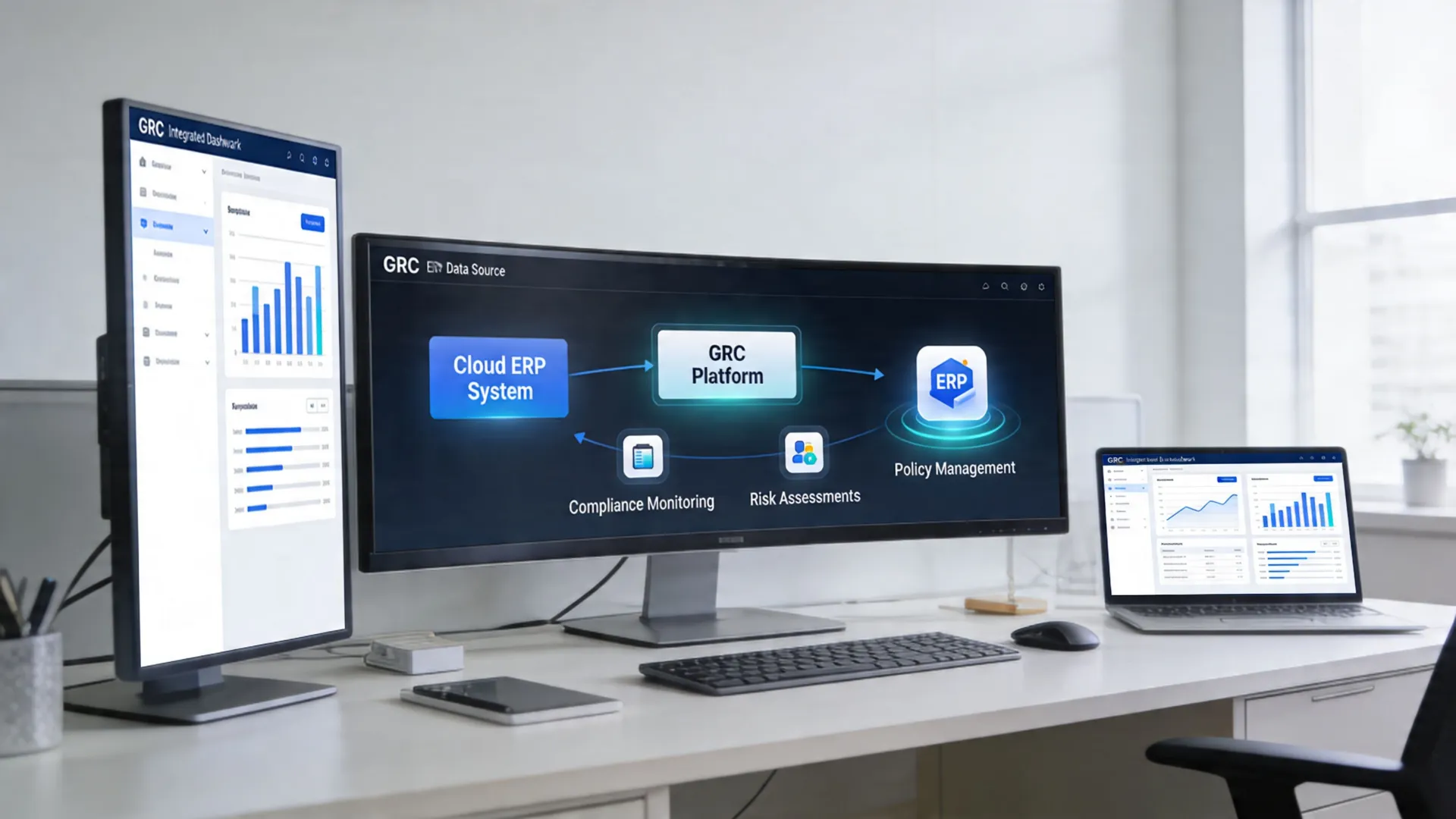
For AU distribution firms, GRC platforms with IRAP Protected certifications provide risk benchmarking against ISM controls, and API integrations with MYOB Acumatica or Epicor Kinetic for continuous control monitoring have been shown to cut manual reporting errors by 40% and improve audit readiness scores by 35%, according to this AU-focused GRC capability guide.
What the integration should actually do
Good integration isn’t just syncing master data. It should create a flow of meaningful control evidence.
A well-designed pattern usually includes:
- ERP to GRC data feeds, carrying transactions, approvals, vendor changes, user-role updates, inventory exceptions, and financial close status
- Workflow feedback loops, so remediation tasks raised in the GRC environment can trigger action in operational systems
- Document and evidence links, connecting reports, logs, policy attestations, and exception records without manual copy-paste
- Role and identity alignment, so the same access model supports both control execution and control oversight
That’s where integration platforms such as Workato, Celigo, Boomi, and Jitterbit matter. They let teams connect the ERP, GRC tool, HR systems like KeyPay or ELMO, finance automation tools like BlackLine and Kyriba, and adjacent platforms such as HubSpot, Salesforce, SPS Commerce, CartonCloud, Netstock, 3DLogistiX, or FernSpeed.
Where projects usually go wrong
The common failure is poor data structure. If vendor names, locations, item codes, chart of accounts segments, or employee records aren’t standardised, the GRC platform receives noisy inputs and produces unreliable alerts.
That’s why data preparation has to come before automation. A practical reference is this article on data cleansing and standardisation for system success, because control monitoring is only as good as the data definitions underneath it.
Another issue is trying to integrate every process at once. A better sequence is to start with a limited set of high-impact controls, usually finance approvals, vendor changes, access management, critical inventory adjustments, and payroll-related workflows. Once those data flows are stable, the scope can expand.
Here’s a useful walkthrough of how connected systems support stronger oversight in practice:
A practical example
Consider a multi-site distributor using MYOB Acumatica for finance and inventory, KeyPay for payroll, and ProSpend for employee spend controls. If supplier onboarding, GST coding checks, expense approvals, and inventory write-off thresholds stay in separate workflows, the CFO gets fragmented assurance.
If those systems feed a GRC layer through APIs, the business can monitor exceptions continuously, route remediation to the right owner, and retain evidence for audit without asking each team to rebuild the story manually. That’s where governance risk management compliance software starts delivering operational efficiency, not just compliance administration.
Meeting Australian and New Zealand Compliance Demands
In Australia and New Zealand, compliance isn’t a side task you can push to quarter end. It touches payroll, privacy, finance, tax, procurement, cyber security, supplier management, and board reporting. That’s why generic global compliance playbooks often fall short. They tend to describe frameworks, but they don’t tell a local finance leader how to manage overlapping obligations inside a live ERP environment.
The strongest argument for GRC in this market is simple. The cost of getting compliance wrong is now too high, and the level of evidence regulators and auditors expect keeps rising.
Privacy, payroll, and reporting pressure
The 2024 Australian Privacy Act reforms impose fines up to AUD 50 million, and those changes have pushed mid-market GRC adoption to 59%. The same market report states that a KPMG Australia study found GRC platforms reduced non-compliance incidents by 41% and delivered an average ROI of 3.2x within 18 months through automated ATO and superannuation compliance, as reported in this Australia-Pacific GRC market summary.
For a CFO, those numbers matter because they connect compliance work to hard commercial outcomes. Better compliance isn’t just about avoiding penalties. It also reduces rework, lowers audit burden, and removes manual checking from high-volume processes.
What local obligations demand from software
A useful GRC stack in this region needs to help with obligations such as:
- Privacy and breach response, including evidence of incident handling and control ownership
- ATO-related processes, where payroll, STP, and superannuation workflows need traceable controls
- ASIC and financial reporting obligations, which require documented review, approval, and issue tracking
- Third-party and supply chain oversight, where vendors and service providers can create both cyber and financial exposure
A payroll example makes this clear. If payroll data sits in one system, approvals in email, employee changes in HR, and reconciliations in spreadsheets, proving compliance becomes a manual exercise every pay cycle. Connected controls cut that burden sharply. For businesses looking at this area specifically, NetSuite-integrated payroll compliance approaches show why system linkage matters more than policy wording alone.
Compliance maturity shows up in the quality of evidence. If your team still scrambles to assemble proof before each review, the process isn’t mature enough.
New Zealand considerations
The same design principles apply in New Zealand, even when the specific regulatory settings differ. Multi-entity groups operating across both countries need control models that can handle local tax, payroll, privacy, and reporting requirements without forcing every site into manual exceptions.
That’s why governance risk management compliance software should be configured around business processes and entity structures, not just a generic control library. The software has to reflect how the organisation operates, who approves what, how evidence is captured, and where obligations differ across jurisdictions.
How to Select the Right GRC Software for Your Business
Most selection processes focus too heavily on feature lists. That’s understandable, but it’s not where most GRC projects succeed or fail. The harder questions are about fit, integration depth, data quality, and who will own the platform once the implementation team leaves.
A 2025 Deloitte Australia report noted that 68% of mid-market manufacturers struggle with disconnected ERP-GRC systems, leading to 25% higher compliance costs. The same summary points to architecture-led implementation approaches, with methodologies like FlexSafe achieving 30% faster compliance mapping.
The shortlist criteria that actually matter
A mid-market AU or NZ business should test vendors and implementation partners against criteria like these:
-
ERP integration depth
Ask how the platform connects with Oracle NetSuite, Epicor Kinetic, or MYOB Acumatica in real terms. Not “can it integrate”, but which objects, events, and workflows are already proven. -
Australian and New Zealand compliance fit
The platform should support local obligations without forcing heavy custom work for every reporting cycle or policy review. -
Evidence model
Review how the system stores, links, and retrieves audit evidence. If evidence still relies on offline files and email trails, the platform won’t reduce enough effort. -
Configurability without chaos
Some tools are so flexible that every business unit builds its own logic. That undermines governance. You want controlled configurability. -
Operational usability
Frontline managers, payroll teams, procurement leads, and finance analysts need to use it without specialist training every time a task appears.
Questions to put to vendors
Use direct questions. They expose gaps quickly.
- Show me a control that starts in the ERP and ends as audit-ready evidence
- How do you handle entity-specific obligations across AU and NZ operations
- What happens when the regulation changes, who updates mappings and workflows
- How do you stop duplicate risk registers appearing across departments
- What parts of the implementation depend on our internal data cleanup
A sector-specific lens also helps. If you’re in a regulated environment or adjacent to it, this Financial Services Compliance Software Guide is a useful reference for thinking about evidence, control design, and oversight expectations, even outside pure financial services.
Don’t buy software in isolation
A GRC platform becomes a long-term asset only if the business can operate it confidently after go-live. That means selection should include not just software capability, but implementation method, change management, training approach, and support model.
Buy for operating reality, not demo polish.
A strong shortlist usually gets smaller once you score each option against your ERP footprint, compliance obligations, integration needs, and internal resourcing. That’s a better discipline than trying to choose the tool with the longest feature sheet.
Ensuring a Successful GRC Implementation with FlexSafe
Most GRC implementations don’t fail because the software is weak. They fail because the business tries to impose a control model without enough design work, stakeholder ownership, or usable process alignment. Teams then get a platform that looks organised but doesn’t fit day-to-day operations.
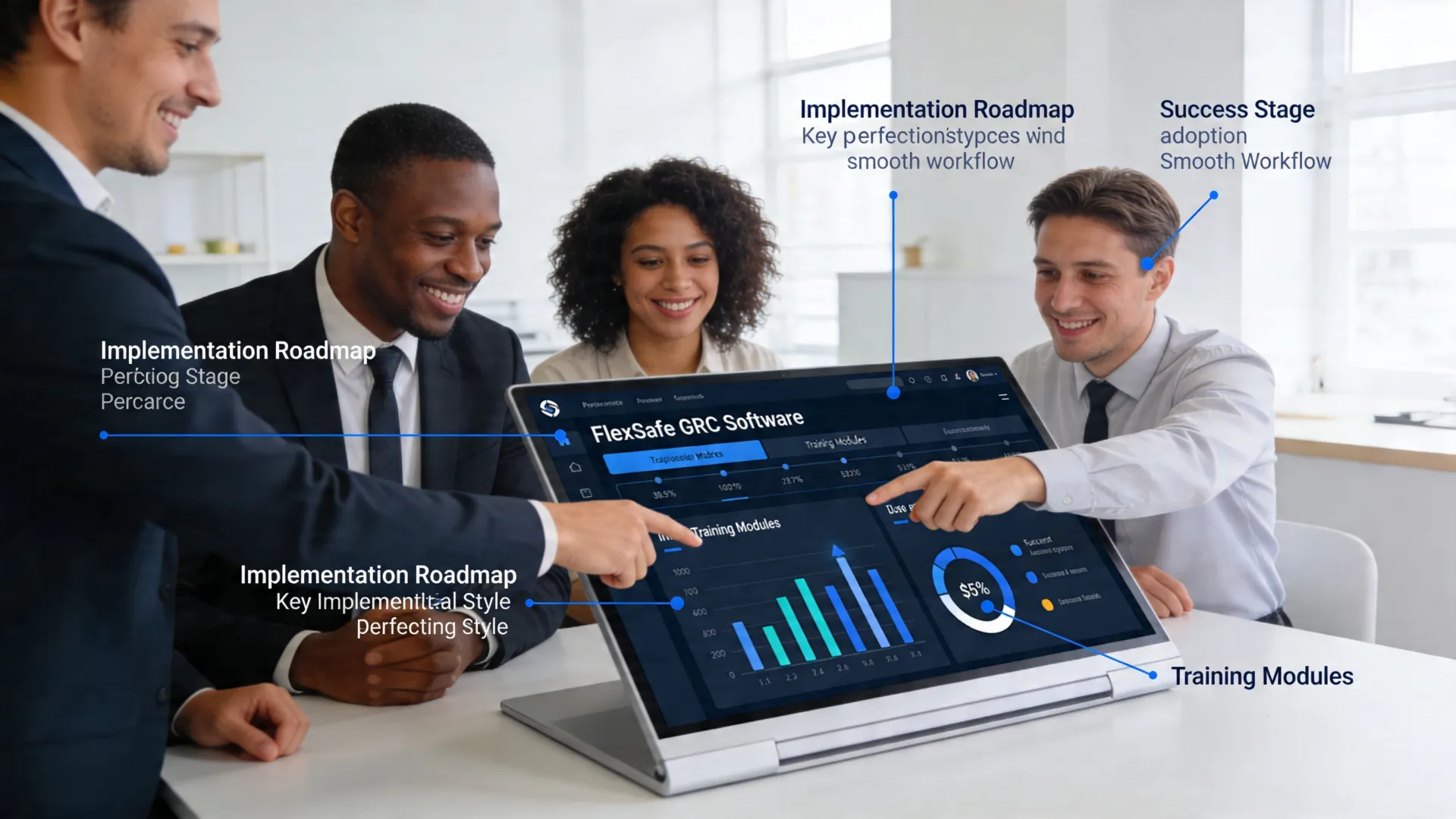
The safer path is an architecture-led rollout that treats governance, process, data, and people as part of the same delivery stream. That’s where a method like FlexSafe is useful. It focuses on risk reduction from the start, rather than assuming adoption will take care of itself once the technology is live.
What a good rollout looks like
A practical implementation pattern often follows this sequence.
Start with control design, not screen design
Before configuring workflows, define the control model. Which obligations matter most? Which processes create the biggest exposure? Who owns each control? What evidence proves it worked? What should escalate automatically?
If those questions aren’t settled early, the platform becomes a place to debate process instead of enforcing it.
Deliver in waves
A sensible first release usually targets the controls with the clearest commercial and compliance impact. Finance approvals, vendor onboarding, payroll governance, access controls, and audit evidence handling are often good candidates.
That gives the business a usable base and avoids the fatigue that comes with trying to digitise every policy and risk category at once.
Build change management into the project
User resistance is often a design problem in disguise. If a warehouse manager, payroll lead, or finance business partner has to click through a complex workflow to complete a straightforward task, they’ll bypass it where they can.
Good implementation teams simplify the process, define role-specific training, and use workflow only where it improves control and speed. Tools like Strongpoint can also help by managing system changes safely and documenting impacts where ERP process design and control design overlap.
Common failure points
The patterns are familiar:
- Too much scope too early, which creates configuration sprawl
- Weak executive ownership, which leaves policy and control decisions unresolved
- Poor master data, which leads to low-trust alerts and exception noise
- Generic training, which doesn’t reflect how finance, HR, procurement, and operations use the system
- No post-go-live governance, so ownership drifts back into silos
What teams should insist on
A successful implementation needs three forms of discipline.
- Decision discipline, so policy and control ownership are explicit
- Architecture discipline, so ERP, HR, finance automation, and GRC data flows are deliberate
- Adoption discipline, so teams know what changes, why it changes, and how success will be measured
The implementation should make the business easier to govern. If it creates more manual reconciliation between systems, the design needs work.
That’s the practical value of a FlexSafe-style approach. It reduces delivery risk by matching platform capability to business readiness, rather than forcing the business to adapt all at once to a toolset it didn’t help shape.
Your Strategic Next Steps to GRC Maturity
Governance risk management compliance software is no longer just a tool for highly regulated enterprises. For Australian and New Zealand mid-market businesses, it’s becoming part of the core operating model, especially where ERP, payroll, procurement, inventory, and supplier processes intersect.
The biggest shift is mindset. Mature organisations stop treating compliance as a reporting burden and start treating GRC as a way to protect margin, reduce operational drag, and improve decision quality. When controls, evidence, and exceptions are linked properly, finance leaders spend less time chasing proof and more time steering the business.
A sensible next step is to assess your current state across four areas:
- Control visibility, what you can see today without manual collation
- System connectivity, which obligations still sit outside your ERP and adjacent platforms
- Evidence quality, how quickly your team can prove compliance
- Ownership clarity, whether every critical risk and control has an accountable owner
If those answers are patchy, your business doesn’t need more spreadsheets. It needs a clearer architecture and a practical roadmap.
If you’re reviewing governance, risk, and compliance options alongside Oracle NetSuite, Epicor Kinetic, or MYOB Acumatica, OneKloudX is a strong place to start. Our team works with Australian and New Zealand organisations to design safer ERP-led architectures, connect the right tools, and implement change with a clear focus on compliance, operational efficiency, and long-term value.