It usually starts with a work-around that became permanent.
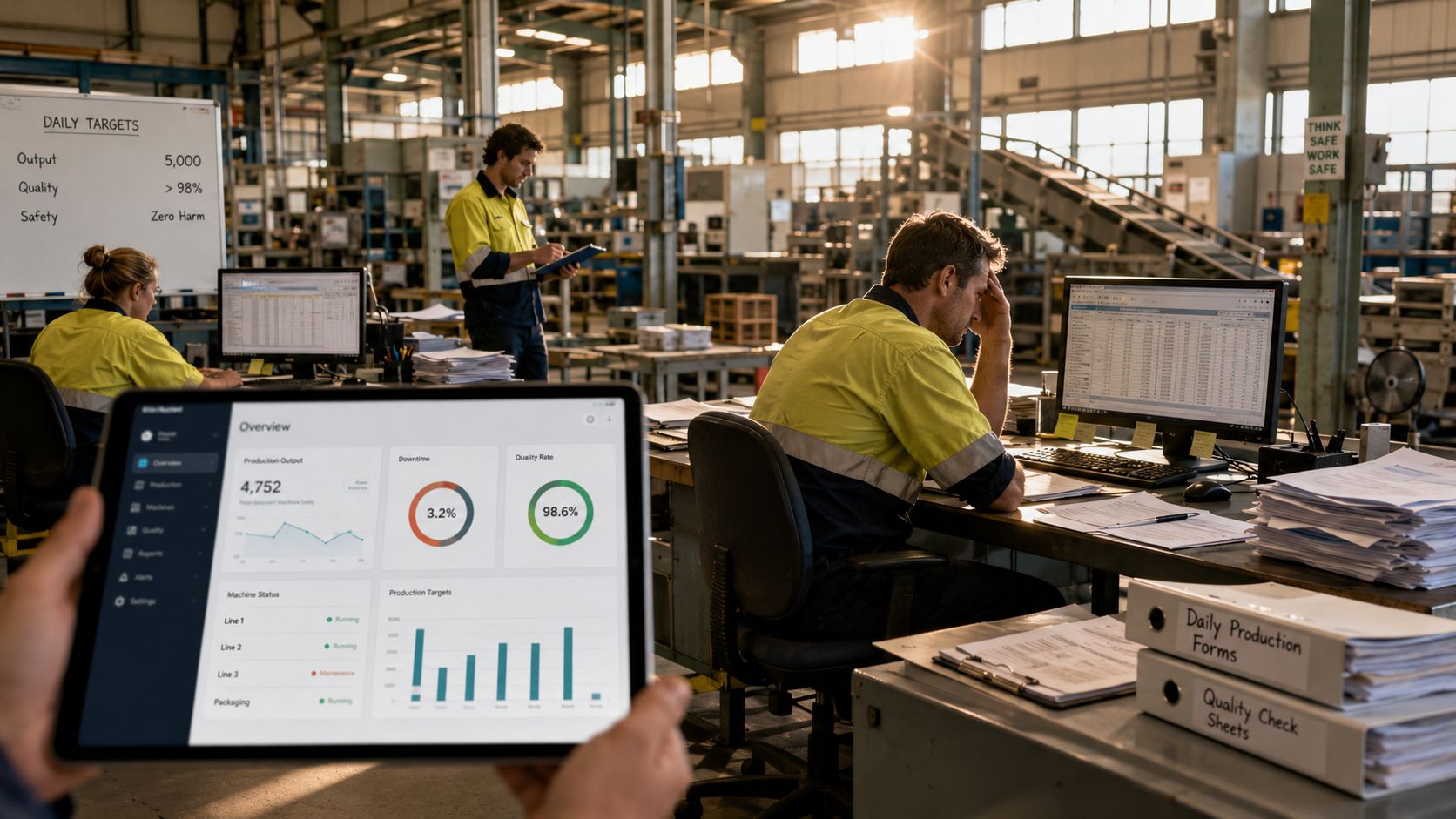
A planner updates production in a spreadsheet. The warehouse team keeps a separate stock file. Finance waits for end-of-day exports before it can see what shipped. The factory can produce good product, but management still can’t answer basic questions quickly, such as what inventory is available, which jobs are drifting, or whether a machine issue is about to hit delivery dates.
That’s where manufacturing IT services stop being a background cost and become an operating model. For Australian and New Zealand manufacturers, the primary job isn’t buying more software. It’s connecting the plant, warehouse, finance function, and leadership team so decisions come from live operational data rather than lagging reports and manual reconciliation.
The Modern Challenge for Australian Manufacturers
Many mid-market manufacturers are trying to scale with a patchwork of legacy systems, tribal knowledge, and spreadsheets that no one fully trusts. The business keeps moving, but every hand-off introduces delay. Production planning sits in one place, inventory in another, and customer commitments somewhere else again.
That arrangement might hold while volumes are stable. It breaks when labour is tight, margins are under pressure, or the business adds another site, product line, or entity. In practice, the pressure shows up as stock surprises, overtime, procurement errors, and finance teams spending too much time cleaning data instead of using it.
Where the friction really sits
The common executive assumption is that the main problem is software age. Usually it isn’t. The deeper issue is disconnection.
- Factory data is trapped: Machine signals, job status, and quality events often stay inside OT systems or paper-based routines.
- Business systems lag behind reality: ERP, payroll, procurement, and reporting only update after someone rekeys or uploads data.
- Leadership sees symptoms, not causes: By the time a KPI turns red, the underlying issue has already affected service, margin, or working capital.
Cyber risk adds another layer. Widely cited industry data shows manufacturing has consistently ranked among the most frequently attacked sectors globally, representing a significant share of ransomware incidents, which has pushed Australian firms to invest more heavily in managed cybersecurity and data recovery services to protect intellectual property and supply chains. For context on why managed services have become essential in this environment, see The Haven’s overview of managed services in manufacturing.
Practical rule: If production can’t share reliable data with finance and supply chain without manual effort, the problem isn’t visibility. It’s architecture.
Why this matters now
Manufacturers don’t need another generic digital transformation pitch. They need systems that reduce operational drag, support compliance, and give managers a clean line of sight from the factory floor to the P&L.
That’s the practical value of manufacturing IT services. Done properly, they connect operations to decision-making. Done poorly, they create one more layer of complexity on top of the old one.
What Are Manufacturing IT Services, Really?
The cleanest way to explain manufacturing IT services is this. They are the digital nervous system of the business.
General corporate IT keeps email, devices, collaboration tools, and user access running. Manufacturing IT services go further. They connect operational technology, such as machines, sensors, SCADA, and shop-floor controls, with information systems like ERP, finance, procurement, warehouse management, payroll, and reporting.
More than support tickets and infrastructure
When executives hear “IT services”, they often picture helpdesk support or cloud hosting. Those matter, but they’re only part of the picture in a manufacturing setting.
A proper manufacturing IT stack has to support questions like these:
- What happened on the line in the last hour?
- Did that event change material demand or job sequencing?
- Has the ERP updated purchasing, inventory, and cost impact accordingly?
- Can the CFO trust the margin view without waiting for manual reconciliation?
If those answers live in different systems, the organisation runs slower than it should.
The factory-to-boardroom data path
In practical terms, manufacturing IT services usually involve these layers:
-
Operational capture
Data comes from machines, operators, sensors, quality checks, and warehouse activity. -
Translation and integration
Middleware and APIs move that data into systems the business can use. That often means tools such as Workato, Celigo, Boomi, or Jitterbit, depending on the estate and integration pattern. -
Execution platforms
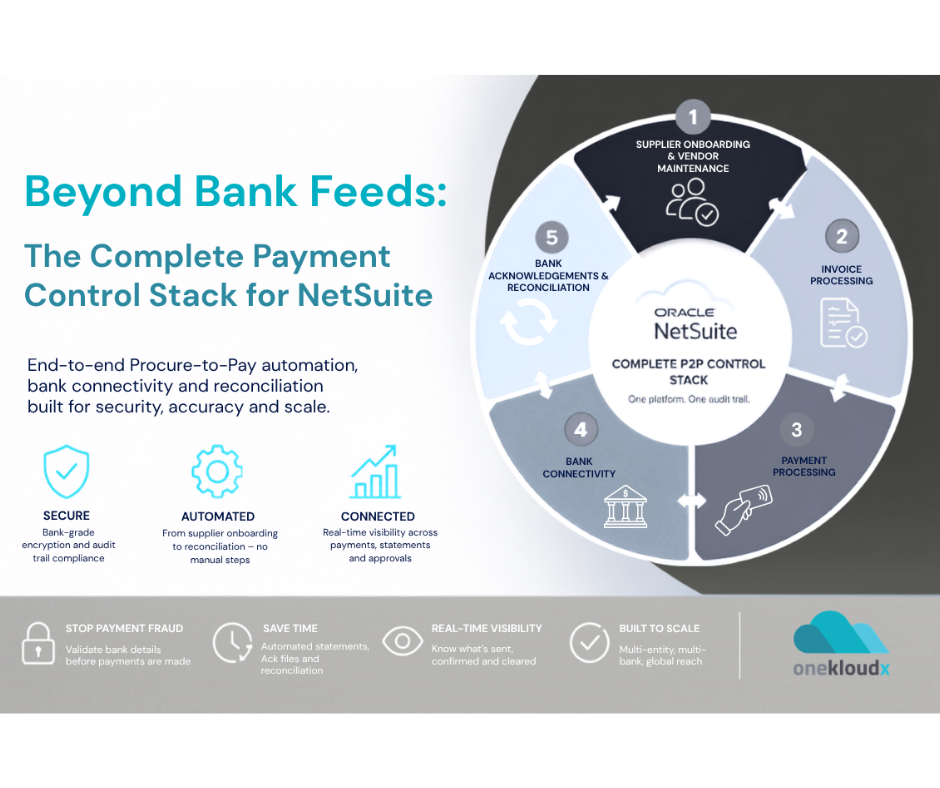
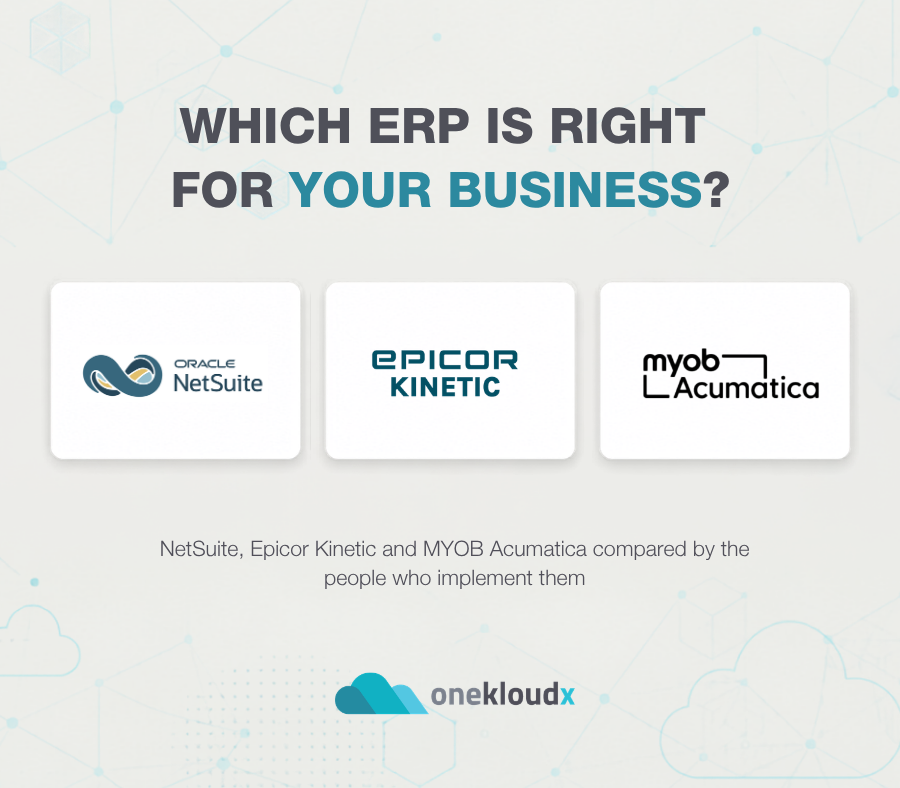
ERP platforms like Oracle NetSuite, Epicor Kinetic, and MYOB Acumatica coordinate finance, inventory, supply chain, and multi-entity operations. Other tools, including CartonCloud, SPS Commerce, KeyPay, ELMO, HubSpot, Salesforce, and Coupa, extend the model where they fit. -
Decision support
Reporting, planning, spend control, and analytics tools translate raw activity into action.
The best manufacturing environments don’t have the most software. They have the fewest breaks between operational events and business response.
What this means for non-technical leaders
For a COO, it means less waiting for yesterday’s reports. For a CFO, it means cleaner working capital control, fewer reconciliation surprises, and stronger confidence in forecasting. For an IT leader, it means fewer fragile work-arounds and a more supportable architecture.
The key distinction is simple. General IT keeps the office productive. Manufacturing IT services keep production, supply chain, and finance aligned with each other. That’s why they sit much closer to strategy than many boards first assume.
The Core Services Driving Modern Production
A modern manufacturing environment doesn’t rely on one platform. It relies on a connected service model. The strongest results usually come from getting a few core capabilities right, then integrating them in a disciplined way.
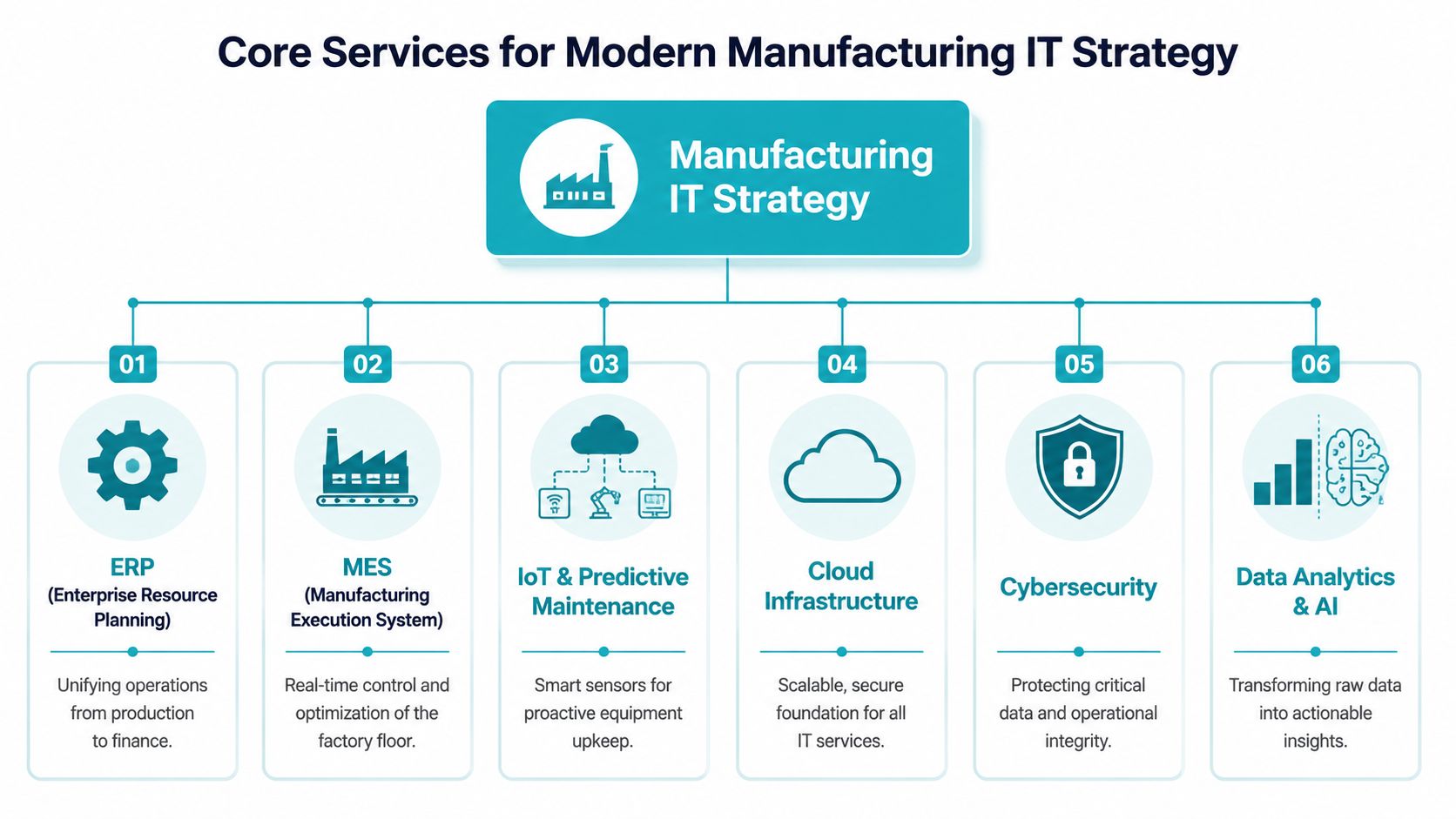
ERP and MES integration
This is the foundation. ERP tells the business what should happen commercially and financially. MES tells the business what is happening on the floor.
When those systems remain separate, planners compensate with spreadsheets and side conversations. When they are integrated, production status, material consumption, labour capture, and job completion can flow into inventory, purchasing, costing, and customer delivery processes with much less friction.
For Australian manufacturers, Oracle NetSuite, Epicor Kinetic, and MYOB Acumatica are common anchors for this layer. Around them, businesses often add MES, WMS, payroll, and CRM capabilities, then use integration platforms such as Workato, Celigo, Boomi, or Jitterbit to keep data moving cleanly.
A practical pattern is to use ERP as the commercial system of record while MES manages execution detail, then define exactly which events must sync in real time and which can move on a schedule.
IoT and predictive maintenance
Many manufacturers still have valuable machine data locked inside OT environments that never reach the systems used by operations or finance. That’s a missed opportunity.
Industry data suggests that integrating IoT-enabled sensors with MES and cloud ERP can reduce equipment downtime by 25 to 30% through predictive maintenance analytics, and that mid-market manufacturers using real-time data pipelines have reported meaningful improvements in overall equipment effectiveness. That matters because it turns machine data into a direct operating lever, not just an engineering dataset.
If your team is trying to scope this properly, Evright Industrial’s asset management software guide is a useful reference point for thinking through maintenance visibility and asset control in a plant context.
One practical extension of this is tighter stock logic. If machine performance, maintenance events, and consumption signals can feed planning properly, replenishment gets far more reliable. That’s especially relevant for manufacturers reviewing their stock management software for manufacturing operations.
Cloud infrastructure and integration architecture
Cloud migration isn’t the outcome. It’s the delivery model that makes the rest of the architecture easier to scale and support.
What matters more is how the cloud environment is structured. In manufacturing, weak architecture usually shows up as brittle integrations, duplicate master data, and unclear ownership of business rules. Good architecture does the opposite. It gives each system a clear role, defines event flows, and reduces the number of manual exceptions people have to manage.
That’s where disciplined use of middleware, data pipelines, and role-based access control becomes operationally important, not just technical.
A few practical decisions tend to separate successful environments from expensive ones:
- Choose a system of record deliberately: Don’t let inventory, pricing, customer data, or production status live in multiple masters.
- Design for exception handling: Every integration works in the happy path. What happens when jobs change, receipts fail, or units of measure don’t align is the true test.
- Keep local compliance in view: Australian and New Zealand data, payroll, tax, and audit requirements need to be built into the design early.
Cybersecurity for OT and business systems
Manufacturing security can’t stop at endpoint protection and MFA. The larger issue is the boundary between OT and IT, and how data moves across it.
Plants often have older equipment, legacy protocols, and operational dependencies that don’t fit standard corporate security playbooks. A board-level mistake is to assume that cyber policy written for office systems automatically protects production.
In practice, manufacturers need segmented access, controlled integrations, disciplined backup and recovery, and clear recovery priorities tied to operational processes. It isn’t enough to restore servers. The business has to restore production capability.
Here’s a useful overview of the operating model in action:
Data analytics and AI tools
Analytics only help when the underlying data is timely and trustworthy. That’s why many AI projects stall. The model isn’t the first problem. The data path is.
Tools such as Cauzzy AI, ProSpend, Medius, Zudello, Lightyear, Blackline, Kyriba, Zone and Co, Avalara, and Strongpoint can add real value around finance automation, spend control, compliance, and insight generation. In the right architecture, they remove repetitive work and improve decision speed. In the wrong architecture, they automate bad data faster.
Use AI after you’ve decided where your operational truth lives. Otherwise you’re scaling confusion.
Translating Technology into Tangible Business Benefits
Executives don’t buy platforms. They fund outcomes.
That’s why the right discussion about manufacturing IT services starts with working capital, production reliability, procurement control, customer service, and decision speed. If a technology initiative can’t improve one of those, it probably belongs in the backlog.
What finance and operations actually gain
For a CFO, the strongest result is usually confidence. Confidence that inventory is real, costs are being captured correctly, and forecasts reflect live operational conditions rather than stale spreadsheets. For a COO, the gain is control over throughput, scheduling, and exception handling without needing the business to rely on heroics.
Cloud ERP adoption among mid-market manufacturing firms in Australia has grown significantly, with Oracle NetSuite, Epicor Kinetic, and MYOB Acumatica among the most common platforms in this segment. The shift makes sense. Once the business stops rekeying, reconciling, and chasing version control problems, leaders can focus on actual operating decisions.
That trend makes sense. Once the business stops rekeying, reconciling, and chasing version control problems, leaders can focus on actual operating decisions.
A practical business lens
The gains usually show up in a few places first:
- Inventory discipline: Better synchronisation between production, warehouse, and purchasing reduces avoidable stock issues and over-ordering.
- Procurement accuracy: Connected approvals and spend controls reduce leakage, duplicate handling, and late visibility.
- Faster reporting cycles: Finance doesn’t need to wait on manual operational updates before closing or reforecasting.
- Better service reliability: Customer commitments improve when job status and stock position reflect reality.
A useful technical explainer for leadership teams thinking about this operating model is Streamkap’s overview of operational agility through data synchronisation. It helps frame why the timing of data movement matters almost as much as the data itself.
A manufacturer rarely improves margins through software alone. Margins improve when the software removes the lag between what happened and what the business does next.
Why the ROI conversation often goes wrong
The weakest business cases focus on licence savings or headcount reduction. Those can matter, but they’re rarely the true payoff.
The better business case looks at fewer planning errors, cleaner procurement, improved fulfilment, stronger budget accuracy, lower operational friction, and less executive time spent managing around system gaps. Those are the outcomes boards feel.
A Practical Roadmap for IT Transformation
Most manufacturing projects fail long before go-live. They fail in discovery, when the business understates integration complexity, ignores compliance configuration, or assumes old OT data will somehow become cloud-ready without design effort.
That’s why a phased approach works better than a software-first approach. The practical sequence is to define business priorities, map current-state constraints, design the target architecture, and only then lock platform and delivery scope.
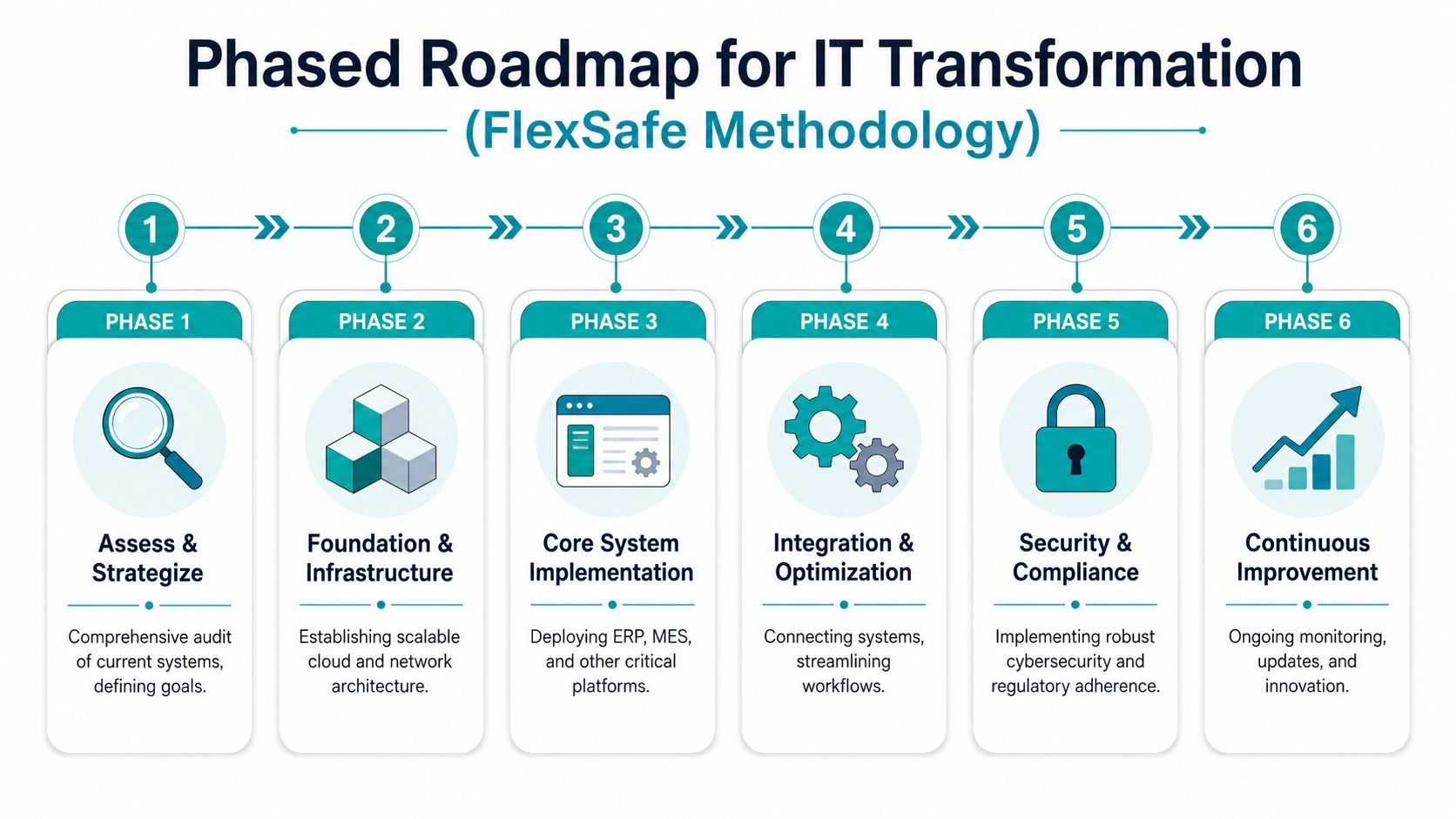
Phase one: find the real bottlenecks
Start with process truth, not vendor demos.
That means walking order-to-cash, procure-to-pay, plan-to-produce, and record-to-report with the people who do the work. Most leaders already know where the pain is. What they often don’t know is where the data breaks, where duplicate entry starts, or which exception paths consume the most effort.
A serious assessment should cover:
- System roles: Which application owns inventory, BOMs, pricing, job status, payroll, and customer data.
- Manual dependencies: Which tasks still depend on spreadsheets, emailed approvals, or offline work instructions.
- OT constraints: Which plant systems are old, isolated, or difficult to expose through modern interfaces.
Phase two: budget for Australian reality
In manufacturing IT services, many business cases drift off course. Generic ERP content talks about efficiency and scale, but local implementations succeed or fail on compliance detail.
Industry implementation data consistently shows that a significant share of Australian mid-market manufacturing firms encounter unforeseen costs mid-project related to localised compliance, including WHS, payroll tax, and GST reporting. That’s a planning problem, not a technology surprise.
The hidden cost areas usually include:
| Cost area | Why it gets missed | What to check early |
|---|---|---|
| Compliance configuration | Global templates often don’t reflect Australian operating requirements | GST, payroll, WHS, audit trails, entity structure |
| Data residency and controls | Security assumptions may not match policy or customer requirements | Hosting region, retention, access controls |
| OT integration | Legacy equipment often needs gateways, middleware, or custom connectors | SCADA access, protocol translation, edge collection |
| Change management | Teams underestimate training and process redesign effort | Role changes, approvals, floor adoption, SOP updates |
If you’re planning a platform move, the implementation path matters as much as the software choice. This overview of ERP system migration planning is useful because it treats migration as a business transition, not just a technical cutover.
Phase three: deliver in controlled waves
Manufacturers don’t need to switch everything on at once. In fact, that usually increases risk.
A better pattern is wave-based delivery:
-
Stabilise the core
Stand up finance, inventory, purchasing, and master data cleanly. -
Connect execution
Integrate MES, warehouse, payroll, CRM, and relevant partner tools such as CartonCloud, KeyPay, ELMO, Salesforce, HubSpot, or SPS Commerce. -
Add optimisation layers
Bring in planning, spend management, automation, and analytics through tools like Netstock, ProSpend, Webexpenses, Expensify, Coupa, Medius, FernSpeed, or Cauzzy AI where the business case is clear.
Don’t treat legacy OT as a reason to delay. Treat it as a design constraint that needs a deliberate integration pattern.
Phase four: keep improving after go-live
A manufacturing environment changes too often for “project complete” thinking. Product mix shifts. Entities get added. New channels appear. Compliance requirements evolve.
The organisations that get value over time are the ones that treat ERP, MES, integration, and support as a managed operating capability. That’s where architecture discipline, health checks, optimisation cycles, and user adoption work make the difference between an implementation and a real business platform.
How to Select the Right Strategic IT Partner
A manufacturing partner shouldn’t just know software. They should understand how factories, warehouses, finance teams, and leadership groups work together under pressure.
That changes how you evaluate vendors. A polished demo means very little if the partner can’t map a legacy SCADA environment, design a reliable MES-to-ERP flow, or deal with Australian payroll, tax, and multi-entity realities without improvising halfway through delivery.
What matters more than a big logo
A strong partner for manufacturing IT services usually has four traits.
First, they understand manufacturing process detail. Not just GL configuration or item masters, but backflushing, scheduling, warehouse movements, quality events, service implications, and what happens when production deviates from plan.
Second, they know the platform ecosystem. Oracle NetSuite, Epicor Kinetic, and MYOB Acumatica each sit inside broader solution environments that may include Workato, Celigo, Boomi, Jitterbit, 3DLogistiX, Netstock, CartonCloud, KeyPay, ELMO, Coupa, Blackline, Kyriba, or Avalara.
Third, they can support the business after go-live. Post-implementation managed services and continuous optimisation support are what separate an implementation from a long-term business platform, particularly in environments where integrations, compliance requirements, and user needs evolve regularly.
Fourth, they have a method that reduces risk, not just a delivery team that reacts quickly.
Vendor selection checklist
| Criterion | Why It Matters | Questions to Ask |
|---|---|---|
| Manufacturing depth | Process knowledge prevents generic designs that fail on the floor | How have you handled MES, WMS, quality, and planning in similar businesses? |
| Local compliance capability | Australian and New Zealand requirements can derail timelines and budgets | How do you handle GST, payroll, WHS, audit needs, and multi-entity reporting? |
| Integration architecture | Most failures sit between systems, not inside them | Which middleware tools do you use, and how do you govern master data? |
| Managed support model | Post-go-live reliability depends on active support and optimisation | What happens after stabilisation, and who owns continuous improvement? |
| Change management | User adoption determines whether process gains stick | How do you train planners, warehouse teams, supervisors, and finance users? |
| Executive communication | Boards need trade-offs explained clearly | How do you escalate risk, report progress, and manage scope decisions? |
If you’re assessing long-term support capability, it’s worth reviewing what a mature outsourced IT support model should include for an operational business, not just an office environment.
The wrong partner installs software. The right partner helps the business make cleaner decisions, with fewer surprises, long after go-live.
Quick Health Check for Your Leadership Team
A lot of leadership teams assume they have a systems problem when they have a visibility problem. The quickest way to test that is to ask role-specific questions and see how many answers depend on manual effort.
Questions for the CFO
- Can you forecast cash flow with confidence using current inventory, purchasing, and production data?
- Do month-end and reforecast cycles depend on spreadsheet manipulation from operations?
- Can you see the financial effect of delays, scrap, rework, or procurement drift before period close?
Questions for the COO
- How many critical decisions still rely on yesterday’s reports?
- When a machine issue, labour gap, or material shortage hits, how quickly does that flow into planning and customer commitments?
- Does your team spend too much time reconciling what happened instead of adjusting what should happen next?
Questions for the Head of IT
- Which integrations are stable, and which survive because one staff member knows how to restart them?
- How much shop-floor data remains trapped in OT or spreadsheets?
- Do you have a clear architecture for Oracle NetSuite, Epicor Kinetic, or MYOB Acumatica, plus surrounding tools such as Workato, Celigo, Boomi, CartonCloud, Netstock, KeyPay, Medius, ProSpend, Salesforce, or HubSpot?
If too many answers are uncertain, the issue isn’t maturity theatre or vendor marketing language. It’s that the business still lacks a reliable operational backbone.
If your team is weighing cloud ERP, MES integration, managed services, or a broader manufacturing systems reset, OneKloudX is a trusted ERP partner for Australian and New Zealand businesses. The team designs, delivers, and supports Oracle NetSuite, Epicor Kinetic, and MYOB Acumatica environments with an architecture-led approach that fits manufacturing reality, including integrations, compliance, optimisation, and long-term support. A discovery session can quickly show where your biggest risks, hidden costs, and fastest wins sit.