Your accounting software is costing you more than just subscription fees.

Every month your finance team closes the books with manual workarounds. Your ops team is re-keying data between systems. Your CEO is making decisions off a spreadsheet that’s already three days old. And somewhere in the middle of all of it, someone is maintaining a reconciliation spreadsheet that only they understand.
That is the real cost of outgrowing your current system.
If you’ve landed here, you’re already past the “do we need an ERP” conversation. The question now is: NetSuite or MYOB Acumatica? And more specifically, which one will actually solve your problems without creating a new set of them?
We’ve implemented both across ANZ businesses spanning manufacturing, distribution, professional services, and construction. Here’s the unvarnished version.
“I need to know where my money actually is, right now.”
For finance managers on legacy systems, this question comes up constantly. Month-end is a scramble. Real-time visibility is a myth. And the CFO keeps asking questions that take two days to answer.
What NetSuite does: Every transaction hits the general ledger in real time. The moment a purchase order is approved, an invoice is raised, or a payment lands, the financials reflect it. You can pull a P&L mid-month and trust the numbers. No lag. No batch processing surprises.
What MYOB Acumatica does: MYOB Acumatica processes sub-ledger entries in batches, which means there can be a gap between when a transaction occurs and when it appears in your financial reports. For many mid-market businesses this is manageable, but if your team is under pressure for real-time reporting, this is worth knowing before you sign.
The honest call: If live financial visibility is non-negotiable for your business, NetSuite has the architectural edge. If you run a more traditional monthly close and real-time data is a nice-to-have rather than a hard requirement, MYOB Acumatica will not hold you back.
“We’re Australian. We need this to handle GST, STP, and BAS without drama.”
ANZ compliance is not optional and it is not small. Getting payroll, Goods and Services Tax (GST), and Australian Taxation Office (ATO) reporting wrong carries real consequences, and the last thing you need is a global ERP platform that treats Australian tax obligations as an afterthought.
What MYOB Acumatica does: This is MYOB Acumatica’s strongest card. GST, Single Touch Payroll (STP), Business Activity Statement (BAS) lodgements, and ATO compliance are native to the platform. They were built in, not bolted on. For most ANZ businesses, this means a faster implementation, fewer consultants configuring compliance from scratch, and significantly lower risk of getting it wrong.
What NetSuite does: NetSuite absolutely supports ANZ compliance, and thousands of Australian businesses run it without issue. But it requires deliberate configuration during implementation. Your implementation partner needs to set it up correctly, and if they cut corners, compliance is where it shows up first.
The honest call: If your business is ANZ-only and you want compliance to just work from day one, MYOB Acumatica has a genuine head start. NetSuite gets there, but it takes more effort to get it right.
“We’re growing. I need a system I won’t have to replace in three years.”
Nothing is more expensive than implementing an ERP twice. The second time you pay the licensing cost again, the implementation cost again, and the productivity cost of your team learning a new system again, all while trying to run the actual business.
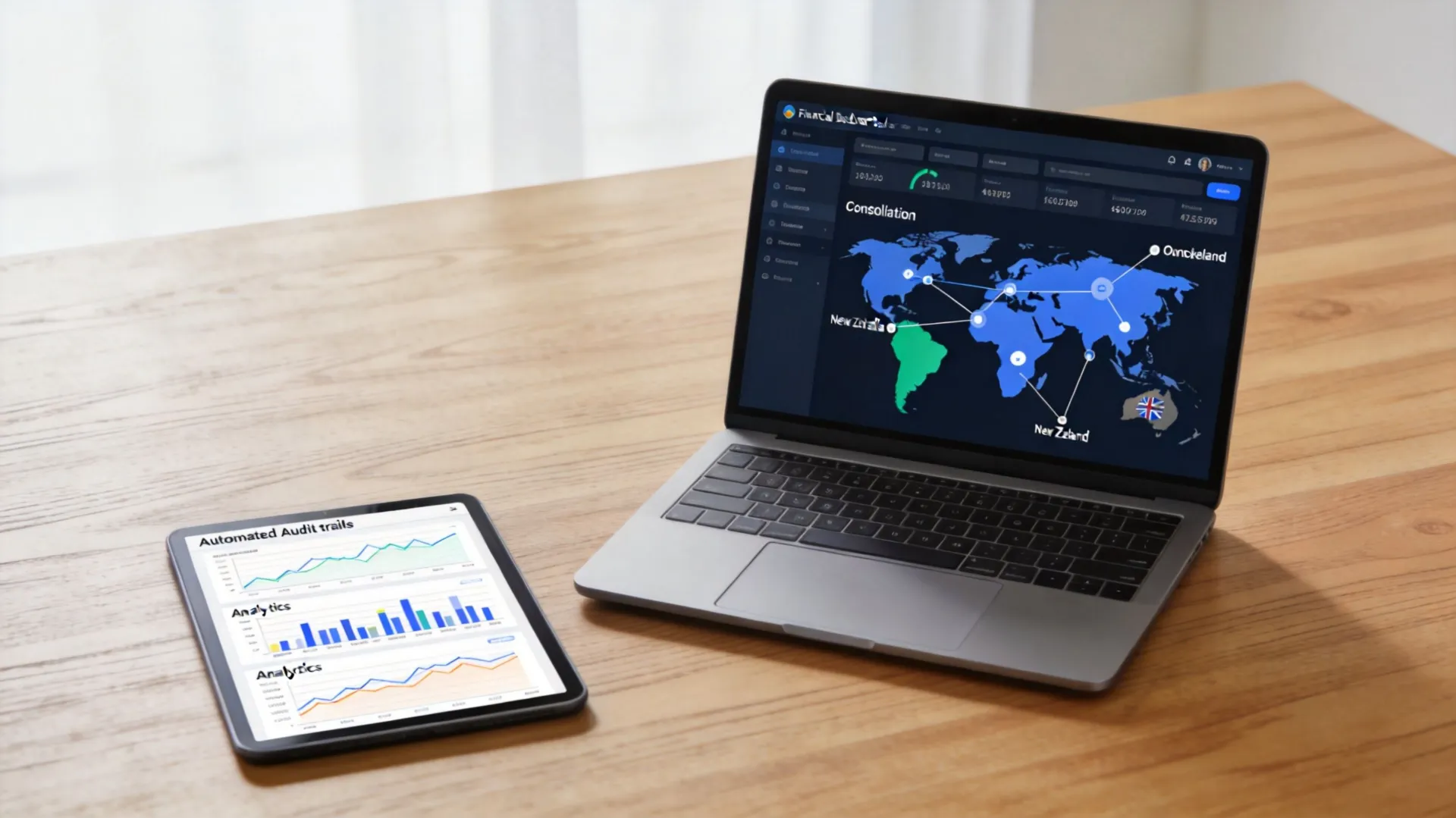
What NetSuite does: NetSuite is built to scale from 20 users to 2,000 without a platform change. If you open an office in Singapore, acquire a business in New Zealand, or start selling in the UK, NetSuite handles it within the same instance. More than 190 currencies, 27 languages, and tax localisation for over 200 countries. Multi-subsidiary consolidation happens natively, meaning your group financials pull together automatically rather than through a monthly spreadsheet exercise.
What MYOB Acumatica does: MYOB Acumatica is licensed for ANZ. If you expand internationally, you need to integrate a separate Acumatica instance for your offshore operations, which creates data silos, additional cost, and reporting complexity. Currency revaluations are also handled manually rather than automatically.

The honest call: If your three-year plan includes any international presence at all, NetSuite is the platform that won’t force your hand later. MYOB Acumatica is an excellent choice for businesses with stable, domestic ANZ operations who are not planning to operate offshore.
“I don’t have an IT department. My team needs to be able to use this without constant consultant support.”
ERP platforms have a reputation for being complicated. Some of that reputation is earned. If your team needs a developer to change a workflow or a consultant to update a report, you have a system that works against you.
What MYOB Acumatica does: MYOB Acumatica’s low-code configuration tools are a genuine strength. Workflows, dashboards, approval rules, and custom screens can be built and adjusted by operations managers or finance leads without technical skills. This is not just a marketing claim; it is consistently cited by MYOB Acumatica customers as a reason they chose it.
What NetSuite does: NetSuite’s standard reporting and saved searches are designed for everyday business users, and most finance teams get comfortable with them quickly. However, deeper customisation, such as building complex workflow automations or custom modules, typically requires SuiteScript (NetSuite’s development framework) and partner support. You will rely on your implementation partner more for ongoing configuration than you would with MYOB Acumatica.
The honest call: If your team is non-technical and you want to own your system configuration without consultant dependency, MYOB Acumatica gives you more autonomy. NetSuite rewards businesses that invest in ongoing partner relationships or have internal NetSuite-trained staff.
“I need to know what this is actually going to cost me.”
Neither vendor publishes a price list, and both will tell you the price depends on your requirements. That is true, but it is also used to avoid the conversation. Here is what you actually need to know.
NetSuite pricing: Per-user, per-module subscription model. A pattern common in the ANZ market is heavy first-year discounts that do not carry through to renewal. Businesses regularly report renewal price increases of 30 to 50 per cent above their initial contract rate. Longer contract terms can lock in better pricing, but reduce your flexibility. For a mid-market ANZ business (20 to 150 staff), expect total first-year investment including implementation to start from AUD $80,000, scaling significantly with complexity.

MYOB Acumatica pricing: More transparent by design. The Acumatica platform uses resource-based pricing, meaning costs scale with what you consume rather than purely with user count. This is a meaningful advantage for businesses with large field teams, warehouse staff, or casual users who need access but not full licences. Implementation costs are generally lower than NetSuite for equivalent scope, and built-in ANZ compliance reduces configuration effort. Comparable implementations typically start from AUD $50,000 to $70,000 all in.
What to watch for with both: Always model total cost of ownership over three to five years, not just year one. Add in module upgrades, partner support retainers, and renewal pricing. The platform with the lower sticker price is not always the cheaper platform over the life of the contract.
“I’ve heard horror stories about ERP implementations. How do I not become one?”
You’ve heard them too. The six-month implementation that took eighteen months. The business that went live on the wrong data. The team that never actually adopted the system and went back to spreadsheets three months later.
These stories are real, and they happen with both platforms. But the reasons are almost always the same: scope was not defined clearly, data was not cleaned before migration, and the implementation partner was chosen on price rather than capability.
NetSuite implementations tend to be more complex and longer, because there is more to configure. A well-run NetSuite implementation with an experienced partner follows the SuiteSuccess methodology, which uses pre-configured industry best practices to reduce custom build time. Expect three to six months for a mid-market implementation.
MYOB Acumatica implementations are generally faster for ANZ businesses of equivalent scope. Built-in compliance reduces configuration time, and the low-code environment makes early user testing more accessible. Expect two to four months for a comparable scope.
The advice that applies to both: Your implementation partner will have a greater impact on your outcome than the software itself. Spend as much time choosing your partner as you spend evaluating the platforms. Ask for references from businesses similar to yours in size and industry. Ask what happens when something goes wrong, not just how it goes right.
Side-by-Side: The Honest Summary
| What You Need | NetSuite | MYOB Acumatica |
|---|---|---|
| Real-time financial visibility | Yes, native | Batch sub-ledger |
| ANZ compliance out of the box | Configuration required | Native |
| International / multi-entity operations | Excellent | ANZ only (integration needed for offshore) |
| Multi-currency (automated) | 190+ currencies | Manual revaluations |
| Multi-book accounting (GAAP / IFRS) | Yes | No |
| Self-service configuration for non-technical teams | Moderate | Strong |
| Customisation depth | High (with dev support) | High (without dev support) |
| eCommerce | SuiteCommerce native | Shopify / BigCommerce connector |
| Pricing transparency | Lower initial, watch renewal | More predictable |
| Typical ANZ implementation entry cost | From AUD $80,000 | From AUD $50,000 |
| Vendor backing | Oracle (publicly listed) | EQT Partners / MYOB |
| Data centre location | Melbourne / Sydney (Oracle Cloud) | Sydney (AWS) |
So Which One Is Right for You?
Choose NetSuite if:
- You have or are planning international operations or multiple entities
- Real-time financial data is critical to how your business makes decisions
- You need multi-book accounting or IFRS/GAAP compliance
- You are in a high-growth phase and cannot afford to re-implement in three to five years
- Your business has access to ongoing partner support for platform management

Choose MYOB Acumatica if:
- You operate exclusively in ANZ with no current international plans
- You want native compliance without heavy configuration investment
- Your operations team needs to self-manage workflows without IT support
- You have a large workforce requiring system access and consumption-based licensing suits your model
- A lower implementation investment is important to getting board or executive sign-off
Frequently Asked Questions
Q: Is MYOB Acumatica the same as MYOB Advanced?
Yes. MYOB rebranded the product in July 2024. The underlying platform is Acumatica, a US-developed cloud ERP that MYOB licences and localises for ANZ. The product itself has not changed significantly, just the name.
Q: Can NetSuite handle Australian payroll and STP natively?
It can, but it requires your implementation partner to configure it correctly. It is not pre-built for ANZ the way MYOB Acumatica is. If your partner has done it before for Australian businesses, this is a straightforward setup. If they have not, it is a risk.
Q: Which platform is easier and faster to implement?
MYOB Acumatica is generally faster for ANZ businesses of equivalent scope, primarily because ANZ compliance is pre-configured. NetSuite takes longer and costs more upfront to implement, but tends to deliver more out of a single platform for businesses with complex requirements.
Q: What if I outgrow MYOB Acumatica and need to migrate later?
It is possible and it happens, but it is not a small project. Data migration between ERP platforms requires careful mapping, cleansing, and validation. Budget for it properly and do not underestimate the business disruption involved. The better question to ask before you choose is: what does my business look like in five years, and which platform can I still be on?
Q: Can both platforms integrate with HubSpot, Shopify, or Microsoft 365?
Yes. Both have integration marketplaces and support API connections. NetSuite’s global ecosystem of pre-built integrations is broader. MYOB Acumatica’s ANZ-relevant integrations are strong. For anything not covered by a native connector, your implementation partner will manage the development.
Q: Is NetSuite overkill for a business with 30 employees?
Headcount is not the right measure. A 30-person business with three entities, multi-currency transactions, and a CFO who needs consolidated reporting is a NetSuite business. A 200-person business with a single ANZ operation and straightforward compliance needs might be better served by MYOB Acumatica. Think complexity, not headcount.
Q: Do I need an implementation partner for either platform?
Yes, for both, at implementation stage. MYOB Acumatica’s low-code tools give you more self-service capability post go-live. But the initial implementation for either platform requires experienced consulting support. Attempting a self-directed implementation significantly increases the risk of a failed or underperforming go-live.
The Bottom Line

Both platforms are capable. Both will replace your spreadsheets, connect your systems, and give your finance team their evenings back.
The difference is in trajectory. MYOB Acumatica is purpose-built for where you are now, with strong ANZ compliance, accessible configuration, and a lower cost of entry. NetSuite is built for where you are going, with the scalability, real-time architecture, and global capability to grow alongside a business that does not intend to stay the same size.
Neither choice is wrong. But one of them is more right for your business, and that distinction is worth getting clear on before you sign anything.