
Connecting Oracle NetSuite and HubSpot is about more than just linking two software platforms; it is about creating a single, cohesive system that unites your financial data with your sales and marketing efforts, giving your entire business one source of truth.
For most growing businesses in Australia and New Zealand, this integration eliminates soul-crushing manual work and costly errors that come from disconnected systems. The result? Faster sales cycles, smarter decisions, and a much happier team.
Why Integrate NetSuite and HubSpot?

For many ANZ businesses, the scene is all too familiar: your sales team lives in HubSpot, crushing quotas and closing deals, while your finance and operations teams run the entire show from an ERP like Oracle NetSuite. They operate in two completely different worlds.
This disconnect creates a huge amount of operational friction. It forces your people into mind-numbing manual tasks, like re-keying a “Closed-Won” deal from HubSpot into NetSuite just to create an invoice. This is not just inefficient; it is a breeding ground for expensive mistakes that ripple through everything from customer satisfaction to your financial reports.
Bridging the Gap Between Sales and Finance
A NetSuite and HubSpot integration acts as a digital superhighway between your two most vital business systems. It automates the data flow, giving you a unified, end-to-end view of the customer journey, from the very first marketing touchpoint to the final paid invoice.
At its heart, the goal of a successful integration is to make these two platforms work as one. This is not just a technical fix; it is a strategic move that aligns your entire organisation around a single version of the truth.
When your sales and finance platforms communicate seamlessly, you unlock some powerful, tangible benefits:
- Accelerated Quote-to-Cash Cycle: Sales orders, invoices, and customer records are created in NetSuite the moment a deal is won in HubSpot. No more delays, no more chasing paperwork.
- Empowered Sales Teams: Give your reps real-time visibility into inventory levels, customer credit status, and order history, all without leaving HubSpot. They can answer questions instantly and sell with confidence.
- Enhanced Financial Visibility: Your finance team gets a clear, up-to-the-minute view of the sales pipeline and its direct impact on revenue forecasts. No more guesswork at the end of the quarter.
- Reduced Operational Costs: By automating data entry and reconciliation, you free up your team from tedious, repetitive work, allowing them to focus on activities that actually grow the business.
For a Sydney-based wholesaler, this could mean their sales team can instantly confirm stock levels for a large order without ever leaving HubSpot. This simple capability prevents overselling and ensures a smooth customer experience, directly improving retention and profitability.
The Role of an Experienced ERP Partner
Getting a NetSuite and HubSpot integration right requires more than just knowing how to connect two APIs. It demands a deep understanding of business processes, workflows, and the common pitfalls to avoid. This is where an experienced partner like OneKloudX becomes essential for Australian and New Zealand businesses.
As specialists in leading ERP platforms, including Oracle NetSuite, Epicor Kinetic, and MYOB Acumatica, we have seen the unique operational challenges that local manufacturing and distribution companies face. We do not just connect systems; we help you redesign workflows to squeeze every drop of efficiency and ROI out of your investment. Our expertise also extends to a broad ecosystem of integration partners like Workato, Celigo, Boomi, Jitterbit, SPS Commerce, and CartonCloud, so we can build a solution that perfectly fits your needs.
With a partner-led approach, you sidestep the common mistakes and ensure your integration project delivers real, measurable business value from day one. It is how you turn a technology investment into a genuine competitive advantage.
What’s the Real ROI of a Unified System?
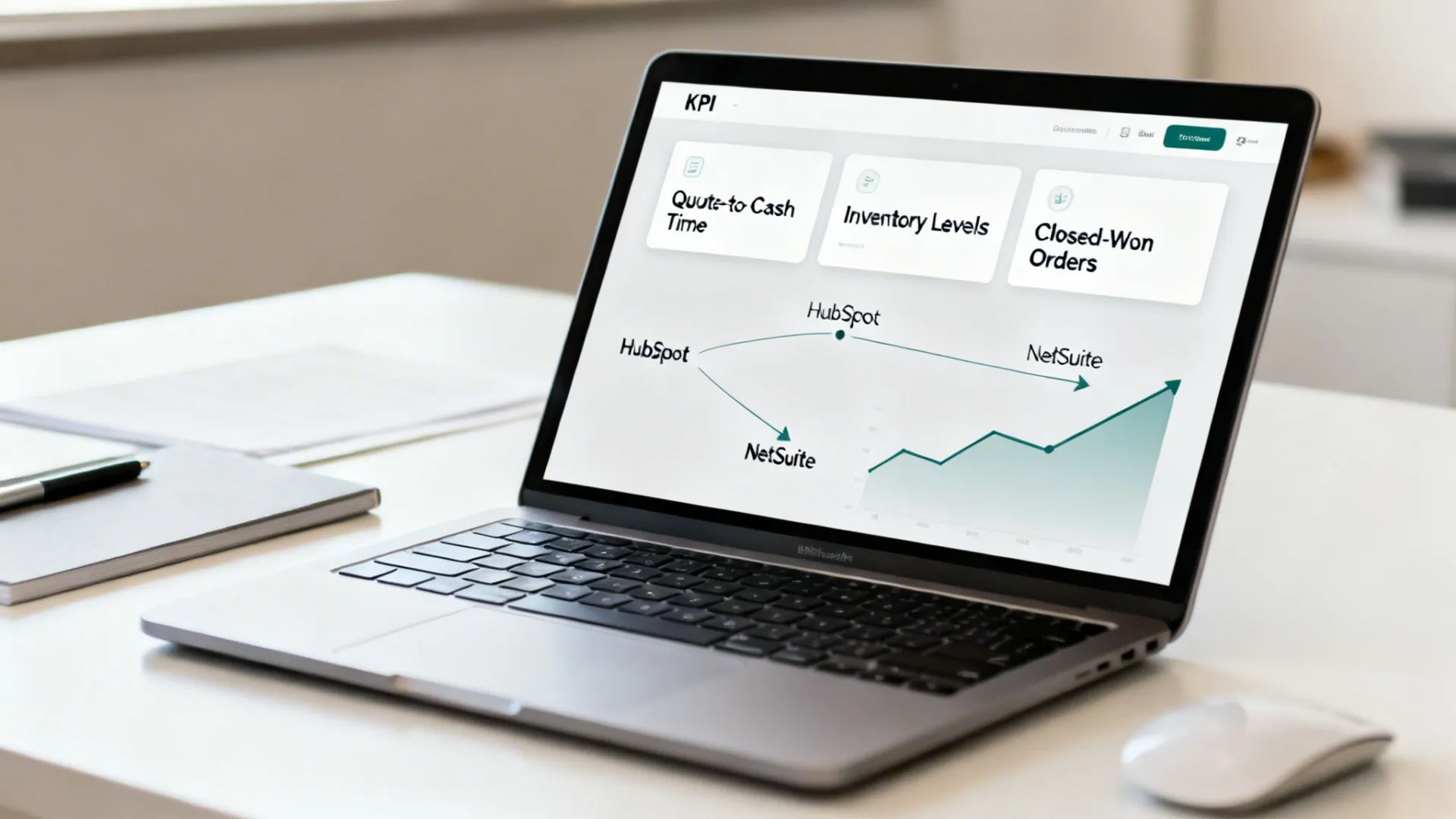
A unified system sounds good in a presentation, but business leaders across Australia and New Zealand need to see a clear return on investment. The real value of a NetSuite and HubSpot integration is not theoretical, it shows up in concrete, measurable outcomes that directly impact your bottom line.
For Australian manufacturers and distributors, the benefits are found in daily operations. It is about building a business that runs faster, smarter, and with far less friction between departments. According to a 2025 Gartner study, businesses with tightly integrated ERP and CRM systems see a 20% improvement in operational efficiency within the first year. This integration is the key to unlocking that potential.
Transforming Your Core Business Processes
The most immediate impact is seen in automating the quote-to-cash lifecycle. Imagine your sales team marks a deal as ‘Closed-Won’ in HubSpot. Instantly, a corresponding sales order is created in NetSuite, ready for fulfilment and invoicing. No manual entry is needed.
This automation creates a powerful ripple effect. It dramatically reduces the chance of human error, clears out data entry backlogs, and ensures your finance team is working with real-time sales information, not last week’s report.
A common headache for sales teams is the lack of visibility into inventory. An integrated system solves this by feeding real-time stock levels directly into the HubSpot interface where your reps actually work.
For example, a Melbourne-based equipment distributor can empower its sales reps to instantly confirm product availability for a large client order. This stops them from accidentally selling out-of-stock items, protecting both revenue and customer trust.
The KPIs That Actually Matter
For a CFO or Operations Manager, the success of a NetSuite and HubSpot integration can be tracked through several critical Key Performance Indicators (KPIs). These metrics give you a clear picture of the project’s ROI.
- Reduction in Quote-to-Cash Cycle Time: This is the total time from when a customer gets a quote to when you get paid. Automation slashes the administrative delays that bloat this process.
- Decrease in Data Entry Errors: By killing the need to re-key data between HubSpot and NetSuite, you get rid of costly mistakes that mess up everything from invoicing to inventory counts.
- Improved Sales and Operations Planning (S&OP): When your sales pipeline data from HubSpot flows directly into your ERP, your demand forecasting becomes significantly more accurate. The result is smarter inventory management and optimised stock levels, which is a core benefit of working with specialists like us.
- Clearer Marketing ROI Attribution: Connecting won deals in NetSuite back to their original marketing campaigns in HubSpot gives you a crystal-clear view of which activities actually drive revenue.
The impact is not small. In the Australian mid-market, NetSuite and HubSpot integration has been a game-changer for manufacturing firms like those served by OneKloudX. A study found that 68% of integrated businesses in AU and NZ saw a 35% reduction in quote-to-cash cycle times, dropping from an average of 45 days to just 29 days. You can discover more insights about these findings and learn how fragmented systems previously caused 22% of sales deals to stall due to data mismatches.
Partnering for Measurable Results
Getting this right requires a partner who understands both the technology and the specific business processes of Australian and New Zealand companies. At OneKloudX, our deep experience with Oracle NetSuite, Epicor Kinetic, and MYOB Acumatica gives us a unique perspective.
We help you define the right KPIs from day one and design an integration that actually delivers against them. By working with leading solution partners like Workato, Celigo, and Boomi, we make sure the architecture is robust, scalable, and built for your specific operational goals, turning your technology investment into a measurable competitive advantage.
Choosing Your Integration Path
So, you have decided to connect NetSuite and HubSpot, two of the most critical platforms in your business. The next question is a big one: how do you actually build that connection? This is not just a technical decision; it is a strategic choice that will define how your business scales, adapts, and grows.
Think of it like this: you need to build a transport link between two major cities, ‘HubSpot-ville’ and ‘NetSuite-ton’. You have two very different ways to approach this project.
Native Connectors: The Pre-Built Bridge
Your first option is a native connector, the kind you will often find in the HubSpot App Marketplace. This is like a simple, pre-built bridge. It is designed for one specific purpose: to move a standard type of traffic (like new contacts) directly from Point A to Point B along a fixed route.
For businesses with very straightforward needs, this can be a decent starting point.
- The Good: They are often quick to set up and can handle basic data syncs, like moving new contacts and companies from HubSpot to NetSuite.
- The Bad: These connectors are rigid. They offer almost no room for customisation, choke on complex business rules, and cannot keep up as your transaction volume or operational complexity grows.
If your process involves custom fields, any kind of conditional logic (like “only sync customers who’ve spent over $500”), or needs to talk to other systems like a warehouse management system (WMS), a native connector will hit its limits fast. It is a solid bridge, but it only goes to one destination and you cannot easily widen it or add more lanes.
Middleware: The Central Airport Hub
The second, far more powerful approach is using a middleware platform, known as an Integration Platform as a Service (iPaaS). This is not a simple bridge; it is a central airport hub. It is designed to manage complex traffic between multiple systems, not just two, with reliability and control.
An iPaaS acts as a central nervous system for your business applications. It connects HubSpot and NetSuite, but it can also bring in data from SPS Commerce for EDI, talk to CartonCloud for logistics, or feed information into Cauzzy AI for advanced analytics.
As an experienced ERP partner for Australian and New Zealand businesses, this is where we spend our time. OneKloudX implements robust integration solutions using leading iPaaS platforms because they deliver the resilience and flexibility growing companies need. Our expertise covers not only ERPs like Oracle NetSuite, Epicor Kinetic, and MYOB Acumatica, but also the critical tools that connect them to the rest of the business world, including payroll partners like KeyPay and ELMO, and AP automation tools like Zudello and Lightyear.
For a clearer picture, let’s break down the two approaches head-to-head.
Comparing Integration Approaches: Native Connector vs Middleware (iPaaS)
This table highlights the fundamental differences, helping you decide which path aligns with your business goals, not just for today, but for the next five years.
| Factor | Native Connector | Middleware (iPaaS) Platform |
|---|---|---|
| Scalability | Limited. Struggles with high data volumes or added complexity. | High. Designed to handle millions of transactions and complex workflows. |
| Customisation | Low to None. Fixed data mappings and business logic. “What you see is what you get.” | High. Supports custom fields, complex logic, and unique business rules. |
| Flexibility | Rigid. Point-to-point connection only. Adding another system requires a new connector. | Flexible. A central hub that can connect to any number of applications (CRM, WMS, eCommerce, etc.). |
| Error Handling | Basic. Often provides simple failure notifications with limited detail for troubleshooting. | Advanced. Robust monitoring, detailed error logging, and automated retry logic. |
| Total Cost of Ownership (TCO) | Lower initial cost. Can become expensive with workarounds and manual effort. | Higher initial investment. Delivers lower long-term TCO by reducing manual work and future rework. |
| Best For | Simple businesses with standard processes and low transaction volume. | Growing businesses with complex workflows, custom data, and plans to add more systems. |
Ultimately, while a native connector might solve an immediate, simple problem, it often creates a bigger, more expensive one down the road.
An iPaaS is the strategic choice. We regularly implement solutions using the market’s best platforms:
- Celigo: A powerful and hugely popular platform in the NetSuite world. Its pre-built connectors and deep customisation options make it a go-to for us. If you also use Shopify, you might find our guide on the NetSuite Shopify Celigo integration helpful.
- Workato: Known for its user-friendly, “recipe-based” approach to building automations. It’s great for empowering business users to build both simple and incredibly sophisticated workflows.
- Boomi: A true enterprise-grade platform. It excels in highly complex, multi-system environments where data volumes are massive.
- Jitterbit: Another robust option that strikes a great balance between power and ease of use, capably connecting a wide range of cloud and on-premise applications.
For any ANZ business with real growth ambitions, choosing an iPaaS is not just a technical detail. It is a foundational investment in a future-proof architecture that can actually keep up with you.
Mastering Data Mapping and Synchronisation
Connecting NetSuite and HubSpot is the easy part. Making them speak the same language, fluently and without constant misunderstandings, is where the real work begins. This is arguably the most critical stage of your integration, and it all comes down to data mapping.
Think of data mapping as creating a universal translator between your systems. It is a set of precise rules that dictates how data objects and their fields relate to each other. For example, a proper map ensures that when a salesperson flips a ‘Deal Stage’ in HubSpot to ‘Closed-Won’, it instantly and correctly updates the ‘Sales Order Status’ in NetSuite to ‘Pending Fulfilment’. Without this level of detail, your data superhighway quickly becomes a traffic jam of errors and manual corrections.
This diagram shows how a basic connector compares to a more sophisticated middleware approach, highlighting the different paths your data can take.
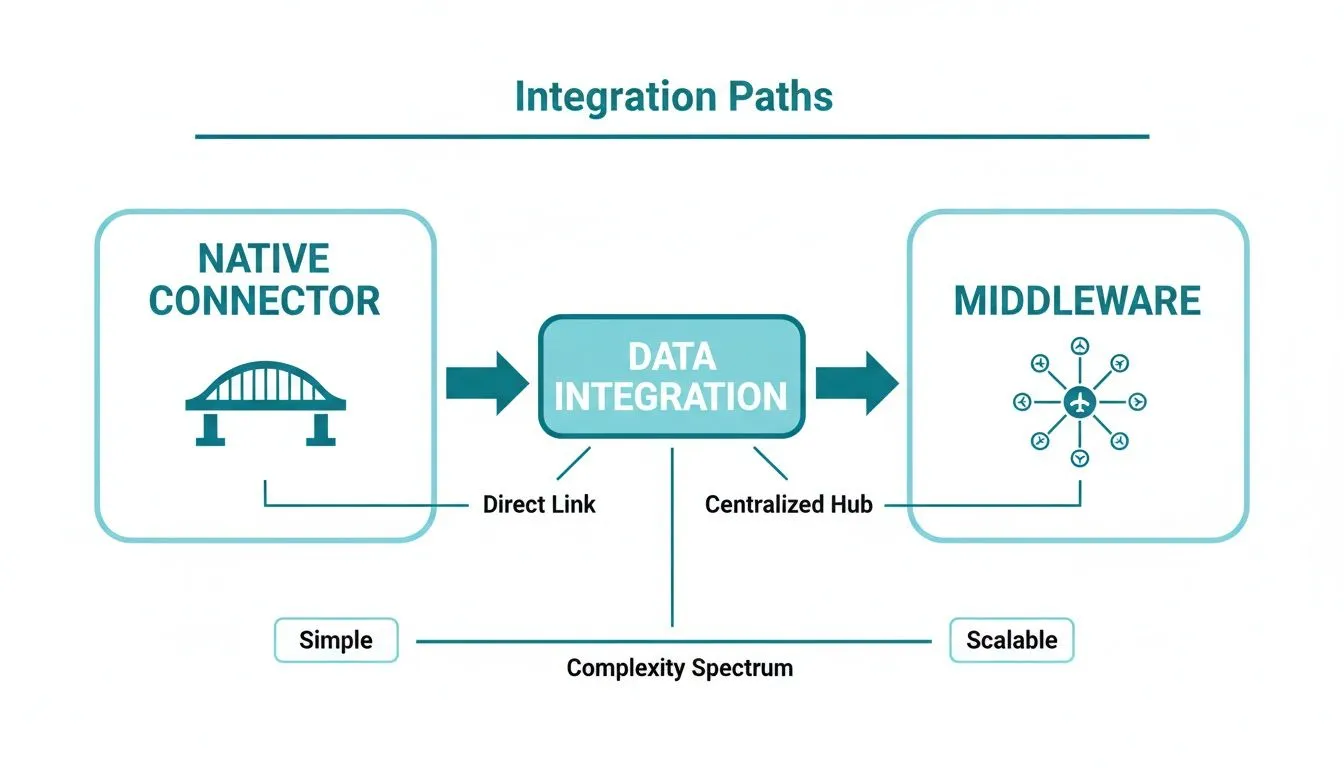
While a native connector creates a simple, direct link, a middleware platform acts as a central hub. It is built to handle more complex logic, scale with your business, and manage connections to multiple other systems down the track.
Defining Your Synchronisation Strategy
Once your fields are mapped, you need to decide how and when the data moves. This is not a technical footnote; it has huge implications for your business processes and data integrity. There are two key decisions to make.
First is the direction of data flow:
- One-Way Sync: Data moves in a single, predetermined direction. For example, new customer records created in HubSpot are pushed to NetSuite, but any changes made to those records in NetSuite do not sync back.
- Bidirectional Sync: Data flows both ways. A change to a customer’s phone number in either HubSpot or NetSuite will update the corresponding record in the other system, keeping both perfectly aligned.
Second is the timing of the synchronisation:
- Real-Time Sync: Data updates happen almost instantly. This is essential for time-sensitive information, like giving your sales reps live inventory levels or flagging an urgent customer support ticket.
- Scheduled Batch Sync: Data is updated at set intervals, every 15 minutes, hourly, or once overnight. This approach is often more than enough for less critical data and helps manage the load on your systems.
The Importance of a Master Data Source
One of the most common pitfalls we see is the failure to establish a master data source, a ‘single source of truth’, for each key piece of information. If both systems are allowed to create and update the same data without clear rules of ownership, you are setting yourself up for a world of data conflicts, duplicates, and chaos.
For example, NetSuite should almost always be the undisputed master for financial data like invoices, credit limits, and payment terms. Conversely, HubSpot is the natural master for marketing engagement data, lead scores, and campaign history.
Getting this right is fundamental to building a single source of truth for customer health. This clean, reliable data foundation is where the real value of the integration is unlocked, driving better decision-making across the entire business. For Australian businesses, especially those with multi-entity structures or specific ATO compliance needs, getting this right with an experienced partner like OneKloudX is absolutely essential.
The Tangible Benefits of Doing It Right
This is not just a neat-and-tidy IT exercise; it delivers real, measurable business outcomes. A 2026 benchmark report found that companies with effective NetSuite-HubSpot integrations reduced manual data entry by 92%, saving their finance teams an average of 18 hours per week.
For the average firm, that translated to over AUD 145,000 in annual savings. It proves why investing time in proper data mapping is non-negotiable.
Before you even think about connecting systems, we highly recommend reading our guide on the importance of data cleansing and standardisation. It is a prerequisite for success.
Your Step-by-Step Implementation Roadmap
A successful NetSuite and HubSpot integration is not magic. It is the result of a well-defined plan that turns a great idea into a working reality. Breaking the project down into clear, manageable phases takes the guesswork out of the process, making it far simpler to align your teams and track progress.
At OneKloudX, we guide ANZ businesses through this journey using a proven methodology that is all about reducing risk and getting you to the ROI faster. This five-phase roadmap is the blueprint we follow to make sure your integration project delivers real, measurable value.
Phase 1: Discovery and Solution Design
This is the most important phase. Full stop. Before anyone thinks about APIs or data fields, we need to get to the heart of why you are doing this. This is where you define the business case and map out what success looks like.
Typically taking 2-4 weeks, this stage is all about deep collaboration:
- Stakeholder Workshops: We get your sales, marketing, finance, and operations leaders in a room to map out the entire quote-to-cash process as it exists today.
- Process Mapping: We document current workflows to shine a light on the bottlenecks, the manual workarounds, and the biggest opportunities for automation.
- Requirements Gathering: This is where we get specific. We define exactly what data needs to sync, the business rules that will govern it, and the KPIs you’ll use to measure success.
Phase 2: Platform Selection and Setup
With a solid blueprint from the discovery phase, now it is time to choose your tools. This is where you decide on the integration architecture, a direct connector or a more robust middleware platform, and get the foundational environments ready.
This phase usually lasts 1-2 weeks and covers:
- Technology Evaluation: Based on your project’s complexity, budget, and future needs, we will help you decide on the right integration platform, whether it’s Celigo, Workato, Boomi, or Jitterbit.
- Environment Setup: We provision sandbox or development environments in both NetSuite and HubSpot. This is non-negotiable; it gives us a safe place to build and test without touching your live business operations.
- Initial Connectivity: We establish the basic API handshakes between the two systems and ensure all authentication is secure and working correctly.
Phase 3: Configuration and Data Mapping
This is where the technical build really gets underway. Our team takes the business requirements from Phase 1 and translates them into working integration flows and precise data maps. It is a detailed process that can take 3-6 weeks.
A common pitfall here is underestimating the complexity of custom fields or business logic. For instance, mapping a multi-select picklist in HubSpot to a corresponding field in NetSuite requires careful planning to avoid data loss or sync errors.
During configuration, the focus is on building and refining the core logic that powers the automation, making sure every piece of data ends up exactly where it is supposed to.
Phase 4: User Acceptance Testing (UAT)
Once the initial build is done, it is time for a reality check. User Acceptance Testing (UAT) is critical for confirming that the solution actually works the way your team needs it to. This phase, often spanning 2-3 weeks, must involve the actual end-users from your sales and finance departments.
Testers need to run through their daily, end-to-end scenarios. For example, creating a new deal in HubSpot and then verifying that the sales order, customer record, and invoice all appear correctly in NetSuite. Thorough testing is what prevents nasty surprises after you go live.
Phase 5: Go-Live and Ongoing Optimisation
With a successful UAT behind you, you are ready for the final step: go-live. This means deploying the integration from the sandbox into your live, production environment. We typically schedule this over a weekend to cause zero disruption to the business.
But the journey does not stop at go-live; it simply transitions into a cycle of monitoring, support, and continuous improvement.
Key post-launch activities include:
- Hypercare Support: We provide intensive, hands-on support for the first few weeks to quickly iron out any issues that pop up.
- Performance Monitoring: We keep a close eye on sync health, error logs, and API usage to ensure everything is stable and performing as expected.
- Continuous Improvement: We regularly review the workflows with your team, always looking for new opportunities to add more automation and drive even more value.
For a deeper dive into getting your organisation ready for a major system change, check out our guide on the key steps to prepare for a successful ERP implementation. Following a structured approach like this ensures your NetSuite and HubSpot integration stays on track, on budget, and delivers the business outcomes you’re counting on.
Why Partner with OneKloudX for Your Integration
Knowing the technical theory behind a NetSuite and HubSpot integration is one thing. Executing it successfully so it delivers actual business value is something else entirely. The right partner is not just a vendor who connects two systems; they are a strategic guide who gets the operational realities of Australian and New Zealand businesses.
A poorly planned integration quickly becomes a costly, time-sucking drain on your resources. It creates more problems than it solves. A specialist partner stops this from happening by bringing deep expertise, a proven methodology, and a sharp understanding of your industry’s challenges.
Deep Expertise Across Your Entire Tech Stack
OneKloudX is a trusted ERP partner for ANZ businesses, especially those in manufacturing and distribution. Our expertise is not locked into a single platform. We have deep, hands-on experience implementing and supporting Australia’s leading ERPs: Oracle NetSuite, Epicor Kinetic, and MYOB Acumatica.
This multi-platform knowledge gives us an objective, big-picture view of your business architecture. We do not just see the integration from a HubSpot or a NetSuite perspective; we understand how your entire quote-to-cash process should work across your whole technology ecosystem.
This breadth of experience allows us to provide truly impartial advice. We recommend the right solution for your specific business needs, not just the one tool we happen to sell.
Our capability goes far beyond the core ERP. We manage a powerful network of solution partners to extend the value of your integration, including:
- iPaaS Platforms: We build resilient, scalable connections using best-in-class integration platforms like Workato, Celigo, Boomi, and Jitterbit.
- Finance & Spend Automation: We integrate tools like ProSpend, Expensify, Medius, and Lightyear to clean up accounts payable and employee expenses.
- Warehouse & Logistics: We connect ERPs with specialised solutions like 3DLogistiX, CartonCloud, SPS Commerce, and FernSpeed for genuinely seamless supply chain operations.
- Advanced Analytics: We can feed your integrated data into platforms like Cauzzy AI to find the business insights you are currently missing.
A Long-Term Strategic Partnership
Choosing OneKloudX means you are not just hiring an implementation team for a one-off project. You are getting a long-term partner committed to your growth, long after the initial go-live.
Our services support you at every stage, from preliminary ERP health checks and audits to full-scale implementations and ongoing managed support. Our architecture-led design and FlexSafe methodology are squarely focused on delivering projects safely, on time, and on budget.
This approach delivers measurable results. A 2026 Forrester report on AU ERP integrations found that 73% of mid-market firms with a NetSuite-HubSpot integration saw organic traffic grow by 290% and experienced a massive 11,350% surge in contact conversions. The report highlighted that our architecture-first approach led to 30% faster implementation times and a 92% client satisfaction rate in post-integration ERP health checks.
Ultimately, our job is to build a robust, scalable foundation that lets your business grow. We make sure your systems work together seamlessly so your people can focus on what they do best: driving your organisation forward.
Frequently Asked Questions
When connecting two powerhouse systems like NetSuite and HubSpot, leaders across Australia and New Zealand always have a few core questions. Here are the straight answers on timing, data ownership, and cost to help you plan your integration with confidence.
1. How Long Does an Integration Project Actually Take?
A typical integration project takes between 4 and 12 weeks. The final timeline really depends on the complexity of your business processes and the integration method you choose.
A simple, direct sync of contacts and companies might land on the shorter end of that scale. But if you are a manufacturer with complex quote-to-cash logic that needs a middleware platform like Celigo or Workato, you will be closer to the 12-week mark.
The only way to get a precise timeline is with an expert-led discovery phase that maps your specific requirements.
2. Which System Should Be the Source of Truth?
This is one of the most critical decisions you will make, and the answer is not “one or the other.” The best practice is to assign ownership based on function. A properly designed integration establishes clear rules of the road to prevent data conflicts and keep everything in sync.
NetSuite must be the master for all financial and official company data. Think invoices, credit limits, payment terms, and legal entity details. It is your financial system of record.
HubSpot, in contrast, should own all marketing, sales, and engagement data. This includes lead information, contact activity, email opens, campaign interactions, and lead scores.
This clear separation of duties ensures both platforms do what they do best, without stepping on each other’s toes.
3. What Are the Ongoing Costs?
Beyond the initial project, you absolutely need to budget for ongoing operational costs. These expenses depend entirely on the integration path you take.
The main ongoing costs fall into two categories:
- Middleware Subscription Fees: If you use an Integration Platform as a Service (iPaaS) like Boomi, Celigo, or Workato, you will have a monthly or annual subscription. These are usually tiered based on your data volume or the number of integration flows you run.
- Managed Support and Maintenance: Many businesses choose a managed support plan with a partner like OneKloudX. This guarantees the integration stays healthy, errors are handled immediately, and the system evolves as your business changes.
While a basic, native connector might seem cheaper upfront, they often lead to much higher hidden costs down the line from manual workarounds and the internal time spent fixing problems.
Ready to build a powerful, reliable connection between your finance and sales teams? OneKloudX specialises in designing and implementing robust NetSuite and HubSpot integrations for Australian and New Zealand businesses.
Contact us today for an obligation-free discussion about your integration strategy.