
Here is a scenario that will be familiar to anyone running a sales team that handles complex product lines: a rep is entering an order under time pressure. The customer is waiting. The drop-down list has hundreds of SKUs. The rep selects what looks right, moves on, and submits the order. The problem surfaces two days later when fulfilment picks the wrong variant and the customer receives the wrong product.
The return is raised. The correct item is re-picked and re-shipped. The original is processed back into inventory. Someone on the operations team spends an hour untangling the records in NetSuite. The customer is frustrated. And the sales rep, who made an entirely understandable mistake given the tools they were working with, gets a complaint logged against their account.
This is not a people problem. It is a systems problem. And it has a straightforward solution.

Why Complex Product Lines and Manual Item Selection Do Not Mix
The challenge is not unique to any one industry. It shows up consistently in businesses that sell configurable products: apparel with size, colour, and material combinations; furniture with finish and dimension options; industrial goods with specification variants; custom manufacturing with multiple build configurations. The more options a product has, the more SKUs exist in the system, and the harder it becomes for a sales team to reliably select the correct item every time from a static drop-down list.
NetSuite is an extraordinarily capable ERP platform. But out of the box, item selection on sales orders is a manual process. Sales reps work from long product lists, apply their knowledge of SKU naming conventions, and hope they have chosen correctly. For businesses with a handful of product variants, this is manageable. For businesses with hundreds or thousands of configurable options, it is a daily source of errors, delays, and rework.
The downstream consequences compound quickly. A fulfilment delay caused by a wrong item selection does not just affect that one order; it affects inventory accuracy, revenue recognition timing, and the customer’s willingness to reorder. According to research cited by Salesforce Ben, 41 per cent of inaccurate data across business systems is attributable to human error, which is not surprising when the process is designed in a way that makes errors easy to make and difficult to catch before they propagate.
What a Guided Item Configurator Changes
The principle behind a NetSuite Item Configurator is straightforward: instead of asking a sales rep to know the correct SKU and find it in a list, the system guides them to it through a series of logical, structured choices.
Rather than selecting from a static product catalogue, the rep answers a sequence of questions that reflect the actual product attributes. What size? What colour? What material? What specification? Each answer narrows the field, and at the end of the guided workflow, the system maps those selections to the correct SKU and adds the right item to the sales order automatically.
The principle behind a NetSuite Item Configurator is straightforward: instead of asking a sales rep to know the correct SKU and find it in a list, the system guides them to it through a series of logical, structured choices.
Rather than selecting from a static product catalogue, the rep answers a sequence of questions that reflect the actual product attributes. What size? What colour? What material? What specification? Each answer narrows the field, and at the end of the guided workflow, the system maps those selections to the correct SKU and adds the right item to the sales order automatically.

The rep does not need to know the SKU. They do not need to remember which product code corresponds to which combination of attributes. They simply answer the questions that reflect what the customer wants, and the configurator handles the translation. The result is that a process which previously required product knowledge, careful attention, and a degree of luck is replaced by a guided workflow that produces the correct outcome regardless of how experienced or new the team member is.
This is the difference between a system that assumes its users will get it right and a system that makes it structurally difficult to get it wrong.
The Operational Impact Across the Business
The benefits of a properly implemented Item Configurator extend well beyond the moment of order entry. They flow through every downstream function that depends on sales order data being correct.
Sales Teams Work Faster and With More Confidence
The most immediate effect is on order entry speed. A sales rep who previously spent several minutes scanning a drop-down list, double-checking a product code, and second-guessing their selection can now complete the same task in a fraction of the time. For high-volume teams processing dozens of orders per day, this reduction in per-order time is meaningful at a team level, and eliminates the cognitive load of having to remember or look up SKU structures for every product combination.
New staff benefit equally. Onboarding a new sales rep onto a business with a complex product catalogue typically involves significant time spent learning SKU structures, understanding which codes correspond to which variants, and building up the product knowledge needed to enter orders confidently. A guided configurator removes that learning curve almost entirely. The system holds the product knowledge; the rep just needs to understand what the customer wants.
Fulfilment Operates on Clean Data
Every order that enters fulfilment with a correctly selected item is an order that does not require correction. The warehouse team picks what is listed. The item that ships is the item the customer ordered. The return rate for incorrect items falls. The operational cost of processing returns, re-picking, and re-shipping is reduced. And the customer experience, which is ultimately what drives repeat business, is protected.
This matters particularly in industries where incorrect variants create more than just an inconvenience. In manufacturing and industrial supply, shipping the wrong specification can affect a customer’s production line. In apparel and furniture, returns are expensive to process and often result in inventory that cannot be resold at full margin. The cost of a single wrong item selection is almost always higher than it appears at the point of entry.
Inventory and Forecasting Reflect Reality
Sales order accuracy has a direct bearing on inventory visibility and demand forecasting. When the items recorded on sales orders accurately reflect what customers are actually ordering, the data that feeds into NetSuite’s inventory and planning modules is trustworthy. When orders are entered with incorrect items and corrected after the fact, that correction introduces noise into the system, skewing demand signals and making it harder to make accurate replenishment and production decisions.
Clean order data at the point of entry means cleaner reporting, more reliable forecasting, and better inventory control throughout the supply chain.
How the OneKloudX Item Configurator Is Built
It is worth distinguishing this solution from the generic CPQ (Configure, Price, Quote) tools that many businesses consider when they first encounter this problem. Most CPQ platforms sit outside the ERP, requiring sales reps to move between systems, and introducing synchronisation dependencies that create their own data integrity risks. The OneKloudX Item Configurator is engineered directly inside NetSuite. Sales reps configure products without leaving the sales order workflow; there is no separate application to open, no login to a third-party platform, and no data transfer required to get the configured item onto the order. The configurator lives where the sales order lives, which is the only place it makes sense to be.
The solution is built using SuiteScript, NetSuite’s native scripting framework, to create the guided front-end interface that sales reps interact with during order entry.
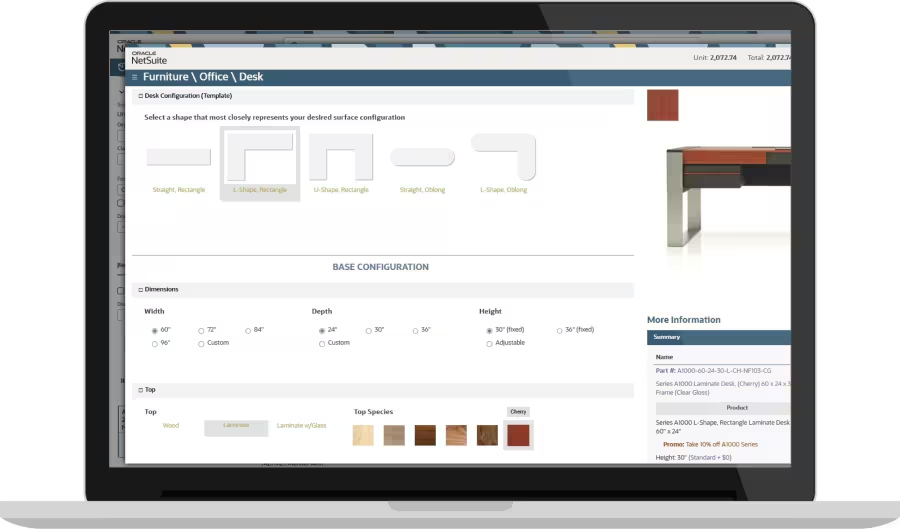
The configuration logic is built around your specific product structure. During the discovery and build phase, the OneKloudX team maps your product attributes, defines the decision tree that guides reps through the selection process, and engineers the mapping rules that translate those attribute selections into the correct NetSuite item record. The configurator then presents that logic through a clean, simplified interface directly within the NetSuite sales order workflow.
When the rep completes the guided selection, the system automatically identifies the matching item and links it to the sales transaction. There is no manual SKU entry, no cross-referencing with a separate product guide, and no opportunity for the wrong item to be selected as long as the configuration logic has been correctly built and maintained.
The interface is designed for adoption. One of the most common reasons that custom tools fail inside ERP systems is that they are technically functional but practically confusing to use. The OneKloudX configurator prioritises a clean, step-by-step user experience that sales reps find intuitive from day one, reducing the need for extended training and improving the speed of adoption across the team.
What This Solution Is Designed to Solve
Before deciding whether an Item Configurator is the right investment, it is worth mapping it against the specific problems it resolves. These are the operational pain points it directly addresses.
– Sales teams spending excessive time on product selection.
If your reps are regularly scrolling through long product lists, consulting external documents to find the right SKU, or asking colleagues to verify their item selections before submitting an order, the configurator replaces that process with a guided workflow that takes a fraction of the time.
– High rates of incorrect item selection on sales orders.
If your operations or fulfilment team regularly catches wrong items on orders before they ship, or if your return rate includes a meaningful proportion of incorrect variant shipments, the configurator eliminates the source of those errors at the point of entry.
– Long onboarding periods for new sales staff.
If new team members take weeks or months to reach full productivity because they need to learn complex SKU structures and product catalogues before they can confidently enter orders, the configurator removes that dependency and accelerates their time to competence.
– Inventory and forecasting data that does not match demand reality.
If your reporting team regularly has to correct or adjust sales order records because of item selection errors, the configurator improves the integrity of the data flowing into your inventory, planning, and financial reporting processes from the outset.
Who This Solution Is Built For
The NetSuite Item Configurator is not a universal requirement. It becomes a high-value investment for specific business profiles.

Businesses selling configurable products
Across any industry where the product exists in multiple variants defined by attributes such as size, colour, material, specification, or configuration. If the number of possible combinations makes manual selection genuinely difficult, a guided configurator is the right solution.

High-volume sales order teams
The time saving per order may seem modest in isolation, but across a team processing large numbers of orders daily, the cumulative gain in productivity is significant. The error reduction benefit compounds at the same rate.

Businesses with high staff turnover or rapid growth in the sales team
Any organisation that regularly onboards new sales reps faces the recurring cost of training them on product knowledge and SKU structures. A configurator reduces that cost substantially and gets new team members to full productivity faster.

Manufacturers and distributors running complex product catalogues in NetSuite
These businesses typically have the highest SKU counts, the most complex product attribute combinations, and the greatest operational consequence when the wrong item ships. The configurator is a direct fit for their order entry challenge.
Questions to Ask Before You Build a Configurator
Not every Item Configurator is built the same way, and the quality of the implementation determines how much of the benefit your business actually realises.
Here are the questions worth asking any NetSuite development partner before you engage them.
Is the configurator built natively inside NetSuite, or does it require a separate CPQ platform?
Generic CPQ tools require sales reps to leave the NetSuite sales order workflow, configure in a separate application, and then sync back. That introduces friction and data transfer risk. Ask specifically whether the solution lives inside NetSuite’s sales order workflow or requires switching between systems.
Will the configurator be built around our specific product structure, or is it a generic template?
Product attribute logic varies significantly between businesses. A configurator that works well for one catalogue may not map correctly to another without meaningful customisation.
How will the configuration logic be maintained as our product range changes?
Products are added, variants are retired, and attribute structures evolve. Ask specifically how updates to the product catalogue are reflected in the configurator without requiring a full rebuild.
How does the configurator integrate with the rest of the NetSuite sales order workflow?
The configured item needs to link cleanly to the sales transaction, carry the correct pricing, and flow through to fulfilment and inventory without additional manual steps.
What does the user interface look like, and how was it designed for adoption?
A technically correct configurator that sales reps find confusing or slow to use will not deliver the productivity gains it promises. Ask to see the interface and evaluate it from the perspective of a busy sales rep entering orders under time pressure.
What does post-implementation support look like?
As NetSuite releases platform updates and your product catalogue evolves, the configurator needs to be maintained. Understand what ongoing support is included and how changes are handled.
Why OneKloudX
OneKloudX is a certified NetSuite partner and custom development specialist based in Australia, with a track record of designing and implementing solutions that eliminate manual work and improve process accuracy for mid-market and enterprise clients across the region.
Our Item Configurator engagements begin with a thorough discovery of your product catalogue, your current order entry process, and the specific points where errors or inefficiencies are occurring. We build the configuration logic around your actual product structure, not a generic template, and we design the user interface with sales team adoption as a primary objective. Implementation includes testing against your existing NetSuite environment before go-live, and post-implementation support is available to ensure the solution continues to perform as your product range and team evolve.
We do not deploy tools and walk away. Our Australian-based team is available after go-live to support updates, answer questions, and ensure the solution keeps delivering the results your business needs.
Frequently Asked Questions
Ready to Eliminate Item Selection Errors from Your Sales Process?
If your team is spending time on manual product selection, managing returns caused by incorrect variants, or investing in onboarding that could be significantly shortened with the right tools, the NetSuite Item Configurator is a targeted, practical solution.
Book a NetSuite Discovery Session with the OneKloudX team and let’s map out exactly how a custom Item Configurator would work within your product catalogue and sales workflow.