You can tell when a mid-market business has hit the limit of its current systems.
Sales is promising stock that operations cannot see. Finance is waiting on month-end numbers that still live in spreadsheets. Procurement is chasing suppliers by email because nobody trusts the purchasing data in the core system. The warehouse has one version of inventory, head office has another, and neither matches what the customer service team is telling customers.
That situation is common across Australian and New Zealand manufacturing and distribution firms. It starts with sensible decisions, a finance package here, a bolt-on inventory tool there, a few spreadsheets to bridge the gaps. Then growth adds complexity, new entities, more warehouses, more compliance pressure, tighter margins, and the workarounds become the operating model.
The conversation about ERP benefits begins there. Not with software features, but with what happens when disconnected systems begin to slow the business down. For many firms, the first sign is that the old finance stack no longer supports the pace or structure of the business, especially when multi-entity reporting and operational visibility matter, which is why this guide on when your business has outgrown Xero resonates with so many growing teams.
Beyond Spreadsheets The Tipping Point for a Modern ERP
A COO sees the tipping point before the rest of the business names it.
It shows up in daily friction. The morning production meeting starts with arguments about whose numbers are right. A stock transfer between sites takes too long to appear in reports. Finance closes late because operations data needs manual checking. Leaders spend more time reconciling than deciding.
What the tipping point looks like in practice
In an AU/NZ manufacturing or distribution business, the warning signs are not dramatic at first. They are repetitive and expensive.
- Inventory uncertainty: Teams carry buffer stock because they do not trust on-hand figures.
- Slow decisions: Leaders wait for manually assembled reports, then discover they are already out of date.
- Compliance strain: BAS, GST, payroll-connected reporting, and entity-level controls become harder when data sits in multiple systems.
- Poor handoffs: Sales, finance, procurement, warehouse, and production all maintain their own records.
That is the point where ERP stops being an IT topic and becomes an operating model decision.
ERP is the response to fragmented growth
A modern ERP brings finance, inventory, procurement, sales, warehousing, and production into one connected platform. For AU/NZ firms, that matters because geography and compliance create extra complexity. Long supply lines, imported inputs, intercompany movements, and multi-site operations punish businesses that run on delayed information.
The practical value is simple. People stop asking which spreadsheet is correct. They work from one operating picture.
Tip: If your management team spends the first part of every meeting validating numbers, not acting on them, you are already paying the cost of fragmented systems.
Oracle NetSuite, Epicor Kinetic, and MYOB Acumatica all address this problem from the same starting point. They centralise data and standardise process. The right fit depends on your operating model, not on whichever product demo looked slickest.
That distinction matters. Businesses do not realise ERP benefits because they bought software. They realise them because they replaced fragmented workflows with disciplined, connected ones.
Unifying Your Business with a Single Source of Truth
Monday, 8:07 a.m. The COO is in the weekly ops meeting. Sales is quoting one backlog number, finance is holding a different debtor position, and the warehouse says the stock on hand report is wrong again. Nobody can make a clean call on purchasing, production, or dispatch until someone “checks the numbers”.
That delay is expensive.
What a single source of truth means
In practical terms, it means customer, supplier, item, inventory, order, purchasing, production, and finance data sit in one system of record. Teams work from the same transactions and master data, instead of exporting records into separate tools and adjusting them offline.
For a mid-market manufacturer or distributor, that changes daily control in a few specific ways.
- Finance sees activity as it happens: Receipts, shipments, work orders, invoices, and stock movements flow through to the financial picture without waiting for someone to rekey data.
- Operations sees business impact earlier: Delays in supply, changes in demand, and inventory variances show up in the same environment as margin, cash exposure, and service levels.
- Leadership spends less time validating reports: Meetings can focus on decisions, exceptions, and actions rather than arguing over whose spreadsheet is current.
The reason this matters is simple. A shared data model shortens the gap between what happened on the floor, in the warehouse, or in the branch network, and what management can confidently act on.
Why this matters more in AU and NZ
Australian and New Zealand firms deal with structural complexity that generic ERP content usually treats as a footnote. Imported stock often comes with long lead times and volatile freight conditions. Multi-entity groups need clean intercompany treatment. GST, BAS, payroll reporting, and audit trails need discipline, not patchwork fixes.
Once the same item exists under different codes at different sites, or one entity recognises revenue on a different basis from another, the reporting problem stops being administrative. It affects purchasing decisions, service reliability, and cash control.
A connected ERP reduces that risk by enforcing common masters, approval rules, tax logic, and reporting structures across the business, while still allowing site-level execution. That matters whether the platform is Oracle NetSuite for multi-entity visibility, Epicor Kinetic for manufacturing control, or MYOB Acumatica for growing distribution and finance operations. The right choice depends on the operating model, which is why ERP selection criteria need to be tied to process reality, not demo polish. OneKloudX covers that in its guide to how to select an ERP system for an Australian mid-market business.
What changes after centralisation
The first gains are usually visible in routine work.
Customer service stops calling three departments to confirm availability. Procurement has a clearer view of demand and supplier status. Finance spends less time reconciling inventory, receivables, and purchasing activity back to operational records. Branches and sites can still run locally, but head office is no longer waiting for emailed extracts before it can trust the month-end pack.
This short explainer captures the concept well in visual form:
The outcome is not just tidier reporting. It creates the conditions for measurable financial and operational ROI, because procurement, inventory, fulfilment, and finance are working from the same version of the business.
The platforms only work if process follows data
Software centralises information. It does not automatically create discipline.
If managers approve exceptions by email, planners maintain unofficial stock files, or finance continues to correct errors after the fact in spreadsheets, the ERP becomes another reference point instead of the operating core. I see this often in distribution businesses with fast growth and in manufacturers carrying legacy workarounds from older systems.
Three design decisions usually determine whether the ERP becomes authoritative:
- Master data ownership: Someone must own item data, supplier records, customer structures, tax settings, and chart design.
- Process control: Purchasing approvals, stock adjustments, intercompany flows, returns, and production transactions need defined rules.
- Role-based visibility: Users need clear access to the information and actions relevant to their jobs, without clutter or duplicate work.
The biggest benefit here is confidence. Once the business trusts the numbers, planning gets sharper, exceptions stand out faster, and execution improves without adding layers of manual checking.
Achieving Measurable Financial and Operational ROI
A mid-market COO usually feels ERP value before they sees it in a report. Month-end stops dragging on. Expedite freight drops. Purchasing stops arguing with warehouse over the stock on hand. Finance spends less time correcting transactions and more time explaining margin movement.
That is the standard. ERP value should appear in the P&L, balance sheet, cash position, and weekly operating rhythm.
For Australian and New Zealand manufacturers and distributors, measurable financial and operational ROI rarely comes from one dramatic gain. It comes from a series of practical improvements that remove waste from daily operations. Shorter close cycles. Better purchasing discipline. Fewer stockouts and fewer excess buys. Cleaner forecasting. Faster exception handling across entities, warehouses, and sites.
What ROI looks like in practice
The pattern is consistent across successful projects. A well-fitted ERP reduces manual handling, decision delay, and avoidable rework.
| Business Area | KPI to Track | Typical ROI Effect |
|---|---|---|
| Finance | Close cycle, reconciliations, audit readiness | Less manual correction, faster reporting, better control |
| Procurement | Off-contract spend, approval cycle time, price variance | Tighter spend control and fewer rush purchases |
| Budgeting | Forecast accuracy, version control, reporting effort | More reliable planning and less spreadsheet rework |
| Inventory | Stock turns, excess and obsolete stock, fill rate | Better working capital use and stronger service levels |
| Planning | Supplier lead-time visibility, replenishment accuracy, schedule adherence | Fewer surprises and more stable execution |
The mistake I see in business cases is treating ROI as a software promise. It is an operating model decision. The benefits only show up when the ERP becomes the system people use to buy, receive, produce, ship, and report.
Finance gains are often the fastest to prove
Operations leaders usually focus on inventory first. Fair enough. That is where cash gets stuck. But finance improvements are often easier to verify in the first six to twelve months, especially in AU/NZ firms dealing with multi-entity reporting, GST treatment, and recurring reconciliation work.
For example, Oracle NetSuite is often a sensible fit for businesses that need tighter control across entities, locations, and consolidated reporting. MYOB Acumatica can suit firms that want broad cloud-based control with strong finance and operational coverage. The platform matters, but process design matters more. If intercompany rules, approval paths, and tax treatment are still handled through side files, the business will carry those delays into the new system.
Many ROI models fall apart at this stage. Teams count labour savings, but they ignore the cost of unresolved process issues.
Operations ROI comes from better control
Automation helps. Control protects margin.
Procurement is a good example. If buyers cannot see current stock, committed demand, supplier pricing, and approval status in one workflow, they buy defensively. That usually means duplicate orders, more urgent freight, weaker supplier conversations, and spend that drifts outside policy. Add-on tools such as ProSpend, Medius, Zudello, Lightyear, and Coupa can strengthen ERP-driven purchasing by improving approval control and spend visibility.
Inventory follows the same logic. In Australia and New Zealand, long inbound lead times and expensive freight punish weak replenishment settings. A business importing into Perth, Christchurch, or regional distribution points cannot afford planning based on stale spreadsheets. ERP planning, sometimes paired with tools such as Netstock, gives planners a better basis for reorder decisions. The outcome is not just lower stock. It is better stock allocation and fewer avoidable shortages.
Platform fit has a direct effect on ROI
A distributor with multiple warehouses, landed cost pressure, and frequent transfers needs different capabilities from a manufacturer running make-to-order or engineer-to-order jobs. Epicor Kinetic often makes sense where shop-floor control, product configuration, and detailed manufacturing costing carry real weight. Oracle NetSuite is often strong for multi-entity growth businesses that need tighter financial consolidation and broader cloud visibility. MYOB Acumatica can be a strong fit for firms that want flexible operational control without overcomplicating the environment.
Selection errors are expensive because they create workarounds early. Workarounds become habits. Habits dilute ROI.
A structured selection process reduces that risk. If your team is still comparing options at a feature-list level, this guide on how to select an ERP is a practical place to start because it forces the discussion back to process fit, reporting needs, integration requirements, and governance.
Build the business case around visible waste
The strongest ERP business cases are operationally honest. They start with problems already visible in monthly numbers and weekly meetings.
Focus on waste you can observe and assign:
- Manual finance effort: reconciliations, close delays, spreadsheet-based consolidations
- Purchasing leakage: off-contract spend, duplicate buying, weak approval control
- Inventory drag: excess stock, avoidable stockouts, poor transfer decisions
- Execution loss: rework, mis-picks, late fulfilment, inaccurate costing
- Management delay: decisions made on old numbers or disputed reports
Each KPI needs an owner. Finance should own close cycle and reconciliation quality. Supply chain should own stock accuracy and service levels. Procurement should own spend visibility and approval compliance. Post-go-live training and process reinforcement should also sit inside the ROI model, because value capture does not happen automatically after cutover.
Done well, ERP ROI is not abstract. It shows up in faster reporting, better cash use, tighter purchasing, and fewer operating surprises.
Driving Excellence in Manufacturing and Distribution
Manufacturing and distribution businesses do not struggle in generic ways. They struggle in operationally specific ways.
A manufacturer in regional Australia may be juggling imported raw materials, variable demand, shop-floor scheduling, and cost pressure from freight and labour. A distributor may be trying to serve customers across multiple states while coordinating 3PLs, warehouse transfers, and supplier lead times that do not behave.
That is why the benefits of an ERP in these sectors need to be judged on execution.

For manufacturers, visibility has to reach the floor
A common before-state looks like this. Production planning happens in one system, actual job progress is tracked elsewhere, and costing gets reconciled after the fact. Supervisors rely on tribal knowledge. Variances are discovered too late.
With a manufacturing-capable ERP, that changes. Epicor Kinetic is often relevant here because it supports advanced manufacturing needs such as MES-style control, product configuration, and tighter linkage between jobs, materials, labour, and cost.
The practical gains are straightforward:
- Job costing becomes more reliable: actual consumption and labour are easier to connect back to the job.
- Scheduling becomes more realistic: planners work from current capacity and material status, not hopeful assumptions.
- Quality and traceability improve: teams can follow issues back through transactions instead of searching email trails.
Panorama Consulting Group noted that many businesses in the Australian manufacturing and distribution sectors saw substantial improvements in supplier interactions. A 2023 Deloitte Australia ERP study also found that local manufacturers adopting cloud ERP saw inventory accuracy rise by 25%, with stockouts cut by 18% and overstock costs reduced by 22% (AU manufacturing and distribution ERP outcomes).
For distributors, warehouse rhythm matters
Distributors usually feel pain in order flow first.
Orders come in from multiple channels. Inventory sits across sites. Customer service promises delivery based on stale information. Warehouse teams pick around exceptions because system data lags reality.
A modern ERP improves that rhythm when it is connected properly to warehouse and logistics tools. CartonCloud, 3DLogistiX, SPS Commerce, and FernSpeed can extend operational visibility around warehousing, fulfilment, and trading partner flows, depending on the business model.
The “after” picture is not glamorous, but it is profitable. Picks are cleaner. Transfers are visible. Exceptions are managed earlier. Customer service can answer with confidence because order, stock, and shipment status are connected.
Geography changes the stakes in AU and NZ
Distance magnifies weak process.
If your supplier is offshore and your warehouse is carrying the wrong stock, you cannot solve that with a same-day workaround. If your branches are spread across states or across the Tasman, poor inventory visibility creates freight waste, customer delays, and excess working capital.
That is why manufacturing and distribution leaders tend to value ERP when it improves coordination, not just reporting. Supplier collaboration, warehouse execution, replenishment logic, and entity-level visibility all need to work together.
For businesses looking at manufacturing-specific workflows in more detail, this guide to manufacturing efficiency with NetSuite is useful because it connects ERP design decisions to day-to-day plant performance.
Key takeaway: In manufacturing and distribution, ERP value is earned on the floor and in the warehouse. If the system cannot improve daily execution, the strategic reporting layer will not matter for long.
Future-Proofing Your Business with Integration and Automation
A modern ERP should not be treated as a finished product. It should be treated as the operational core of a connected business.
That matters because growth changes the systems around it. You might add a CRM, a WMS, an expense platform, payroll, AP automation, a treasury tool, or AI-driven forecasting. If the ERP cannot sit at the centre of that ecosystem, the business drifts back into fragmentation.
ERP becomes more valuable when it is connected
The practical definition of ERP integration is simple. Data moves between systems in a controlled, reliable way so teams do not rekey, re-export, or reconcile by hand.
For an AU/NZ mid-market business, common integration patterns include:
- CRM to ERP: HubSpot or Salesforce passing customer, quote, and order data into the operating core.
- Payroll and HR to ERP: KeyPay and ELMO supporting cleaner people and payroll processes around the finance backbone.
- Finance automation around ERP: BlackLine, Kyriba, Zone and Co, Avalara, Webexpenses, Expensify, and ProSpend strengthening close, treasury, tax, and spend processes.
- Integration platforms connecting the stack: Workato, Celigo, Boomi, and Jitterbit handling data movement across the broader application ecosystem.
When those connections are designed well, process friction drops. Teams spend less time moving information and more time managing exceptions.
Automation works best when rules are stable
Many businesses chase automation too early. They want approvals, alerts, invoice capture, or replenishment rules automated before they have agreed on the process itself.
That creates digital clutter.
The better sequence is to stabilise the workflow, define ownership, and then automate the repetitive parts. Once that foundation exists, ERP-centred automation can remove a surprising amount of admin from finance and operations.
Examples that deliver practical value include:
- Purchase approval routing
- Invoice matching and exception handling
- Order import from commerce or CRM systems
- Expense and spend data capture
- Intercompany transaction handling
- Warehouse event updates into the ERP record
AI becomes useful when the data backbone is clean
Tools like Cauzzy AI are most effective when they work from a reliable operational dataset. Without that, “insight” becomes another source of noise.
With a clean ERP core, AI can support demand sensing, anomaly detection, and decision support. It can help teams spot unusual purchasing behaviour, demand shifts, margin leakage, or stock risk earlier. The point is not to replace judgement. It is to direct attention to where judgement matters most.
Tip: Treat automation and AI as force multipliers for good process. They do not rescue weak governance or bad data.
Future-proofing is really about reducing rework
The strongest ERP environments make future change less painful.
When a business opens a new site, adds a legal entity, changes a warehouse model, or adopts a new front-office system, the ERP and integration architecture should absorb that change without forcing a rebuild. That is the long-term gain. Less rework, fewer brittle workarounds, and a cleaner path to scale.
How to Realise Your ERP Benefits
A Brisbane distributor goes live on a new ERP, then keeps running replenishment in spreadsheets, approvals in email, and month-end workarounds in shared drives. Six months later, leadership says the system has underdelivered. In reality, the software is only doing part of the job because the business never finished the operating change.
That pattern is common across Australian and New Zealand mid-market manufacturing and distribution firms. Long supply lines, multi-site operations, 3PL dependencies, landed cost pressure, and ATO or Inland Revenue compliance do not leave much room for half-adopted processes. ERP value shows up when the business changes how it works, not when the licence is activated.
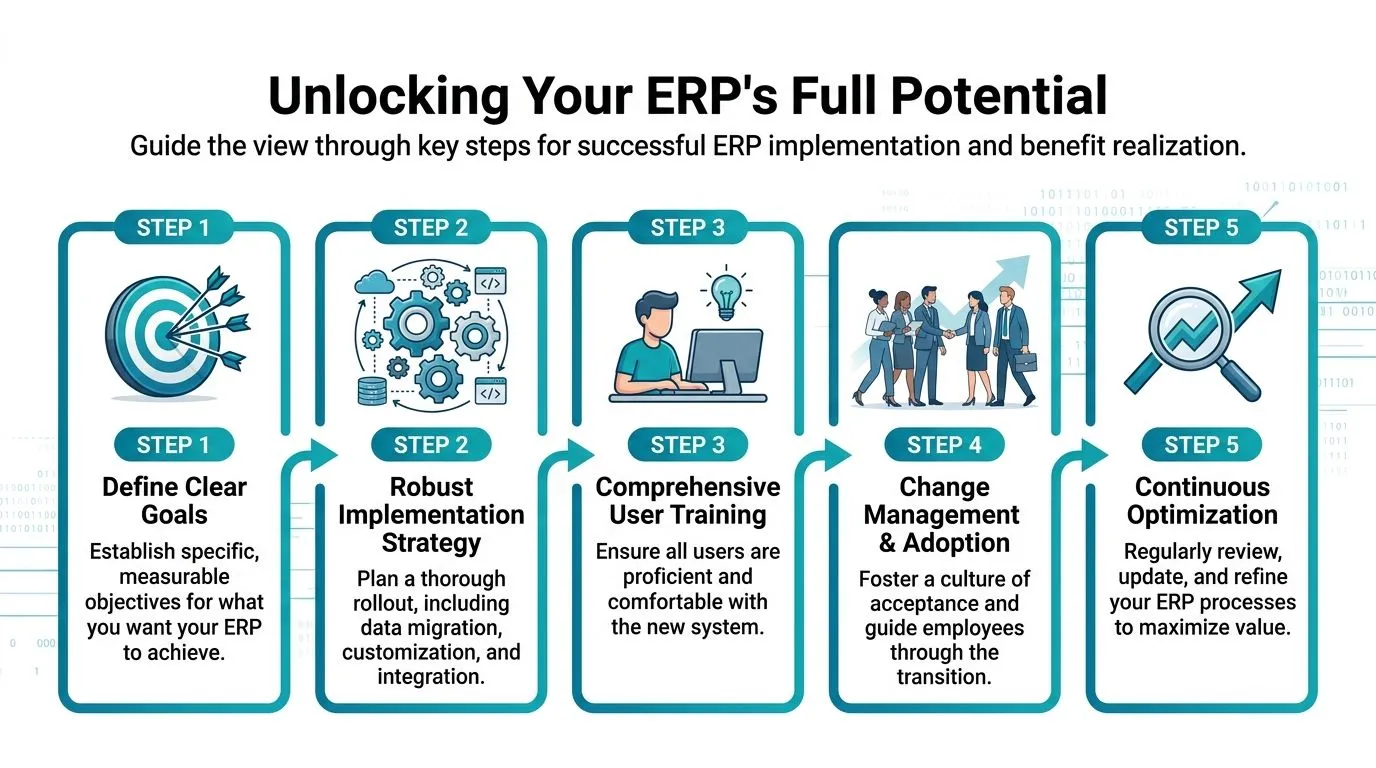
Start with operating goals, not modules
Teams get into trouble when the project starts with a feature list and a vendor demo script. A better starting point is a short set of measurable outcomes the COO and CFO both care about.
For an AU/NZ manufacturer, that might mean shorter close cycles, cleaner job costing, better production visibility, or fewer stockouts on imported components. For a distributor, it is often order accuracy, margin control, warehouse throughput, supplier performance, and clearer landed cost reporting. If those targets are not defined early, configuration becomes a debate about screens instead of business results.
Good projects make the trade-offs explicit. Standardise the process where possible. Customise only where the operating model or compliance requirement demands it.
Architecture matters more in ANZ than many firms expect
Mid-market firms in Australia and New Zealand often carry more complexity than their size suggests. One entity may buy in USD, sell in AUD and NZD, warehouse across multiple sites, and report under different approval and tax rules. Another may run manufacturing, field service, and distribution inside the same group.
That complexity needs design discipline before anyone starts configuring workflows or reports. The data structure, entity model, inventory logic, approval paths, GST treatment, reporting hierarchy, and integrations need to work together. If they do not, the business ends up rebuilding decisions after go-live, usually at the busiest possible time.
This is why platform fit matters. Oracle NetSuite, Epicor Kinetic, and MYOB Acumatica can all work well in the mid-market, but they solve different operational problems in different ways. OneKloudX is one implementation partner in that market, with a Discovery and Solution Design approach across those platforms. The practical value is not branding. It is getting the operating model, process design, and risk controls settled before build starts.
Benefits are realised through decisions, not software alone
ERP programmes usually disappoint for predictable reasons. The chart of accounts is left unresolved. Item masters are inconsistent. Warehouse rules are vague. Approval limits sit in policy documents but not in the system. Teams are told to adopt new processes without seeing how their day changes.
The projects that produce measurable gains do a few things well.
Executive ownership is active
The COO, CFO, and functional leaders need to make decisions quickly and hold the line on process. If ERP is treated as an IT rollout, operations will keep old habits and finance will inherit the clean-up.
Process design happens early
Approval flows, replenishment logic, production transactions, intercompany rules, and exception handling need decisions before testing starts. Delay here usually turns into complexity, rework, and user confusion.
Data cleanup is treated as a business task
Poor item, supplier, customer, BOM, pricing, or chart data will surface fast after launch. This is one of the least glamorous parts of the programme and one of the most important.
Training is built around roles
Warehouse teams need to practise receipting, putaway, picking, transfers, and cycle counts. Buyers need supplier, pricing, and approval scenarios. Finance needs real close, reconciliation, GST, and month-end workflows. Generic demos do not change behaviour.
Tip: If a planner, buyer, or warehouse supervisor cannot explain their new daily process in plain language, the project is not ready for cutover.
What usually goes wrong
A few mistakes show up repeatedly in mid-market ERP programmes.
- Too much customisation too early: support costs rise and upgrades get harder.
- Weak master data governance: reporting, planning, and replenishment all become less reliable.
- No clear owner for post-go-live improvement: issues linger and confidence drops.
- Go-live treated as the finish line: teams stop refining the processes that drive the return.
I have seen businesses spend heavily on implementation, then lose value by tolerating small workarounds for months. One spreadsheet for inventory adjustments becomes three. One exception process in accounts payable becomes the default. That drift is expensive because it slowly breaks trust in the system.
Post-go-live is where value is protected
The first 90 to 180 days matter. This is when a business finds out whether the ERP is becoming the system of record or just another layer over old habits.
The right review cadence is practical. Check user adoption, exception volumes, approval delays, reporting gaps, inventory anomalies, and manual journal patterns. Review where teams are stepping outside the process and why. Some requests will be valid improvements. Others are attempts to recreate the old system inside the new one.
Health checks, managed services, and targeted optimisation work can help here, especially for firms adding new warehouses, entities, channels, or reporting needs. That matters in ANZ businesses because growth often adds complexity faster than internal teams can redesign controls.
A practical sequence for benefit realisation
Keep the programme disciplined.
-
Set a small number of measurable outcomes
Focus on results such as faster close, lower stock variance, better supplier visibility, improved DIFOT, cleaner job costing, or stronger margin reporting. -
Design the operating model before configuration
Lock in ownership, approvals, master data rules, reporting structures, and exception handling early. -
Choose the platform based on fit
NetSuite, Epicor Kinetic, and MYOB Acumatica each suit different mixes of manufacturing, distribution, finance, and multi-entity complexity. -
Test real operating scenarios
Use actual purchase flows, production jobs, warehouse movements, returns, and month-end cases. Do not rely on happy-path demos. -
Train by role and reinforce after go-live
Adoption improves when people see exactly how the new process replaces the old one. -
Review and optimise on a schedule
Quarterly reviews are usually enough to catch drift, tighten controls, and prioritise the next round of improvements.
ERP benefits come from operational redesign, disciplined implementation, and steady post-go-live management. For Australian and New Zealand mid-market firms, that is the difference between another expensive system and a business that runs with better control, better visibility, and fewer avoidable delays.
Your Next Step Towards a Connected Business
The benefits of an ERP are not abstract. They show up when a business stops running on fragmented data and starts operating from one connected model.
That shift matters most in AU/NZ manufacturing and distribution businesses because complexity arrives from several directions at once. Multi-entity structures, cross-border compliance, long supply chains, warehouse coordination, production visibility, and margin pressure all punish delay and poor data discipline.
A well-implemented ERP changes that. It gives finance cleaner control, operations better visibility, procurement sharper discipline, and leadership a more reliable basis for decisions. It also creates the foundation for integration, automation, and ongoing improvement, rather than another patchwork round of bolt-ons and spreadsheets.
The hard truth is that software alone does not create those outcomes. Clear operating goals, sensible platform fit, disciplined implementation, and post-go-live optimisation are what turn capability into value.
If you are weighing Oracle NetSuite, Epicor Kinetic, or MYOB Acumatica, the next step is not another generic demo. It is a serious look at your operating model, your reporting pain points, your process gaps, and the ROI levers that matter to your business.
If your business is dealing with disconnected systems, slow reporting, inventory uncertainty, or multi-entity complexity, a practical next step is to book a discovery conversation with OneKloudX.
A focused ERP readiness assessment can clarify where the biggest gains sit, which platform fits your model, and what it will take to realise the benefits without adding more operational risk.