For a lot of mid-market businesses, Australian payroll feels less like a process and more like a high-wire act without a net. The right Australian payroll software isn’t just about paying people; it’s the system that brings the clarity and compliance you need to stop payroll from being a constant headache and start using it to make smarter decisions. This guide will show you how to find it.
Moving Beyond the Payroll Maze
Running payroll in Australia is a serious business. It’s governed by a tangled web of rules that seem to change every other week. A simple mistake, a miscalculated super contribution or an error in PAYG withholding can result in hefty ATO penalties and pull your team away from actually growing the business.
For many companies on the rise, there’s a clear breaking point. It’s the moment when the spreadsheets, manual workarounds, and basic accounting tools just can’t keep up anymore. In fact, it’s been shown that nearly 60% of Australian companies have made a payroll error in the last two years, and those manual methods are almost always the culprit.
The Pain of Disconnected Systems
When your payroll runs on its own island, separate from the rest of your operations, you create friction everywhere. It’s like trying to build something when all your tools are in different sheds. Data gets manually shuffled between HR, timesheets, and finance, opening the door for mistakes and wasted time at every step.
This drag on your administration causes a domino effect:
- Wasted Hours: Your finance team spends days, not hours, trying to reconcile numbers and tick all the compliance boxes.
- No Real-Time Visibility: You can’t get an accurate, up-to-the-minute view of labour costs. This makes it incredibly difficult to budget for projects or new production runs.
- Compliance Risks: Every time someone has to manually enter data, you’re increasing the odds of falling out of compliance with STP, modern awards, and other legislation.
This guide is here to get you past these roadblocks. We’ll walk you through how modern Australian payroll software, when properly integrated with your core ERP system, can turn payroll from a pure cost centre into an asset that gives you real business intelligence.
A New Path Forward
Instead of just being a tool to push payments through, the right software gives you a single, clear path. It automates the messy calculations, keeps you compliant, and acts as the one source of truth for all your employee-related financial data. We’re going to break down the entire process, from understanding the legal must-haves to figuring out your return on investment.
Hitting the ceiling with your current system is often a sign of success and growth. If you’re starting to wonder whether your accounting solution can keep up, you might find it useful to see if your business has outgrown Xero.
Why Modern Payroll Software Is Business-Critical
The days of treating payroll as a simple, back-office task are well and truly over. In Australia’s notoriously complex regulatory environment, relying on legacy systems or manual spreadsheets isn’t just inefficient, it’s a massive business risk. Modern Australian payroll software is no longer a nice-to-have; it’s a non-negotiable tool for survival and stability.
Think of it this way: running payroll manually is like trying to navigate a busy shipping lane with an old paper map. You might get there eventually, but you’re completely blind to real-time changes, surprise obstacles, and the modern compliance rules that demand pinpoint accuracy. Automation is your GPS, radar, and autopilot all in one, guiding you safely through what can be very treacherous waters.
The Unforgiving Australian Compliance Landscape
Australian businesses are held to a strict and constantly shifting set of rules. Trying to juggle these obligations by hand is a recipe for mistakes and costly penalties. This is where modern payroll software becomes absolutely critical, especially for keeping up with major requirements like Single Touch Payroll.
There are a few key compliance pillars that practically scream for automation:
- Single Touch Payroll (STP) Phase 2: This is about much more than just reporting salaries. It forces the disaggregation of pay components, things like overtime, allowances, and bonuses giving the ATO a far more detailed look at employee earnings with every single pay run.
- PAYG Withholding: Getting Pay As You Go tax calculations right is fundamental. The right software automates this based on the latest tax tables, taking the guesswork and human error out of this vital process.
- State-Based Payroll Tax: With different thresholds and rates in every state and territory, calculating payroll tax liability is a huge headache for any business operating across state lines. Automated systems handle these jurisdictional nuances without breaking a sweat.
Relying on outdated processes creates a dangerous gap in confidence. In 2025, a staggering 35% of Australian organisations reported their payroll was accurate every single pay cycle, with less than half feeling truly confident in their compliance. You can discover more insights about payroll development trends on toxsl.com.
The Next Compliance Wave: Pay Day Super
And if you thought the landscape was demanding now, it’s about to get even tougher. The Federal Government is introducing mandatory Pay Day Superannuation, which is set to kick in on 1 July 2026. This is a fundamental shift in how businesses operate.
The legislation will require you to pay super contributions on the exact same day you pay your employees.
For any business still depending on manual processes or clunky, batch-based legacy systems, this is a ticking time bomb. The familiar quarterly super payment schedule will be gone. This change alone makes real-time, integrated Australian payroll software an absolute necessity, not a luxury.
A system that cannot handle real-time super payments will instantly render a business non-compliant. The cost of inaction is not just potential fines but a complete operational disruption as you scramble to meet new, non-negotiable deadlines.
Automation as a Defensive Strategy
Ultimately, the case for modern payroll software is built on defence. It’s about protecting your business from the very real financial and reputational damage of non-compliance. Look at any payroll process, and you’ll find that manual data entry is the single largest point of failure.
Automation simply eliminates this risk. It creates a single, unbroken flow of data. Information is entered once, maybe through a timesheet, an HR update, or an ERP and it flows through to the final payslip and ATO report without anyone needing to touch it again.
This creates the transparent, auditable trail that every finance leader needs to see. It transforms payroll from a source of constant anxiety into a reliable, automated function you can trust. By moving away from manual methods, you’re not just finding efficiencies; you’re building a fortress of compliance around one of your most critical business functions.
Essential Features of Top-Tier Payroll Solutions
Thinking about Australian payroll as just a calculator and a calendar is a recipe for disaster. A proper Australian payroll software solution is the central nervous system for your entire employee payment and compliance framework.
The real difference between a basic tool and a powerful, integrated solution shows up when things get complicated. It’s not just about paying people on time; it’s about paying them accurately, compliantly, and efficiently, no matter how much your business grows. For businesses in sectors like manufacturing and distribution, these features aren’t just nice-to-haves, they’re fundamental to daily operations.
Core Compliance Automation
At the absolute heart of any worthwhile payroll system is its power to automate compliance. This is the bedrock. It’s what protects your business from costly mistakes and the watchful eye of the ATO. It goes way beyond simple tax calculations to manage the fiddly details of Australian employment law without someone having to check it all manually.
Key automation functions you should expect include:
- Automated Tax and Superannuation: The system must automatically calculate PAYG withholding using the latest ATO tables. It also needs to manage super contributions, ensuring you’re ready for the upcoming Pay Day Super mandate without any last-minute panic.
- Leave Management: It needs to track and calculate every type of leave, from annual and personal days to long service leave and apply the correct accrual rates for your full-time, part-time, and casual staff.
- Single Touch Payroll (STP) Reporting: After every single pay run, the software must automatically generate and lodge a compliant STP report directly with the ATO. This isn’t optional; it’s a core legal duty that should happen seamlessly.
This kind of automation ensures your critical compliance tasks are handled correctly, every time. It frees up your team from risky manual work to focus on tasks that actually add value to the business.
Advanced Workforce and Award Management
For so many Australian businesses, especially in manufacturing, hospitality, or retail, managing complex pay conditions is a huge headache. Modern awards with their jungle of different rates, penalties, and allowances can turn manual payroll into a minefield. A superior payroll system tackles this head-on with a powerful award interpretation engine.
Think of this engine as an expert translator for your industrial agreements. You set up the rules once, and the system automatically applies the correct pay rates for:
- Different times of day or days of the week.
- Overtime hours and complicated shift patterns.
- Special allowances for tools, uniforms, or specific duties.
This is where the system earns its keep in manufacturing and distribution, environments where you have a mix of full-time, part-time, and casual staff working across all hours. When you integrate it with your time and attendance systems, you get a seamless flow of data. Every hour worked is captured and paid correctly according to the award, without human error.
Strategic Reporting and Analytics
Real Australian payroll software does more than just push payments out the door. It gives you the data you need to make smarter business decisions. A basic system might spit out a simple pay run summary, but a top-tier solution delivers deep, customisable reports and analytics dashboards.
This unlocks an instant, accurate picture of your single largest expense, labour. You can generate reports on:
- Labour Costs by Department or Project: Finally understand exactly where your wage dollars are going.
- Overtime and Allowance Trends: Spot patterns in extra costs so you can improve scheduling and tighten your budget.
- Leave Liability: Keep a clear, up-to-date view of your financial obligations for accrued employee leave.
This strategic visibility turns payroll from a back-office chore into a source of genuine business intelligence.
The gap between a simple payroll tool and a solution that’s truly part of your business operations is significant. The table below lays out the key differences.
Basic Payroll Tools vs. Integrated ERP Payroll Solutions
| Feature | Basic Payroll Tool | Integrated ERP Payroll Solution |
|---|---|---|
| Compliance | Manual updates for tax & super | Automated, real-time compliance updates (STP, PAYG, Super) |
| Award Interpretation | Manual calculations or basic templates | Fully automated award engine for complex pay conditions |
| Reporting | Standard, pre-defined pay run summaries | Customisable dashboards with real-time labour cost analysis |
| Integration | Limited or no connection to other systems | Seamless data flow with ERP, HR, and time & attendance |
| Scalability | Struggles with multiple entities or locations | Designed to handle multi-company and multi-state complexity |
As you can see, an integrated solution moves payroll from a standalone task to a strategic function, giving you the control and insight needed to manage your workforce effectively and scale your business with confidence.
For far too long, payroll has been stuck in its own silo, completely cut off from the rest of the business. This is a huge problem. It means the data on your single biggest expense, your people is trapped, unable to inform crucial business decisions.
Integrating your Australian payroll software with your Enterprise Resource Planning (ERP) system smashes down these walls. It stops payroll from being a simple, back-office chore and turns it into a genuine strategic asset.
Think of your ERP as the brain of your business, coordinating everything from finance and inventory to your sales pipeline. In this picture, an integrated payroll system is the heart, pumping vital, real-time data on labour costs to every corner of the organisation. This is the information every other department needs to function effectively.
The Power of a Single Source of Truth
When your payroll and ERP systems don’t talk to each other, your finance team is left to pick up the pieces. They spend hours manually pulling reports from one system, only to painstakingly re-enter the same numbers into the general ledger.
This isn’t just slow and frustrating; it’s a recipe for disaster. We see it all the time. In fact, studies show that a staggering 48% of businesses still depend on manual data entry for their payroll.
An integrated system creates a single, reliable source of truth. Data flows automatically, wiping out the need for duplicate work and guaranteeing everyone is working from the same accurate, up-to-date numbers. This direct connection is what gives you access to real business intelligence, right when you need it.
Here’s a simple view of how an integrated solution supports the core pillars of payroll, moving data effortlessly between compliance, workforce management, and reporting.
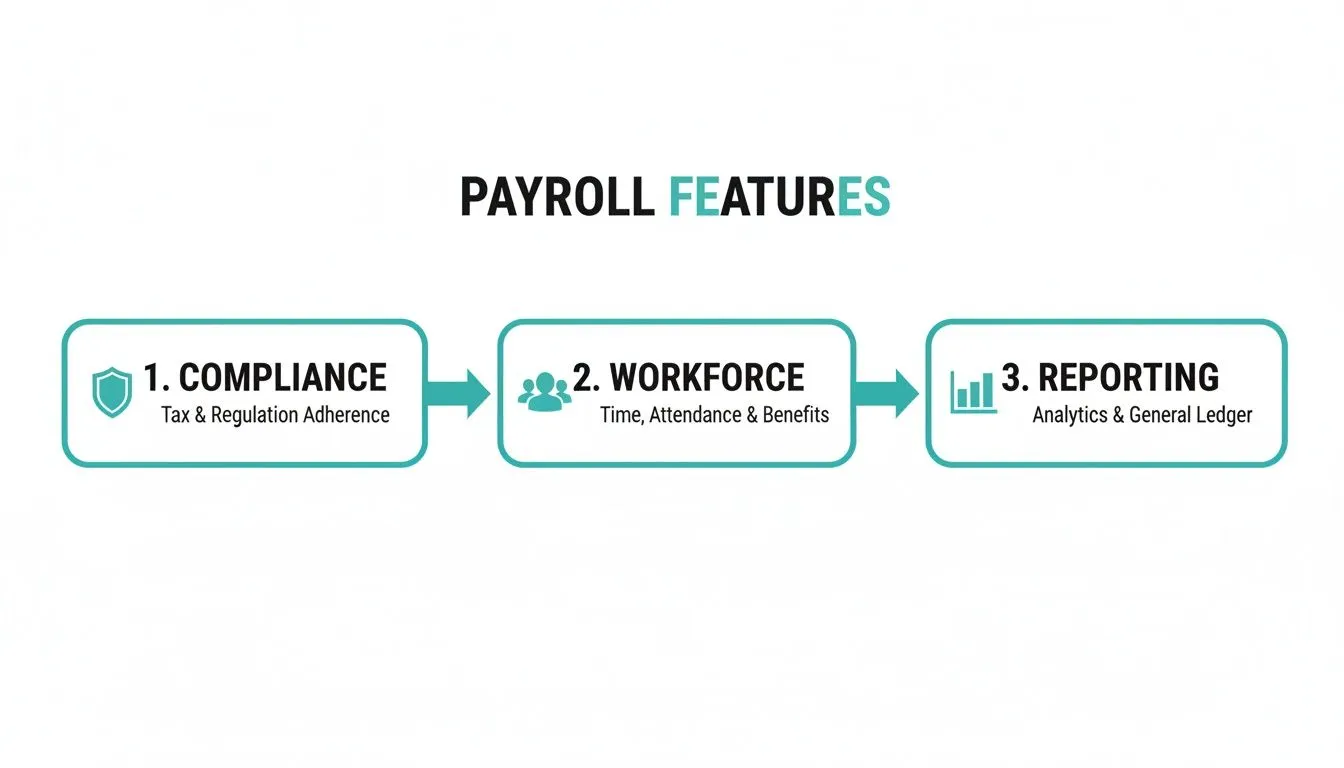
The diagram shows a continuous loop of accurate data, where each part of the process informs the next. This is the foundation of a modern, efficient payroll function.
How Integrated Data Flows Work in Practice
Let’s walk through a real-world example for a mid-market manufacturing business. You can see how data captured on the factory floor flows all the way through to give you a precise, real-time picture of profitability.
- Data Capture: A worker clocks on for their shift using a time and attendance terminal. The system captures their exact start and finish times, along with any breaks.
- Payroll Processing: At the end of the pay cycle, this timesheet data is automatically fed into the Australian payroll software. The platform calculates gross pay, tax, superannuation, and any relevant allowances or overtime, all based on pre-set award rules.
- Financial Posting: Once the pay run is approved, the system does more than just issue payslips. It automatically generates and posts a journal entry directly to the ERP’s general ledger. All wage, tax, and super expenses land in the correct accounts instantly, no manual work needed.
- Job Costing: This is where it gets really powerful. The labour costs are also automatically assigned to the specific production run or project that the employee was working on.
This seamless flow means that just minutes after a pay run is finished, company leaders have an exact, up-to-the-minute view of their true production costs. They’re no longer waiting until the end of the month to find out if a project is making money.
From Cost Centre to Strategic Driver
This level of integration gives you the power to make smarter decisions, faster. A disconnected payroll system only gives you a backward-looking view of what you’ve already spent. An integrated one shows you what’s happening right now, allowing you to get on the front foot.
With this real-time visibility, you can:
- Accurately Cost Projects: Know the precise labour cost for any job, which leads to much more accurate pricing and quotes.
- Track Profitability in Real Time: Keep an eye on project budgets and margins as the work is happening, not weeks later when it’s too late to fix a problem.
- Optimise Your Operations: Easily spot which departments or jobs are racking up the most overtime and adjust schedules or resources to get back on track.
- Improve Budgeting and Forecasting: Use solid historical and real-time labour data to build financial forecasts you can actually trust.
By connecting payroll to the core of your business, you turn it into a source of invaluable insight. If you want to dive deeper into how integrated solutions help with compliance, you can read also about avoiding payroll compliance penalties in our detailed guide. This approach ensures every decision you make is backed by solid, real-time data.
Your Checklist for Choosing a Payroll Partner
Picking new Australian payroll software isn’t like buying a new piece of tech off the shelf. You’re not just buying a product; you’re entering a long-term partnership. The right partner will be your guide through a complex change, guarantee your compliance is solid from the get-go, and deliver a system that can actually grow with you.
You have to look past the flashy sales demo and the long list of features. It’s about digging into their real-world experience, their process, and how committed they are to local support. This checklist will help you ask the tough questions that get to the heart of what a potential partner is really like, so you can choose one who reduces risk and brings genuine, long-term value.
The HR payroll software market is certainly booming. It’s set to jump from $38.82 billion in 2025 to $42.78 billion in 2026, largely because businesses are moving to the cloud and need to keep up with compliance. You can read the full research about these market trends to see the full picture. More options are great, but it also means you need a rock-solid evaluation plan.
Evaluating Scalability and Industry Fit
Your business isn’t standing still, so why would you choose a payroll system that is? The first thing you need to test is how well the software can scale. A system that’s fine for 50 employees might completely fall over at 150.
Ask potential vendors some direct questions about growth:
- How does your system cope with multiple business entities or payroll across different states?
- What’s the real process for adding new employees, new business units, or even a whole new company after an acquisition?
- Can the system handle a much higher volume of transactions without slowing down?
Beyond just getting bigger, the software has to be right for your industry. For a business in manufacturing or distribution, a generic, one-size-fits-all payroll solution is a recipe for disaster. You need a system that has proven it can handle things like complex award interpretation, specific shift allowances, and the unique overtime rules common in your sector. Ask to see case studies or talk to references from businesses that have the same operational headaches as you.
Assessing Integration and Implementation Expertise
A payroll system that can’t talk to your ERP is just creating more work, not less. Proper integration means your data flows automatically between payroll, finance, and operations. This kills off manual data entry, cuts down on costly mistakes, and gives you a single source of truth for critical numbers like labour costs.
The implementation is the real test of any partnership. A bad implementation can completely derail your project, blow your budget, and put your business at serious risk. You’re not just buying software; you’re buying their implementation methodology.
Get right into the details of their process:
- Can you show me your documented implementation methodology? You’re looking for a structured, step-by-step approach that covers planning, data migration, and thorough testing.
- How do you handle migrating our data? Ask them about their game plan for cleaning, validating, and moving years of sensitive payroll history.
- Do you run parallel pay runs before go-live? This is non-negotiable. It’s the only way to be 100% sure the new system is accurate before you flip the switch.
A partner’s compliance track record is another massive red flag or a green light. You need to be confident they stay on top of legislative changes and ensure their clients are always prepared for things like Pay Day Super. As you build out your criteria, a guide on how to choose the best payroll service for your needs can provide some great foundational principles.
Choosing the Right Local Partner
Finally, never underestimate the value of having local experts in your corner. An offshore support desk that doesn’t live and breathe Australian compliance is a huge liability. A local partner gives you access to people who are in your time zone, understand your specific regulatory environment, and can give you clear answers when you need them most.
When you’re making that final call, think about the tools they use and their experience with businesses of your size and complexity. For instance, comparing platforms is a standard part of the process. To get a better sense of how different solutions stack up for growing companies, you can check out our guide on NetSuite vs Xero vs MYOB. Doing your homework here ensures you pick not just a platform, but a partner who can truly support your business for the long haul.
Calculating the True ROI of Modern Payroll Software
So, how do you get the new Australian payroll software investment across the line with your CFO? The conversation almost always gets stuck on the monthly subscription fee, but that’s a tiny piece of the financial puzzle. To build a business case that actually works, you have to look past the price tag and put a number on the huge, often invisible, costs of sticking with your old system.
A proper Return on Investment (ROI) calculation is a balancing act. On one side, you have the total cost of ownership; on the other, you have the very real savings and strategic wins you get from a modern, integrated platform. It’s only when you weigh both that the financial sense of making the change becomes undeniable.
Deconstructing the Total Cost of Ownership
First, let’s get real about the investment. It’s always more than just the software license. A full cost breakdown is the only way to get the transparency you need for an accurate ROI forecast.
Your total cost of ownership will include:
- Software Subscription Fees: The predictable, recurring cost to use the platform.
- Implementation and Setup: The one-off cost to have an implementation partner configure the system, migrate your data, and lock in compliance.
- Data Migration: The specific work needed to move historical employee data, leave balances, and year-to-date figures securely and without errors.
- Training and Change Management: The investment in getting your team up to speed and comfortable with the new way of working.
While these costs are real, a skilled implementation partner can drastically shorten the timeline and cut down the resources you need. A faster, safer implementation means you start seeing a return on this investment much, much sooner.
Quantifying the Hidden Costs You Eliminate
This is where the business case for new payroll software really comes to life. The slow, risky, and manual processes of your legacy system are bleeding money every single day. By moving to modern Australian payroll software, you turn these hidden costs into measurable savings.
There are three key areas to calculate these savings:
- Reduced Administrative Hours: Start tracking the time your payroll and finance teams spend on manual data entry, double-checking spreadsheets, reconciling reports, and fixing inevitable errors. Automating these jobs frees up dozens, if not hundreds, of hours a year.
- Elimination of Payroll Errors: Even tiny mistakes are expensive. A single underpayment can trigger hours of admin work to fix, and good luck clawing back an overpayment. A system with built-in award interpretation and compliance rules simply stops these costly errors from happening.
- Strategic Value of Integrated Data: When payroll data flows straight into your ERP, you get a real-time view of your single biggest expense. This makes for accurate job costing, smarter project budgeting, and operational decisions that directly boost your bottom line.
The real cost of an employee in Australia extends far beyond their base salary. Calculating this “fully loaded” cost is essential for understanding the true impact of any efficiency gains you make.
By 2026, benchmarks show that employee on-costs can push the total expense to 40-45% above base salary once you factor in superannuation, leave, and payroll tax. These costs hit growing businesses the hardest, which is why automating even small parts of the process delivers such big savings. You can see more about the market dynamics in the Australian software payroll market share on adthena.com.
When you save an hour of an employee’s time, you’re not just saving their hourly rate; you’re saving that rate plus all the associated on-costs. This is what massively amplifies your ROI.
Got Questions? We’ve Got Answers.
When you’re thinking about a new payroll system, a few key questions always come up. It’s completely normal. Here are the straight answers to the most common queries we hear from businesses just like yours.
How Long Does an Implementation Actually Take?
Look, anyone who gives you a single number without knowing your business isn’t being straight with you. For a typical mid-market business, you’re generally looking at a 3 to 6 month journey from the first design workshop to going live.
The timeline really depends on a few things: the complexity of your business, how clean your existing data is, and how many different entities you’re bringing into the new system. A partner with a solid, architecture-led methodology can make a huge difference here. A structured plan for migrating data, configuring the system, and properly testing everything doesn’t just cut down the timeline it de-risks the entire project and gets you a return on your investment faster.
Can New Software Really Handle Our Modern Awards?
Yes, absolutely. In fact, if it can’t, you shouldn’t even be considering it. This is a core, non-negotiable function for any top-tier Australian payroll software worth its salt. The best systems come with powerful, built-in award interpreters designed to automate the heavy lifting.
These engines are designed to get it right every time, automatically applying the correct rates for:
- Specific times of day or tricky penalty rates
- Complex overtime rules and different shift patterns
- Industry-specific allowances and other entitlements
When you’re looking at different software options, make sure you dig deep and confirm it can handle the specific modern awards that apply to your team.
The biggest implementation risk is almost always a messy data migration. Getting historical employee data, leave balances, and year-to-date figures wrong during the transfer can create a massive headache of compliance and payment issues later on.
The only way to really get around this is to work with an implementation partner who has a bulletproof data migration strategy. This has to include a detailed validation process and running parallel pay runs before you flick the final switch. It’s the only way to ensure 100% accuracy and give your team total confidence from day one.
A successful ERP and payroll implementation hinges on partnering with a team that understands the unique challenges of your industry. At OneKloudX, we use our architecture-led methodology to deliver fast, safe, and compliant solutions that grow right alongside your business. Find out how we can help you by visiting https://www.onekloudx.com.au.