A change management consultant is a specialist who gets your people ready, willing, and able to embrace a major business transformation, like a new ERP system. Their entire focus is on the human side of the change, making sure your team understands, adopts, and actually uses the new technology to deliver real business value.
Why Your ERP Project Needs a Change Management Consultant
Putting in a new ERP is so much more than just a software upgrade; it’s a fundamental rewiring of your company’s operational DNA. Think of your new ERP as the business’s central nervous system. A change management consultant is the specialist who ensures every part of the organisation, from the warehouse floor to the C-suite connects to this new system without painful disruption.
Too many expensive ERP projects fail to deliver on their promise. It’s rarely the software’s fault. The failure almost always comes down to people. This is where a consultant becomes your project’s insurance policy, actively managing the inevitable risks that come with asking people to change how they work. You can learn more about the pitfalls of sticking with outdated platforms by understanding the six key risks of legacy ERP systems.
Protecting Your Investment by Managing Your People
The reality for many businesses today is a state of constant flux. Change saturation is a real problem across Australian organisations, with a staggering 73% near, at, or beyond their capacity to handle more change. This makes a dedicated change expert essential for any mid-market business tackling an ERP upgrade.
Without a structured plan for your people, you’re almost guaranteed to face:
- Widespread employee resistance: Staff clinging to old, familiar spreadsheets and inefficient workarounds out of fear or comfort.
- Low user adoption: Your expensive new system sits underutilised, failing to deliver the data and efficiencies you paid for.
- A collapse in productivity: Teams stumble through the new processes, causing a performance dip that can drag on for months.
A change management consultant is your frontline defence against these issues. They are the bridge between your technical project team and the employees who have to live with the new system every single day.
To see the stark difference a specialist makes, consider the common scenarios that play out in a typical ERP project.
ERP Project Risks With vs Without a Change Management Consultant
| Project Aspect | Without Change Management | With a Change Management Consultant |
|---|---|---|
| User Adoption | Staff resist using the new ERP, leading to low ROI and inconsistent data. | Users are prepared, trained, and supported, leading to high adoption and immediate value. |
| Productivity | A significant, prolonged dip in productivity occurs as teams struggle to adapt. | The initial productivity dip is minimised and quickly followed by performance gains. |
| Project ROI | The business case is never fully realised; benefits remain theoretical. | The project achieves its intended financial and operational goals. |
| Employee Morale | Frustration, confusion, and anxiety lead to low morale and potential staff turnover. | Employees feel heard, supported, and confident, leading to positive engagement. |
| Go-Live | The “go-live” date is often chaotic, with widespread issues and support desk overload. | Go-live is a well-managed, smooth transition with proactive support structures in place. |
The table makes it clear: neglecting the human element is a direct threat to your project’s success.
A consultant’s primary goal is to turn resistance into readiness. They don’t just manage a process; they guide your people through a personal and professional transition, ensuring the project’s business case is fully realised.
To truly appreciate the value a change management consultant brings to your ERP implementation, it’s helpful to review some impactful real-world examples of change management.
For CFOs and COOs in the ANZ mid-market, the conclusion is simple. Managing the people side of change isn’t a “nice-to-have.” It is an essential, non-negotiable activity for protecting your significant technology investment and achieving the strategic goals that prompted it in the first place.
What a Change Management Consultant Actually Does
So, what does a change management consultant really do? In the middle of a complex ERP project, like a move to Oracle NetSuite or Epicor Kinetic, their role has nothing to do with the technology itself. Their entire focus is on your people.
They are the crucial bridge connecting the project team building the system and the people on the floor in finance, operations, and the warehouse who have to live with it every day. To get a real sense of their role, it helps to understand the fundamentals of Change Management as a formal discipline. The consultant’s job is to apply those principles to make sure your investment actually pays off.
This journey from initial resistance to full team adoption is something we see in almost every project.
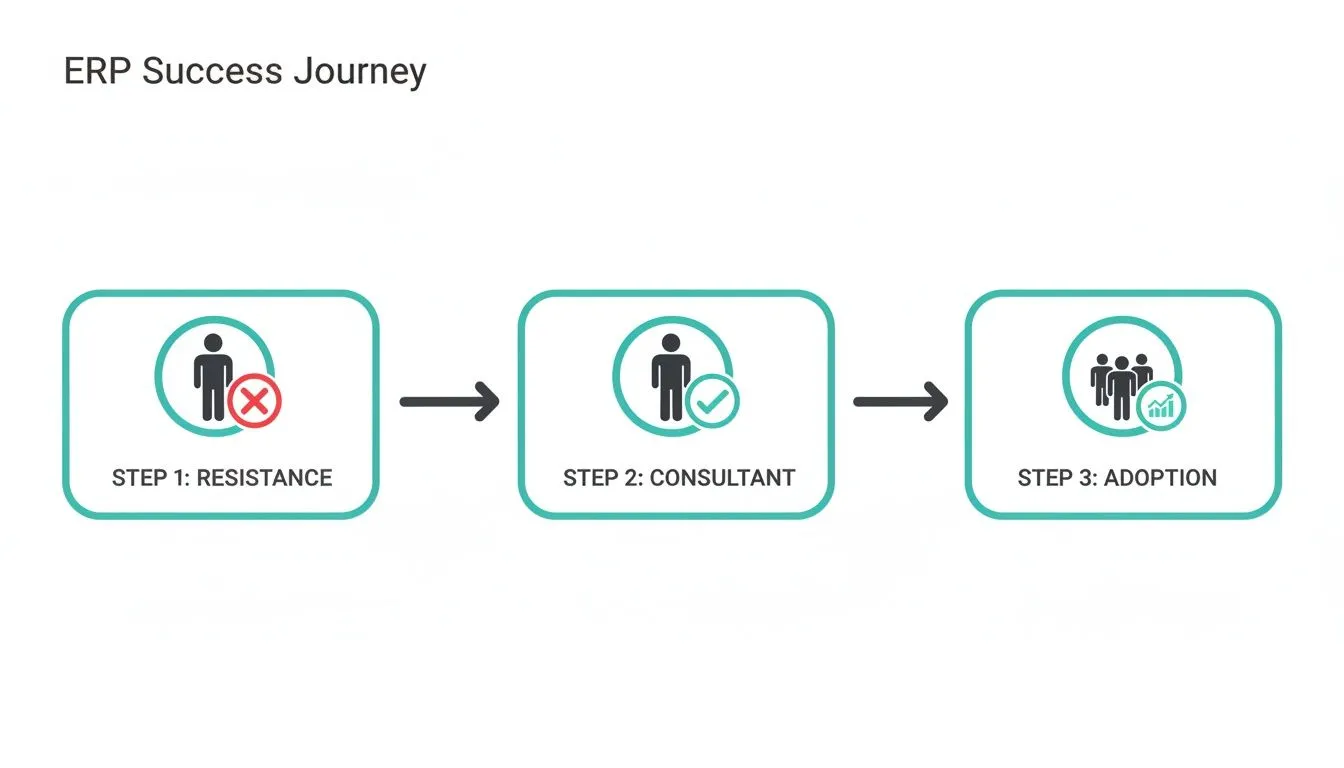
As you can see, the consultant is the catalyst. They’re the ones who actively guide your teams from a place of opposition to one of productive, confident use of the new system.
From Strategy to On-the-Ground Execution
A good change consultant gets involved long before anyone clicks a button in the new ERP. They work across the entire project, starting with high-level strategy and staying on to provide hands-on support.
This isn’t about sending a few rah-rah emails and hoping for the best. Their work is tangible, measurable, and tied directly to hitting your project goals.
A consultant’s real value is their ability to translate a complex technical project into simple, compelling reasons for change that make sense to every single employee. They answer the critical “What’s in it for me?” question before it grows into a source of resistance.
The need for these specialist skills is growing fast. The Australia Management Consulting Services Market is on track to hit USD 12.66 billion, partly because businesses realise how critical the ‘people’ part of a project is. We’re also seeing a trend where organisations are moving away from the big, slow consulting firms and toward more agile specialists who can deliver faster, safer ERP implementations.
Core Activities and Deliverables
So, what do you actually get for your investment? A change consultant’s work isn’t abstract theory; it results in concrete plans and actions that steer the human side of your ERP implementation.
Typical deliverables you should expect include:
- Stakeholder Analysis and Mapping: First, they figure out who’s who. They identify key people and groups across the business, map out their influence and potential concerns, and then build a specific plan to get each of them on board.
- Communication Plan: This is a detailed roadmap for communication. It outlines what messages go to which people (from the C-suite to the warehouse floor) and when, ensuring nobody is left in the dark.
- Resistance Management Plan: They proactively hunt for the likely sources of pushback, fear of job changes, worries about losing familiar routines, or anxiety about new tech, and create solid strategies to address those fears before they can derail the project. You can find more practical strategies in our guide on how to manage internal change from resistance to readiness.
- Targeted Training Strategy: A consultant works with the technical team to ensure training goes beyond just “how to click this button.” The focus is on real-world job roles and business processes, so your team builds genuine competence and confidence.
- Sponsorship and Leadership Coaching: This is a big one. They actively coach your senior leaders and line managers on how to lead the charge, demonstrate the right behaviours, and consistently reinforce the new way of working.
In short, a change management consultant takes ownership of making sure your people aren’t just compliant, but are genuinely committed to the new system’s success. They build the organisational readiness you need to actually achieve the business case you signed off on.
The Right Time to Engage Your Consultant
When it comes to a major new ERP system, timing is everything. A common and incredibly costly mistake is treating a change management consultant like a firefighter, someone you call only when the flames of employee resistance and project delays are already raging.
This reactive approach is a recipe for budget blowouts and a failed implementation.
The single best time to engage a change management consultant is at the very beginning. Ideally, this should happen during the Discovery and Solution Design phase of your ERP project. Bringing them in this early completely changes their role from a reactive problem-solver to a proactive architect of success. They can embed user-centric thinking into the project from day one.
This way, the consultant works shoulder-to-shoulder with your technical team and key business leaders. They make sure the future system is designed not just to meet a technical spec sheet, but to align with how your people actually get their jobs done. This early involvement helps you get ahead of change impacts long before they become project-stopping roadblocks.
The Cost of Waiting Too Long
Delaying bringing in a change management specialist is often disguised as a cost-saving measure. In reality, it’s one of the most expensive gambles you can take with your ERP investment. Waiting until the system is built and you’re nearing “go-live” almost always creates a cascade of predictable problems.
Engaging a consultant late in the project is like hiring an architect after the foundation has been poured and the walls are already up. They can suggest cosmetic fixes, but they can’t alter the fundamental structure to prevent it from collapsing.
When a consultant is brought in late, they are forced into damage control mode. This is far less effective and significantly more expensive than planning for adoption from the start.
Common consequences of late engagement include:
- Deep-Seated Resistance: By the time problems surface, employee opinions have hardened. Overcoming this entrenched negativity requires much more effort than guiding positive adoption from the start.
- Reactive Firefighting: The project team gets bogged down putting out user-related fires and managing conflict instead of focusing on a smooth rollout. This creates stress, burns out your team, and distracts everyone from the project’s real goals.
- Costly Rework: The solution may have been designed without fully understanding user workflows. This often leads to expensive and time-consuming system modifications after the fact, just to make it usable.
- Eroded Trust: A chaotic rollout damages the credibility of leadership. When employees feel ignored, they become 37% more likely to resist organisational change simply because they don’t trust the process.
Triggers That Signal It’s Time to Call a Consultant
While getting help early is always the best move, certain project characteristics make it non-negotiable. If your ERP transformation involves any of the following, take it as a clear sign to bring a change management consultant on board immediately.
Key Triggers for Engagement:
- Replacing Multiple Legacy Systems: Moving from several disconnected, “heritage” systems to a single ERP is a massive cultural and procedural shock. It impacts numerous departments, each with its own deeply ingrained way of working.
- Overhauling Core Business Processes: If your project aims to fundamentally change how you manage inventory, close the books, or process orders, you’re not just changing software, you are changing people’s jobs.
- A History of Failed Projects: If your organisation has a poor track record with past change initiatives, it’s a red flag. It shows your internal capacity for managing change is low, and you need an external expert to help break the cycle.
- Significant Workforce Impact: Any project that will alter job roles, team structures, or required skills needs professional change management to navigate the human side of the transition sensitively and effectively.
By recognising these triggers and engaging a change management consultant at the outset, you aren’t adding a cost. You are making a strategic investment to protect your entire ERP budget and ensure you actually get the business outcomes you’re paying for.
How to Select the Right Change Management Consultant

Finding the right change management consultant isn’t like hiring a temp for a project. It’s more like bringing on a strategic business partner. Get this choice right, and your ERP adoption is smooth and effective. Get it wrong, and you’re looking at chaos, budget blowouts, and a system nobody wants to use.
For manufacturing and distribution leaders across Australia and New Zealand, the selection process has to be sharp. You need to look past a generic resume and find a true fit for your industry, your company culture, and your specific project goals.
The Australian management consulting landscape is certainly crowded projected to hit 98,840 businesses by 2026. This reflects a huge demand for specialised skills, particularly for complex ERP transformations in mid-market companies like those supported by partners such as OneKloudX. To cut through the noise, you need to know exactly what you’re looking for. You can read more about the trends in Australia’s management consulting sector at IBISWorld.com.
Key Selection Criteria for Your ANZ Change Management Consultant
This scorecard is designed to help you methodically evaluate and compare potential change management consultants. It focuses on the competencies that matter most for an ERP project in the ANZ manufacturing and distribution sectors.
| Evaluation Criterion | What to Look For | Red Flags to Avoid |
|---|---|---|
| Industry Experience | Deep, hands-on experience in ANZ manufacturing or distribution. They know the language of your warehouse team and the pressures on your finance department. | A generalist background. Someone who has only managed HR policy changes or IT projects in unrelated sectors like banking or government. |
| ERP Project Track Record | Proven success with mid-market ERPs like NetSuite or Epicor. Can show specific examples of managing the “people side” of a system implementation. | Vague talk about “digital transformation” without concrete examples. No experience with the specific challenges of go-live, data migration, and user adoption. |
| Practical, Not Theoretical | Focuses on actionable plans, clear communication, and measurable outcomes. They talk about tools and tactics, not just abstract change models. | Relies heavily on academic jargon and complex methodologies without explaining how they apply to your business. |
| Cultural Fit & Approach | Listens intently, asks smart questions, and shows genuine empathy for your team. A collaborative partner who wants to build your internal skills. | A “know-it-all” attitude. Presents a rigid, one-size-fits-all solution before fully understanding your unique challenges and culture. |
| Stakeholder Management Skills | Can provide clear examples of winning over resistant managers or union reps. Comfortable navigating tough conversations at all levels of the business. | Avoids discussing conflict or difficult stakeholders. Suggests that a good communication plan is all you need to get buy-in. |
Using a structured approach like this ensures you’re not just hiring on a gut feeling. It forces a focus on the practical skills and experience that directly contribute to a successful ERP implementation, weeding out the theorists from the true practitioners.
Go Beyond Theory with Practical Questions
Once you’ve shortlisted candidates, the interview is where you separate the real experts from the talkers. Your questions must test their practical skills and force them to move beyond buzzwords. You need to hear how they operate under pressure and handle the messy reality of a major business change.
Here are a few critical questions to get you started:
- “Tell me about a time you had to deal with a powerful, resistant stakeholder. What was your strategy, and what was the outcome?”
- “How do you measure the success of your change activities? Give us specific examples of KPIs you have used on past ERP projects.”
- “Our business is a lean, mid-market operation. How would you adapt your approach from a large corporate environment to fit our pace and budget?”
- “Walk us through how you’d build a communication plan for an ERP go-live that needs to reach everyone from the CFO to our forklift drivers on the night shift.”
Their answers will tell you everything you need to know about their problem-solving style, their communication skills, and whether they have the grit to handle the inevitable tough conversations.
Evaluate Cultural Fit and Partnership Potential
Finally, remember this person will be deeply embedded in your organisation. They’ll be coaching your leaders, working alongside your frontline staff, and acting as a trusted advisor to the entire project team. Because of this, personality and cultural fit are just as important as their professional credentials.
Look for a consultant who listens more than they talk. Someone who asks insightful questions about your business and shows real empathy for the people who will feel the impact of this change the most. This isn’t a role for an outsider who dictates from a distance; it requires someone who can build trust and rapport from the boardroom to the factory floor.
The right partner is focused on building your internal capability, not creating long-term dependency. They should be passionate about equipping your own people with the skills to lead change long after the ERP project is complete.
Measuring the Real ROI of Change Management
How do you justify the cost of a change management consultant to a CFO who lives and breathes the bottom line? You have to skip the talk about “soft” benefits like morale and get straight to the measurable return on investment (ROI).
It’s actually a pretty simple conversation to have.
The ROI of good change management isn’t some abstract concept. It’s a direct measure of how well your ERP project delivers on its original promises. If you bought the system to cut costs and work faster, the ROI is measured by how much cost you actually cut and how much faster you’re now working. A change consultant’s value is judged on how much they accelerate and maximise that result.
From People Metrics to Business Outcomes
To really prove the value, you need to draw a straight line from the change management work to the hard business numbers. This isn’t about tracking how people feel; it’s about measuring the specific actions that create financial results.
Think of it this way: your sales team tracks the number of calls they make (a leading indicator) because they know it directly impacts the number of deals they close (a lagging indicator). We do the exact same thing for user adoption.
Key Performance Indicators to Track
Your consultant will help you measure where you are before the new ERP goes live. By establishing this baseline, you can track the same metrics afterwards to create a clear before-and-after picture of the impact. The numbers make it impossible to deny.
1. People-Focused KPIs (Leading Indicators)
These numbers track how well your people are actually adopting and using the new system. They are the earliest warning signs of success or failure.
- User Adoption Rates: We track the percentage of staff logging in daily or weekly. We also monitor transaction volumes to see if the system is being used properly, not just turned on.
- Proficiency Scores: A classic one is measuring the drop in data entry errors over time. A lower error rate means your people are getting the hang of it and the data in your ERP is becoming more reliable.
- Speed to Competency: How long does it take for someone to do their key tasks without calling the help desk or grabbing a supervisor? The faster they get up to speed, the quicker the project pays for itself.
2. Business-Focused KPIs (Lagging Indicators)
These are the bottom-line results your board and CFO are waiting for. The people-focused KPIs above are what drive these critical business outcomes.
The real job of a change management consultant is to close the gap between your technology spend and its intended business value. Organisations with strong change management are 2.6 times more likely to see significant revenue growth than those without.
When people adopt the new system and get good at using it, the impact shows up directly in your financial and operational metrics.
- Improved Inventory Turns: When warehouse staff use the system properly for receiving, picking, and cycle counting, your inventory data becomes accurate. This leads to much smarter stock management and higher turnover.
- Faster Financial Close Cycles: As your finance team gets proficient, they stop doing manual reconciliations and wrestling with spreadsheets. Data flows smoothly, and the time it takes to close the books each month drops dramatically.
- Reduced Operational Costs: High user adoption means you can finally turn off old parallel systems and stop relying on outdated spreadsheets both of which cost a fortune to maintain. It also cuts the ongoing costs of support tickets and fixing data errors caused by untrained users.
Ultimately, the ROI isn’t an abstract number on a consultant’s report. It’s the measurable financial impact of your employees using the new ERP to do their jobs better, faster, and more effectively. Your change management consultant is simply the catalyst who makes sure that happens.
Your ERP Change Readiness Checklist

Successfully delivering an ERP transformation is about much more than the technology; it’s about your organisation’s readiness to embrace it. Think of this checklist as a practical health check for ANZ business leaders to gauge how prepared your company really is.
It’s designed to help you build a solid foundation for change before a single line of code is written. Waiting for problems to show up is a recipe for failure. This checklist helps you get on the front foot, focusing on the people and processes that will make or break your project.
Foundational Strategy and Vision
Before you even look at software, you need to be rock-solid on your ‘why’. A clear, compelling vision is the bedrock of any successful change.
- Define a Clear Business Case: Can you explain the top 3-5 business problems this ERP will fix in plain English? Go beyond vague goals like “upgrading our tech” and get specific. Think: “reduce inventory holding costs by 15%” or “cut our financial close process by three days.”
- Establish Success Metrics: What does a win actually look like? This isn’t just about financial KPIs like reduced operational costs. It must also include people-focused metrics, like user adoption rates and team proficiency scores.
- Secure Executive Alignment: Is every single person on your leadership team genuinely behind this? They can’t just sign the cheque; they need to be prepared to champion the change, consistently and visibly.
People and Leadership Readiness
Your people are your biggest asset, but they’re also the biggest variable in this equation. You absolutely must gauge their readiness and prepare your leaders to guide them.
- Assess Change Capacity: How much change are your teams already juggling? With 73% of employees reporting they feel overwhelmed by constant workplace change, you have to understand their current level of change fatigue.
- Identify Your Champions: Who are the real influencers in your business? These aren’t always the people with fancy titles. Find those informal leaders on the floor and in the office, and get them involved early.
- Coach Your Leaders: Do your line managers actually have the skills to lead people through uncertainty? They need coaching on how to communicate the vision, manage resistance, and handle the human side of the transition.
The most successful change projects are the ones that involve employees from the start, set clear goals, and communicate relentlessly. A change management consultant formalises this, turning good intentions into a structured, executable plan.
Planning and Resource Allocation
Proper planning prevents poor performance. This means giving the people side of change the same rigour and attention you give the technical project plan. You can learn more by reviewing the key steps to prepare your organisation for a successful ERP implementation.
- Map Your Stakeholders: Have you done a thorough analysis of which departments, teams, and individuals will be most affected by the new system? Who wins, who loses, who needs the most support?
- Budget for Change Management: Is there a specific budget allocated to change management activities? It needs to be a dedicated line item, not an afterthought scraped from leftover funds. This must cover communication, training, and specialist support.
- Establish Communication Channels: Do you have a plan for genuine two-way communication? This isn’t just about broadcasting what’s happening. You need clear channels for people to ask tough questions, voice concerns, and give honest feedback.
- Engage a Change Partner: Looking at this checklist, where are the gaps? If you’ve identified significant weak spots in your readiness, bringing in an external change management consultant early is a critical next step.
By honestly working through this checklist, you shift your mindset. It stops being a pure technology project and becomes what it should be: a true business transformation. This is how you dramatically increase your chances of getting the full return on your ERP investment.
Here are some of the questions we hear most often from CFOs and COOs across the ANZ mid-market when they’re weighing up the need for a change management consultant.
Can Our Internal Project Manager Just Handle the Change Management?
It’s a fair question, but it’s based on a common misunderstanding. These are two very different, though complementary, roles.
Your project manager’s world revolves around the technical delivery. They live and breathe timelines, budgets, and project scope, making sure the system gets built and switched on. Their focus is the solution.
A change management consultant, on the other hand, is focused entirely on the people. Their job is to manage adoption, ensure everyone can use the new system well, and keep communication flowing. Relying on a project manager for this almost guarantees the people side gets left behind. When that happens, you get low user adoption and a frustrating failure to see the project’s true benefits, all because nobody was dedicated to managing resistance and building genuine buy-in.
Isn’t a Change Management Consultant Just for Big Corporates?
Not at all. In fact, their impact can be even greater in a mid-market business. With leaner teams, the successful adoption by every single employee is proportionally more critical to the project’s success.
Unlike in a large enterprise with layers of bureaucracy, a consultant in a mid-market company can work directly with your teams on the factory floor or in the finance department. This hands-on approach makes for a much smoother transition that’s tailored to your company culture. The principles of managing change are universal; the execution is simply scaled to fit.
The real issue isn’t your company’s size; it’s the magnitude of the change. Replacing your core business system touches everyone. That human transition needs to be professionally managed, regardless of headcount.
What’s the Difference Between Change Management and Training?
This is a crucial distinction. Training teaches people the ‘how’ how to log in, how to process an invoice, how to run a stocktake report. It’s a nuts-and-bolts activity focused on the mechanics of the system.
Change management addresses the ‘why’. It’s the entire strategic framework that makes sure the training actually sticks. It covers:
- Communication: Explaining why the change is happening, why it matters, and what’s in it for each person and team.
- Stakeholder Engagement: Actively working with leaders and influential staff to build support and tackle concerns head-on.
- Resistance Management: Proactively finding and resolving the reasons people might push back against the new system.
- Reinforcement: Building mechanisms to ensure new ways of working become permanent habits, long after the training sessions end.
Put simply, training is just one activity within the broader, more strategic process of change management. Without that bigger picture, your training investment is unlikely to pay off because people won’t be motivated to apply what they’ve learned.
At OneKloudX, we integrate change management into our ERP implementation methodology to ensure your technology investment delivers real business value. Learn more about how we partner with ANZ businesses for successful transformations.