
An ERP system migration is the process of moving from one Enterprise Resource Planning system to another; a critical, high-stakes project for any business looking to get out from under outdated technology. Let’s be clear: this is far more than a simple technical upgrade. It’s a strategic overhaul designed to sharpen operational agility, deliver genuine data visibility, and secure a competitive footing in a tough market.
For most ambitious Australian and New Zealand businesses, this means one thing: finally ditching restrictive, on-premise systems for a flexible, modern cloud platform.
Why ANZ Businesses Are Moving to Modern ERP Systems
The business landscape across Australia and New Zealand is unforgiving. Relying on a clunky legacy system or a patchwork of disconnected spreadsheets is no longer a viable strategy for growth. It’s a recipe for disaster.
These outdated tools inevitably create information silos, hobbling everything from accurate financial reporting across multiple entities to efficient stock management in a busy warehouse.
An experienced partner like OneKloudX sees this play out constantly. A CFO at a growing Australian distribution company spends days trying to consolidate financials from different states, only to work with stale data that’s already obsolete. A COO at a Kiwi manufacturing firm struggles with zero visibility into real-time stock levels, leading to production delays and broken promises to customers. These aren’t just hypotheticals; they are the daily, growth-stifling realities for too many organisations.
The Shift to Cloud-Powered Operations
Modern cloud ERP platforms like Oracle NetSuite, Epicor Kinetic, and MYOB Acumatica are built to solve these exact problems. They deliver a single source of truth, giving decision-makers the real-time data needed to act with confidence. This isn’t a trend; it’s a fundamental shift in how successful businesses now operate.
The data backs this up. A 2023 Gartner study found that cloud-native solutions now account for over 85% of new mid-market ERP implementations in the ANZ region. This wave is fuelled by our high internet penetration, empowering leaders with mobile access to oversee everything from procurement to inventory control, wherever they are. With the market projected to hit AUD 11.94 billion by 2035, the move to cloud ERP is now a question of when, not if.
Solving Real-World Business Challenges
At its core, an ERP system migration is a direct response to tangible business pain. By moving to a modern platform, organisations can finally address specific operational bottlenecks and unlock efficiencies that were previously impossible.
- Unified Financials: For businesses with multiple locations or entities across ANZ, a modern ERP consolidates financial data automatically. This means no more manual spreadsheet wrangling and a live, accurate view of your entire organisation’s financial health.
- Optimised Inventory and Supply Chain: Platforms like Epicor Kinetic offer deep, specialised functionality for manufacturers, while Oracle NetSuite excels at multi-location inventory for distributors. The result? Reduced carrying costs, fewer stockouts, and happier customers.
- True Scalability: Legacy systems nearly always buckle under the pressure of growth. Cloud ERPs are built to scale, easily handling new users, business units, or geographic locations without requiring massive hardware investments.
Before committing to a migration, it’s crucial to understand the business impact. The differences between old and new systems are stark when you lay them out side-by-side.
Comparing Legacy Systems and Modern Cloud ERP
| Feature | Legacy On-Premise ERP | Modern Cloud ERP (e.g., NetSuite, Epicor, MYOB Acumatica) |
|---|---|---|
| Data Visibility | Siloed data, stale reports, manual consolidation. | Single source of truth, real-time dashboards, automated reporting. |
| Accessibility | Limited to the office, often requires VPN, no real mobile access. | Secure access from any device, anywhere with an internet connection. |
| Scalability | Expensive and slow to scale; requires new hardware and IT staff. | Elastic and on-demand; add users, modules, or locations easily. |
| Upgrades | Infrequent, costly, and disruptive multi-month projects. | Automatic, seamless updates delivered by the vendor with no downtime. |
| Total Cost | High upfront capital expenditure plus ongoing maintenance fees. | Predictable subscription model (OPEX), no hardware costs. |
| Integration | Difficult and expensive custom-coded point-to-point connections. | Open APIs and pre-built connectors for a flexible tech stack. |
The table makes it obvious: sticking with a legacy system isn’t just an IT issue, it’s a direct inhibitor of business agility and growth.
An ERP system migration isn’t just about replacing old software. It’s about building a resilient, agile, and competitive business foundation for the future. It’s a strategic move to break free from the limitations holding your organisation back.
Of course, choosing the right partner is just as critical as choosing the right software. A trusted and experienced team like OneKloudX, with deep expertise in leading platforms like Oracle NetSuite, Epicor Kinetic, and MYOB Acumatica, can guide Australian and New Zealand businesses through this complex transformation. A good partner provides more than just technical skill; they bring the strategic insight to ensure the migration aligns perfectly with your business goals.
Building the Foundation for Your Migration
A successful ERP migration starts long before you see a single demo. This foundational stage is all about deliberate strategy, honest preparation, and tightly aligning the technology with what your business actually needs to achieve. Jumping straight into vendor presentations without this groundwork is one of the most common ways projects get derailed right from the start.
The very first thing you need to do is take a hard, honest look at your current business processes. This isn’t just about writing down what you do; it’s about digging into the real-world inefficiencies that are costing you time and money. Where are the holdups in your order-to-cash cycle? How many hours does your finance team lose manually pulling together reports from different entities? Mapping this out brings these pain points into sharp focus.
For example, a manufacturer in Western Sydney that OneKloudX worked with was using a paper-based system to track jobs on the floor. This was causing significant production delays and made it impossible to get accurate job costing. That single insight immediately defined a non-negotiable requirement for their new ERP: a robust Manufacturing Execution System (MES), a key strength in platforms like Epicor Kinetic.
Assembling Your Internal Team and Setting Clear Goals
Once you’ve got a handle on your process challenges, it’s time to build your internal project team. You absolutely need a strong executive sponsor who can champion the project, fight for resources, and keep things moving. The team should also include key people from every department that will touch the new system, from the warehouse floor to the finance office.
Their first job is to turn those process improvement goals into clear, measurable Key Performance Indicators (KPIs). These aren’t technical metrics; they’re business outcomes.
- Instead of: “Implement a new WMS module.”
- Aim for: “Reduce inventory picking errors by 15% within six months of go-live.”
- Instead of: “Deploy financial consolidation.”
- Aim for: “Cut our month-end close process from 10 days to 3 days.”
This focus on outcomes is critical. It ensures your ERP migration stays anchored to delivering real business value, not just new software.
The Importance of Architecture-Led Discovery
To make sure the technology you choose perfectly aligns with these goals, an architecture-led Discovery & Solution Design process is non-negotiable. This is a core part of how we operate at OneKloudX. It’s a deep-dive engagement where our expert team works with your team to map your processes, KPIs, and strategic objectives directly to the capabilities of a platform like Oracle NetSuite or MYOB Acumatica.
This goes way beyond a simple requirements checklist. We look at your entire technology ecosystem, including those crucial integrations with your CRM (like HubSpot or Salesforce) and logistics partners (such as CartonCloud or SPS Commerce). The result is a detailed blueprint for your future state, guaranteeing the solution is built for your business, not the other way around. Effective project governance is central to making this work, providing the structure you need for success. You can explore how effective governance drives ERP project success in our detailed article.
This level of upfront planning is absolutely vital. The Australian Federal Police’s (AFP) April 2024 decision to migrate from its old SAP system illustrates this perfectly. They launched a year-long discovery phase to meticulously assess automation and integration needs before even starting the main project, highlighting just how important deep preparation is. This proactive approach is especially critical as new state-level regulations in Australia continue to add complexity to data management.
Choosing the Right ERP Implementation Partner
Your implementation partner is the single most important factor in the success of your ERP migration. The right software in the hands of the wrong partner is a recipe for disaster.
A great partner brings more than just technical skill; they offer industry-specific expertise, a proven methodology, and a commitment to being your long-term strategic guide. They understand the nuances of the ANZ market and become an extension of your own team.
When you’re evaluating potential partners, use this practical checklist:
- Local Industry Expertise: Do they have proven success with Australian and New Zealand businesses in your sector, like manufacturing or distribution? Ask for case studies. OneKloudX, for example, specialises in these key industries across the ANZ region.
- Proven Methodology: Do they have a structured, risk-averse implementation framework, like our FlexSafe methodology, which prioritises clear communication and stakeholder engagement?
- Platform Mastery: Do they have deep expertise across the platforms you’re considering, whether it’s Oracle NetSuite, Epicor Kinetic, or MYOB Acumatica?
- Long-Term Support: What does their post-go-live support and continuous improvement model look like? A successful ERP is a journey, not a one-time event.
- Integration Capability: Can they show you examples of how they’ve connected an ERP to a wider ecosystem of solutions, including tools like Workato, Celigo, or specialised providers like Cauzzy AI and Netstock?
Mastering Your Data Migration and System Integration
An ERP migration lives or dies by its data. This is where the strategic promise of your new system collides with the messy reality of your business information. Your data is the lifeblood of your organisation, and moving it represents the single highest-risk phase of the entire project.
Get it wrong, and you’re looking at operational chaos. But a well-executed strategy ensures you hit the ground running with a clean system, delivering value from day one. This isn’t just about copying files; it’s a meticulous, multi-stage effort that demands a disciplined approach to cleansing, mapping, validating, and finally, cutting over. Having an experienced partner like OneKloudX in your corner provides the guardrails to manage these risks and ensure a secure, accurate transition.
A Roadmap for Secure Data Migration
Before you move a single byte, you have to clean house. This means digging into your legacy systems to identify and either fix or discard corrupt, inaccurate, incomplete, or duplicated data. This is, without a doubt, the most underestimated part of an ERP system migration. You simply can’t afford to carry years of inconsistent data entry and outdated information into your new, pristine ERP.
Next comes data mapping, the critical process of matching fields from your old system to the new one. Think of it like a translation exercise. A field named ‘Cust_ID’ in your legacy system might need to be mapped to ‘CustomerNumber’ in a platform like Oracle NetSuite. This requires an intimate understanding of both systems to make sure nothing gets lost in translation.
- Cleansing: You need to dedicate real resources to this. That means fixing outdated customer details, getting rid of duplicate item codes, and correcting years-old supplier information.
- Mapping: Work hand-in-glove with your implementation partner to build a detailed map for every critical data object, from your chart of accounts all the way to a complex bill of materials.
- Validation: You must conduct multiple test migrations; we call them mock cutovers; in a sandbox environment. This is your chance to confirm that financials balance, inventory levels are correct, and customer histories are fully intact before you go live.
The process below shows the core foundations of a solid migration strategy: a thorough Review, a dedicated internal Team, and an expert Partner.
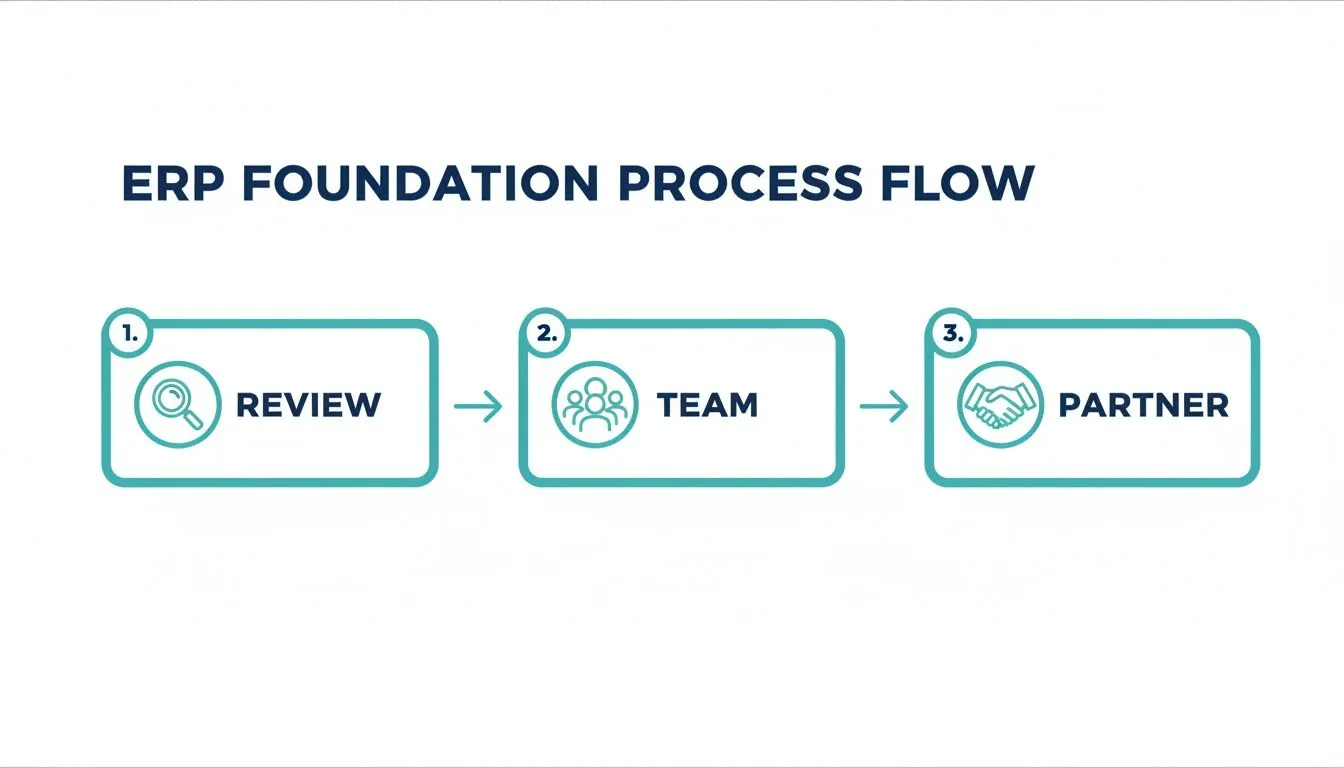
This isn’t just a technical task. It’s a strategic one. This foundational triad is what ensures that data integrity and the five rights of data are upheld throughout the entire project.
Connecting Your ERP to Your Business Ecosystem
Your ERP doesn’t work in a vacuum. Its real power is unleashed only when it’s connected seamlessly to the other systems that run your business, from your warehouse management software to your CRM. Without a rock-solid integration strategy, you’re just creating new data silos, defeating one of the main reasons you started this project in the first place.
Following proven data integration best practices is non-negotiable. This means using modern platforms designed to create reliable, scalable connections between all your applications.
At OneKloudX, we are experts in using powerful Integration Platform as a Service (iPaaS) solutions like Workato, Celigo, Boomi, and Jitterbit. These tools provide pre-built connectors and flexible workflows that are essential for linking your ERP with other key systems.
A well-integrated ERP becomes the central nervous system of your operations, providing a single, undisputed source of truth. It lets data flow automatically between departments, killing off manual data entry and giving you real-time visibility across the entire organisation.
For an Australian manufacturing firm on Epicor Kinetic, this could mean integrating with Netstock for smarter inventory planning and 3DLogistiX to streamline warehouse operations. Or, for a multi-entity distributor running MYOB Acumatica, it might involve connecting to CartonCloud for transport management and SPS Commerce for EDI with major retailers like Woolworths or Coles.
These integrations are what amplify the value of your core ERP. By connecting specialised, best-of-breed solutions, you create a powerful, cohesive ecosystem:
- AI and Business Insights: Tools like Cauzzy AI can plug directly into your ERP data to deliver predictive analytics and genuinely actionable insights.
- Finance and Spend Automation: Integrating with platforms like ProSpend, Webexpenses, Expensify, Medius, Zudello, or Lightyear automates painful accounts payable processes, saving your finance team hundreds of hours.
- HR and Payroll: Connecting to KeyPay or ELMO ensures your employee and payroll data is perfectly consistent between HR and finance systems.
A partner with deep, real-world integration experience is vital here. We help you design an integration architecture that not only solves today’s problems but is also flexible enough to scale as your business grows, incorporating solutions from partners like FernSpeed and more.
Executing a Smooth Go-Live and Driving User Adoption
The go-live date feels like the finish line, but it’s really just the starting gun. The true success of your ERP project is decided in the critical weeks before and after you flick the switch.
This is where the project shifts from technology to people. Getting your team confident, capable, and ready to embrace new ways of working is just as important as getting the code right. This is where meticulous planning, tough testing, and a real focus on change management pay off.
A structured methodology, like OneKloudX’s FlexSafe approach, is built to de-risk this exact stage. It ensures everyone is prepared and engaged for a successful launch and, most importantly, high user adoption.
De-Risking Go-Live with User Acceptance Testing
Before you can even think about a go-live weekend, the system needs to be put through its paces with User Acceptance Testing (UAT). This isn’t a job for the IT department. This is where your key business users get their hands on the system and prove it works for them in the real world.
Effective UAT is all about test scripts that mirror your actual day-to-day work. Forget generic checklists. These need to be detailed, business-specific scenarios.
Imagine you’re an Australian distributor using Oracle NetSuite. A solid UAT script would look something like this:
- Create a sales order for a major customer in Perth.
- Check that the system correctly allocates stock from your WA warehouse.
- Generate a picking slip that integrates with your CartonCloud WMS.
- Process the final invoice and confirm GST is calculated correctly for the transaction.
Every step must be tested by the people who will actually do these jobs. This not only confirms the system is configured correctly, but it also builds user confidence long before launch day.
Driving Adoption Through Effective Change Management
Resistance to change is the number one reason ERP projects fail to deliver on their promises. A new system means new processes, and your team needs support to get through this transition. A strong change management and training plan isn’t a nice-to-have; it’s non-negotiable.
It all starts with clear communication, championed from the top. Your leadership team needs to explain not just what is changing, but why. When your team understands how the new ERP will make their jobs genuinely easier; for example, how Epicor Kinetic will give production managers real-time job costing data; they turn from obstacles into advocates.
Successful user adoption is never a happy accident. It’s the direct result of a deliberate, empathetic, and well-resourced change management strategy that puts your people at the absolute centre of the project.
Training has to be role-based and hands-on, always in a sandbox environment that looks and feels like the real thing. A finance user in a multi-entity company using MYOB Acumatica needs completely different training to a warehouse picker. By tailoring the content, you make it relevant and ensure every person feels ready for day one.
Planning the Cutover Weekend
The cutover is that final, intense period where you turn off the old system and bring the new one to life. It’s almost always done over a weekend to keep business disruption to a minimum. A good cutover is like a well-rehearsed stage production, where every single step is planned and timed to the minute.
A typical cutover plan covers a few key beats:
- Final Data Loads: The last pull and load of transactional data like open sales orders, purchase orders, and current inventory levels.
- System Lockdowns: Locking all users out of the old system. This is critical to ensure no data is changed while the migration is in progress.
- Final Verifications: A last round of high-level checks to confirm that key financial data, like bank balances and accounts receivable totals, has migrated correctly.
- Opening Balances: The finance team’s crucial step of setting the opening balances in the new ERP.
- Integration Checks: Confirming that all connections to your third-party systems are live and working; think payroll with KeyPay or your spend management tool like ProSpend.
With an expert partner like OneKloudX steering the process, the cutover becomes a controlled, low-stress event. Our job is to manage the technical heavy lifting, freeing up your team to focus on one thing: being ready to use their new, more powerful system on Monday morning.
Beyond Go-Live: A Continuous Improvement Journey
You’ve made it. The frantic pace of migration, the endless testing cycles, the late-night cutover planning – it’s all behind you. Your new ERP is live. Pop the champagne, celebrate the win, because you’ve earned it. But don’t get too comfortable.
Go-live isn’t the finish line; it’s the starting block for the real work. Now the focus shifts from just getting the system running to making it work for your business, driving the value that justified this whole project in the first place.
This is where your relationship with your implementation partner changes. The OneKloudX team that got you across the line now pivots from a project-focused role to your long-term strategic support crew. Their job is to guide you through those crucial first few months, helping embed the new ways of working and build genuine confidence across your teams.
So, Was It All Worth It? Measuring Your Migration Success
Remember those KPIs you painstakingly defined all those months ago? Now’s their time to shine. Whether you’re running Oracle NetSuite, Epicor Kinetic, or MYOB Acumatica, this is how you prove the project’s worth.
This isn’t about ticking a box for the board. It’s about getting an honest, data-driven look at the impact on your business. Tracking these metrics shows exactly where you’re getting a return and, just as importantly, where there are still opportunities to improve.
A simple checklist is the best way to keep everyone honest and focused on the results. Here are the core metrics we see our manufacturing, distribution, and finance clients track post-go-live.
Post-Migration Success Metrics Checklist
| Business Area | Key Metric to Track | Example Target |
|---|---|---|
| Finance | Days to Close Month-End | Reduce from 10 days to 3 days |
| Inventory | Inventory Turnover Ratio | Increase by 20% annually |
| Manufacturing | On-Time Delivery Rate | Improve from 85% to 95% |
| Procurement | Purchase Order Cycle Time | Decrease from 5 days to 2 days |
| Sales | Quote-to-Cash Cycle | Shorten by 30% |
When you can walk into a leadership meeting with a report showing a 30% shorter cash cycle or a 20% jump in inventory turns, you’re not just justifying the project; you’re building the case for future technology investment.
The Never-Ending Story: Continuous Improvement
A modern ERP is a living, breathing part of your business, not a static piece of software you install and forget. The real gains come from tweaking, refining, and extending its capabilities over time. This is what we mean by continuous improvement.
Think of an ERP health check like a regular service for your car. It’s not for when things are broken. It’s about proactive maintenance that spots small issues before they become major breakdowns and finds opportunities to boost performance and efficiency.
An ERP health check, performed by an experienced partner like OneKloudX, is the fastest way to do this. We’ll dive into how your teams are actually using the system, analyse process efficiency, and check adoption levels. We might find a new feature in the latest update that could automate a painful manual task for your finance team, or that some targeted training for the warehouse crew could slash picking errors. It’s about unlocking the value you’ve already paid for.
Building Your Tech Ecosystem
Your business doesn’t stand still, and your ERP shouldn’t either. The smartest ANZ companies we work with view their ERP as the central hub of a connected technology ecosystem. Instead of trying to force the core ERP to do everything with expensive customisations, they integrate best-of-breed solutions to handle specific jobs. To truly get the most out of your new system and ensure continuous improvement, consider implementing advanced Business Process Automation Examples to further streamline operations and enhance efficiency.
This approach gives you specialised power where you need it most. For businesses in Australia and New Zealand, this often means solving specific local challenges.
- Finance and Spend Management: Why are you still processing invoices manually? Integrating with platforms like ProSpend, Webexpenses, Medius, or Zudello automates AP and expense reporting. For the month-end grind, tools like Blackline and Zone and Co offer serious financial close automation. For treasury and cash management, solutions such as Kyriba and Coupa provide visibility and control.
- HR and Payroll: Connecting your ERP to local payroll leaders like KeyPay or ELMO is a no-brainer. It eliminates dual data entry and keeps you compliant with Australian requirements like Single Touch Payroll without any extra effort.
- System Governance and Security: As your system gets more complex, you need to keep control. For Oracle NetSuite users, tools like Salto and Strongpoint are essential for managing changes and ensuring you don’t accidentally break something critical during an update. For tax compliance, Avalara is a key integration partner.
When you treat your ERP system migration as the foundation, not the finished building, you create a platform that’s resilient, adaptable, and ready for whatever comes next. With a dedicated partner like OneKloudX in your corner, your technology doesn’t just support your business, it actively pushes it forward.
Your ERP Migration Questions Answered
Embarking on an ERP migration is a massive commitment, so it’s only natural to have a long list of questions. Drawing on our experience guiding mid-market Australian and New Zealand businesses through this journey, we’ve cut straight to the chase with direct answers to the most common queries we hear.
How Long Does a Typical ERP Migration Take?
For a mid-market manufacturing or distribution business in Australia or New Zealand, a standard ERP system migration usually takes between 6 to 12 months. But let’s be clear: this is just a ballpark figure.
The real timeline depends entirely on the specifics of your business. How complex are your current workflows? What’s the quality of your data? How many third-party systems need to be integrated? Are there unique customisations you can’t live without? The only way to get a firm date is through a proper Discovery & Solution Design phase, which is a non-negotiable part of our process at OneKloudX.
While some straightforward projects can be done faster, more complex scenarios, like multi-entity financial consolidations across different states or countries, will always take longer.
The goal should never be speed for speed’s sake. A safe, meticulously planned migration is infinitely better than a rushed one. Our FlexSafe methodology is designed to accelerate delivery, often by up to 30%, but never by cutting corners on quality or safety.
What Are the Biggest Hidden Costs in an ERP Project?
The budget blowouts on an ERP project almost never come from the software licence itself. The real surprises creep in from the areas that get glossed over during the initial planning phase.
Knowing where to look for these costs is the best way to prevent them. A transparent partner like OneKloudX will always map out all potential expenses in a detailed statement of work so there are no nasty shocks later on.
Here’s where we see the most common hidden costs pop up:
- Data Cleansing and Migration: Businesses consistently underestimate the sheer effort needed to clean, validate, and move years of legacy data. It’s a resource-heavy task that can quickly become a major cost if not properly scoped from the start.
- Change Management and Training: Slashing the training budget is a classic false economy. If your team doesn’t know how to use the new system or actively resists it, you’ve completely undermined the project’s ROI before you even go live.
- Over-customisation: One of the biggest mistakes is trying to bend a modern ERP to perfectly replicate every single quirk of your old system. This leads to a mountain of expensive, brittle custom code that’s a nightmare to maintain and can block future upgrades.
- Integration Costs: Your new ERP doesn’t live on an island. Connecting it to other critical systems like a WMS (think CartonCloud) or a CRM like Salesforce requires specialist expertise and tools. These costs must be factored into the budget from day one.
Which ERP Is Best: NetSuite, Epicor, or MYOB Acumatica?
There’s no such thing as a single “best” ERP. The best system is the one that actually fits your industry, your specific processes, and your plans for the future. As an experienced ERP partner, OneKloudX works with these three leaders precisely because they solve different problems for different kinds of ANZ businesses.
-
Oracle NetSuite: An incredibly deep, all-in-one cloud platform. It’s the go-to for dynamic, fast-growing companies, especially those with multiple entities needing powerful financial consolidation, sophisticated inventory management, and native e-commerce.
-
Epicor Kinetic: This is a purpose-built ERP with a rich heritage in manufacturing. If your world revolves around complex production schedules, bills of materials, or you need a top-tier Manufacturing Execution System (MES), Epicor Kinetic is tough to beat.
-
MYOB Acumatica: A highly flexible and configurable cloud ERP that shines in the distribution and construction sectors. Its open architecture makes it a great choice for businesses with unique operational needs that don’t fit a standard mould.
You don’t pick the right ERP from a marketing brochure. You find it through a detailed discovery process where an expert partner like OneKloudX maps your operational reality and strategic goals to the specific strengths of each platform. It’s about finding the perfect fit, not just the most popular name.
How Do We Ensure Australian Regulatory Compliance?
Staying compliant with Australian regulations isn’t an optional extra; it’s a fundamental requirement of any ERP migration. This covers everything from Single Touch Payroll (STP) Phase 2 and GST reporting to the Peppol e-invoicing framework.
The good news is that modern cloud ERPs like Oracle NetSuite, Epicor Kinetic, and MYOB Acumatica are designed with these rules built-in. The vendors push out regular, automatic updates to keep your system aligned with any changes from the Australian Taxation Office (ATO).
During implementation, an experienced local partner like OneKloudX handles the configuration to meet all Australian tax and reporting laws. We make sure your payroll link with solutions like KeyPay or ELMO is fully STP-compliant and that your system is ready for Peppol e-invoicing from day one. By choosing a modern platform and a knowledgeable partner, you lift a massive compliance weight off your shoulders.
An ERP migration is a complex journey, but it’s also one of the most rewarding investments you can make. Having the right strategic partner to guide you makes all the difference.
To learn how OneKloudX can help your business achieve a successful migration with our proven methodology and deep ANZ industry expertise, contact us for a consultation.