Let’s be honest. Staring at a page full of ERP acronyms can feel like trying to decipher a foreign language. But here’s the thing: this isn’t just tech jargon. It’s the language of business growth.
Think of an ERP system as your business’s central nervous system. To make it work for you, you need to know how to speak its language. Understanding the terminology is what allows you to direct the entire system towards your actual strategic goals.
Translating Tech Jargon into Business Strategy
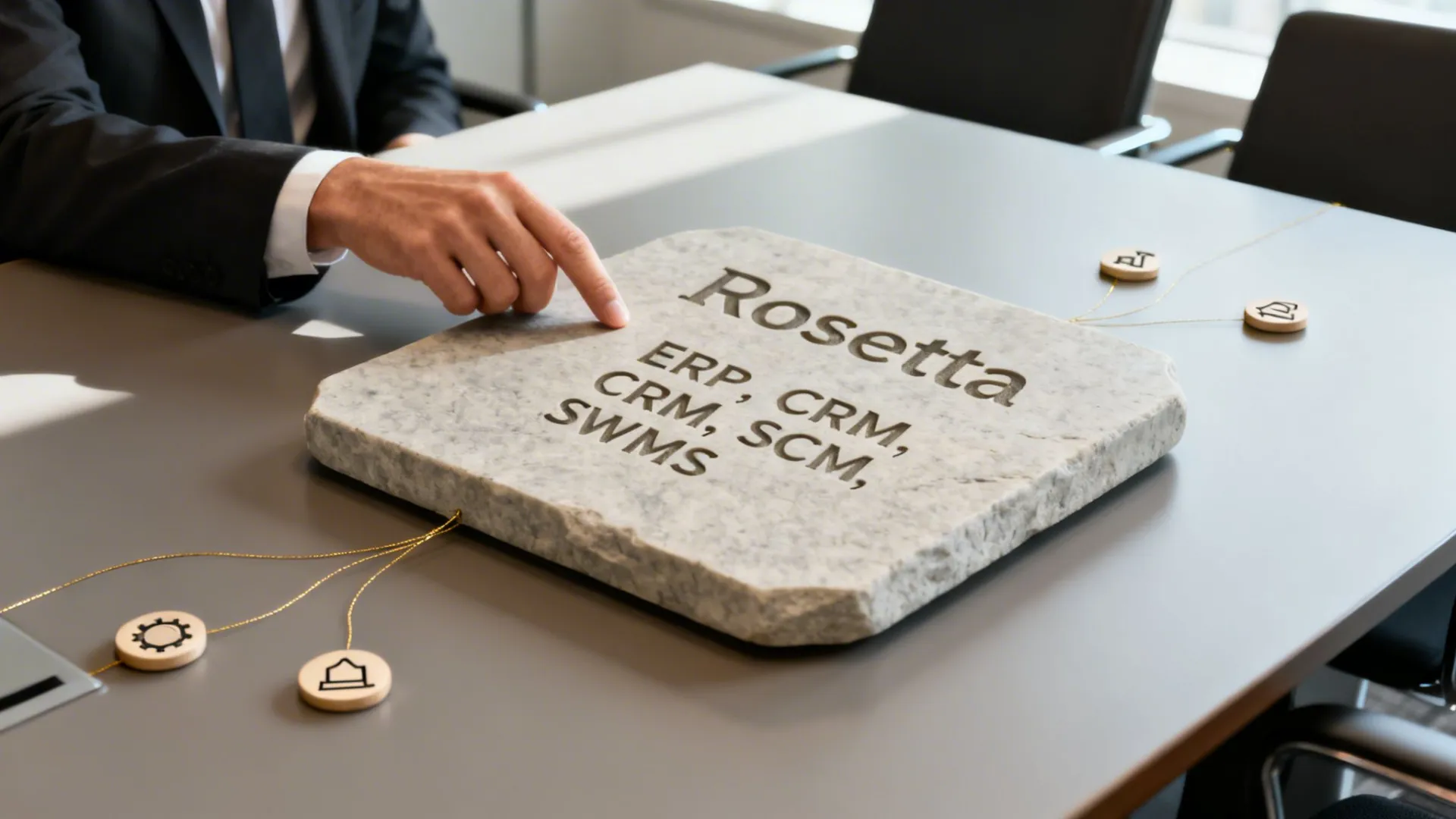
This guide is your ‘Rosetta Stone’ for ERP terminology, built specifically for business leaders in Australia and New Zealand. The whole point isn’t to memorise definitions; it’s about showing you how knowing these terms helps you connect technology directly to tangible business outcomes.
It’s about giving CFOs, COOs, and IT leaders the clarity needed to lead a successful transformation, not just an IT project.
When you can speak the language of ERP, you can articulate precisely what your business needs to grow. It means you can confidently evaluate different solutions and have productive, no-nonsense conversations with technology partners.
Why Mastering ERP Terms Matters
Grasping the core concepts is the first, non-negotiable step toward making a sound investment. Without this foundation, you can’t realistically compare systems or understand how a new platform will solve your specific operational headaches.
For example, a Perth-based distributor struggling with stockouts needs to understand terms like ‘Supply Chain Management (SCM)’ and ‘Inventory Control’ to find the right solution. Just knowing what they mean allows them to ask much smarter questions.
As an experienced ERP partner for Australian and New Zealand businesses, OneKloudX helps you translate those strategic objectives into real-world outcomes using powerful platforms like Oracle NetSuite, Epicor Kinetic, and MYOB Acumatica. We act as your interpreter, ensuring the technology solution perfectly matches your business vision.
An ERP system isn’t just software; it’s a business methodology enabled by technology. As highlighted by Gartner, integrating core functions onto a single platform can reduce operational costs by up to 23% by optimising business processes.
This guide will walk you through the essential vocabulary, moving from foundational concepts to more advanced applications. We’ll cover terms relevant to key business areas, building a practical understanding you can act on immediately.
This knowledge empowers you to lead the conversation, make confident decisions, and drive your business forward with a clear strategy. When you partner with experts, you make sure every piece of terminology translates directly into measurable value for your organisation.
Building Your Foundational ERP Vocabulary
To make a smart decision, you need to speak the language. Let’s break down the core ERP terms you’ll hear in any technology discussion.
This isn’t about turning you into a tech expert. It’s about giving you the confidence to lead the conversation and ask the right questions for your Australian or New Zealand business.
First up, the big one: ERP (Enterprise Resource Planning). At its core, an ERP is the central nervous system for your business. It’s a suite of integrated software that connects all your essential operations: finance, sales, inventory, and more, in real time.
Think of it as the single source of truth that gets everyone working from the same, up-to-the-minute information, finally killing off those dreaded data silos between departments.
Cloud ERP Versus On-Premise
One of the first big questions you’ll face is about the deployment model. This really comes down to two main options, and understanding the difference is crucial for any business leader.
- On-Premise ERP: This is like owning a house. You buy the property (the software license) and it sits on your land (your own servers). You are completely responsible for maintenance, security, and upgrades. This gives you deep control but demands a hefty upfront investment and a dedicated IT team to manage everything.
- Cloud ERP: This is more like leasing a modern, high-end apartment. You get all the premium amenities (powerful software) without owning the building. The provider handles all the infrastructure, security, and maintenance. This model, used by platforms like Oracle NetSuite and MYOB Acumatica, offers flexibility, scalability, and predictable ongoing costs.
The shift in the Australian mid-market is clear: cloud is winning. A 2025 Forrester report showed that 78% of manufacturing and distribution firms in Australia and New Zealand now use cloud-based ERPs to run their operations. That’s a massive jump from just 42% back in 2018.
This is especially true for growing businesses with multiple entities. For them, 65% have ditched legacy spreadsheets for cloud systems, leading to real results like a 30% average drop in inventory holding costs.
Understanding ERP Modules
An ERP isn’t one giant piece of software. It’s a collection of interconnected applications called modules. Each one is built for a specific business function, but they all share the same central database, which is what makes the data flow so seamless.
Imagine your business as a well-organised toolkit. Each module is a specialised tool for a specific job, but they all fit perfectly in the same toolbox.
Common modules include:
- Financial Management: The heart of most ERP systems. It manages your general ledger, accounts payable, accounts receivable, and all financial reporting.
- Supply Chain Management (SCM): This oversees the entire journey of your goods, from buying materials and manufacturing to inventory control and logistics. It’s a critical area where platforms like Epicor Kinetic really shine.
- Customer Relationship Management (CRM): This helps you manage every interaction with current and potential customers, tracking sales leads, service cases, and marketing efforts.
- Human Resources (HR): Manages all your employee data, from payroll and recruitment to performance. It can be extended with partners like KeyPay and ELMO to handle specialised AU/NZ compliance.
The key takeaway is that modules let you build an ERP that solves your specific problems. A Sydney-based manufacturer might prioritise SCM and Finance, while a national professional services firm focuses on CRM and Financials. As an experienced partner for Australian and New Zealand businesses, OneKloudX helps you choose the right combination for maximum impact.
To build a strong foundation, it’s essential to grasp what these core terms really mean. For a deeper look into the specifics, you can find more about the various ERP system meanings explained. This knowledge is your first step to navigating ERP discussions with total confidence.
Understanding the Language of ERP Implementation
Knowing a few ERP buzzwords is one thing. Understanding how those terms translate into real-world project decisions is something else entirely. This is where the vocabulary of action comes in; the language that defines your ERP journey from initial planning to long-term success.
For leaders in Australia and New Zealand, getting this language right has direct consequences for your budget, your team, and your timeline. It’s the difference between a project that delivers value and one that just delivers headaches.
Let’s start with Implementation. This isn’t just about flicking a switch on new software. It’s the entire, hands-on process of getting the ERP system running in your business. This covers everything from configuring the platform and migrating your data to training your staff and managing the cutover from old systems.
A smooth implementation always follows a clear, structured methodology. At OneKloudX, we use our FlexSafe methodology, a proven approach that puts a heavy emphasis on discovery and solution design upfront. This ensures every step is mapped out, risks are flagged early, and the project stays on track, aligning the tech with your specific business goals from day one.
Key Stages and Concepts in an ERP Project
Your implementation journey is marked by several critical milestones. Understanding what they mean helps you track progress and manage expectations across the business.
- Go-Live: This is the moment your new ERP is turned on and becomes the live system for your day-to-day operations. It’s a huge milestone, but it’s definitely not the finish line. A successful Go-Live is the direct result of months of meticulous planning and testing.
- Change Management: This is the strategic work of helping your employees not just accept but actually embrace the new system. It’s about communication, training, and support, ensuring your team is confident and competent. Without it, you’ll never see the ROI you’re hoping for.
- Integration: Your ERP can’t operate in a silo. Integration is the process of connecting your ERP platform, like Oracle NetSuite or MYOB Acumatica, with your other critical business tools. This creates a seamless flow of data across your entire tech stack, from sales to the warehouse floor.
For any growing business, integration is non-negotiable. A Panorama Consulting Group study found that organisations with well-integrated systems see a 77% improvement in breaking down departmental data silos and a 70% boost in customer experience.
Building Your Project Team
An ERP project isn’t an “IT project”; it’s a business project that requires a dedicated, cross-functional team. Getting the right people in the right seats is arguably the most important decision you’ll make. Below are the core roles you’ll need to fill.
Key Roles in Your ERP Project Team
| Role | Primary Responsibility | Why This Role Is Crucial |
|---|---|---|
| Executive Sponsor | Champions the project at the C-suite level, secures budget, and removes high-level roadblocks. | Provides the authority and vision needed to keep the project on track and ensures it remains a top business priority. |
| Project Manager | Manages the day-to-day timeline, budget, resources, and communication between your team and the implementation partner. | This is the operational engine of the project. A great PM prevents scope creep, manages risks, and keeps everyone accountable. |
| Solution Architect | Designs the overall ERP solution, ensuring it aligns with business processes and technical requirements. | This person is the bridge between what the business needs and what the technology can do, making critical design decisions. |
| Functional Leads | Subject matter experts from key departments (e.g., Finance, Operations) who define and validate business requirements. | Ensures the system is configured to solve real-world problems and meet the specific needs of each department. |
| End Users / Super Users | Participate in testing, provide feedback, and become internal champions for the new system within their teams. | Their involvement guarantees the system is practical and user-friendly, which is essential for successful adoption post-Go-Live. |
Having these roles clearly defined from the start creates a structure for clear communication and effective decision-making, which are the hallmarks of a project that succeeds.
The Power of a Connected Ecosystem
To get that seamless data flow, businesses rely on expert partners and powerful tools. Integration Platforms as a Service (iPaaS) from providers like Workato, Celigo, Jitterbit, and Boomi are the engines that make these connections robust and scalable.
For example, a Brisbane-based distributor might integrate Epicor Kinetic with a Warehouse Management System (WMS) from CartonCloud for real-time inventory accuracy. That same company could use Workato to connect their ERP to HubSpot or Salesforce, ensuring the sales and finance teams are always looking at the exact same customer data. Other solution partners, like Cauzzy AI for advanced analytics, SPS Commerce for EDI, FernSpeed for e-commerce, or 3DLogistiX for freight management, can further extend the power of the core ERP.
This diagram shows the fundamental difference between the old way (on-premise) and the modern approach (cloud).
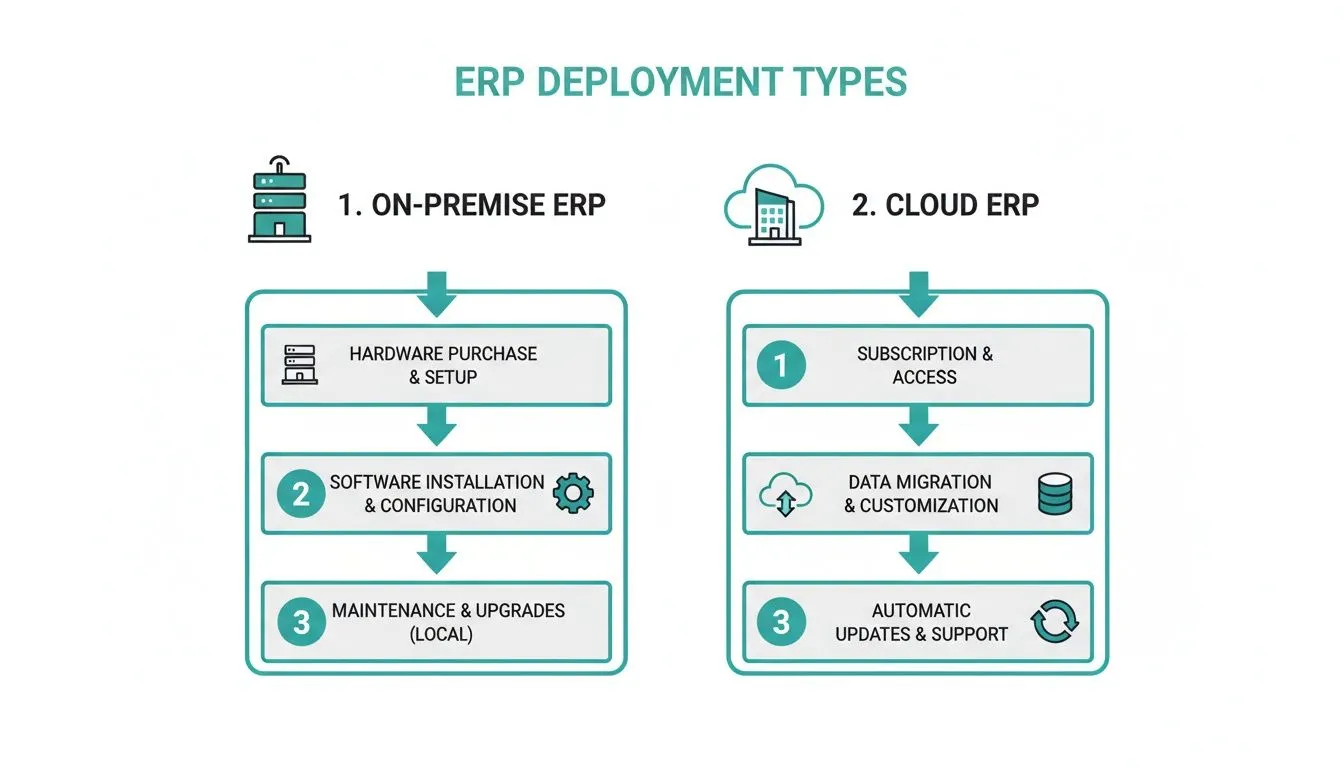
As you can see, cloud ERPs completely remove the burden of buying and maintaining servers. This frees up your team to focus on strategic activities that actually grow the business, not just keep the lights on.
Optimising Your Investment After Go-Live
Your ERP journey doesn’t stop once the system is live. To make sure it keeps delivering value as your business changes, you need to think about ongoing optimisation.
This is where concepts like an ERP Audit or Health Check come in. These are periodic reviews of your system, usually done by an expert partner like OneKloudX. The goal is to find inefficiencies, fine-tune workflows, and ensure the platform is still perfectly aligned with where your business is heading. Solution partners like Strongpoint or Salto can assist in managing and documenting these changes effectively.
Strong project oversight is what separates an ERP that delivers compounding returns from one that slowly becomes obsolete. You can learn more about this in our guide on how effective governance drives ERP project success.
Speaking the Language of Manufacturing and Distribution
For Australian and New Zealand businesses in manufacturing and distribution, the alphabet soup of ERP terms isn’t just jargon, it’s the language of operational control. Getting fluent is the first step to turning complex factory floor and warehouse processes into real, measurable efficiency gains.
This isn’t about learning acronyms for their own sake. It’s about understanding how these concepts connect to solve the day-to-day problems you actually face. With a partner like OneKloudX, this language becomes the blueprint for configuring platforms like Epicor Kinetic, Oracle NetSuite, or MYOB Acumatica to master your operations, from raw material intake to final delivery.
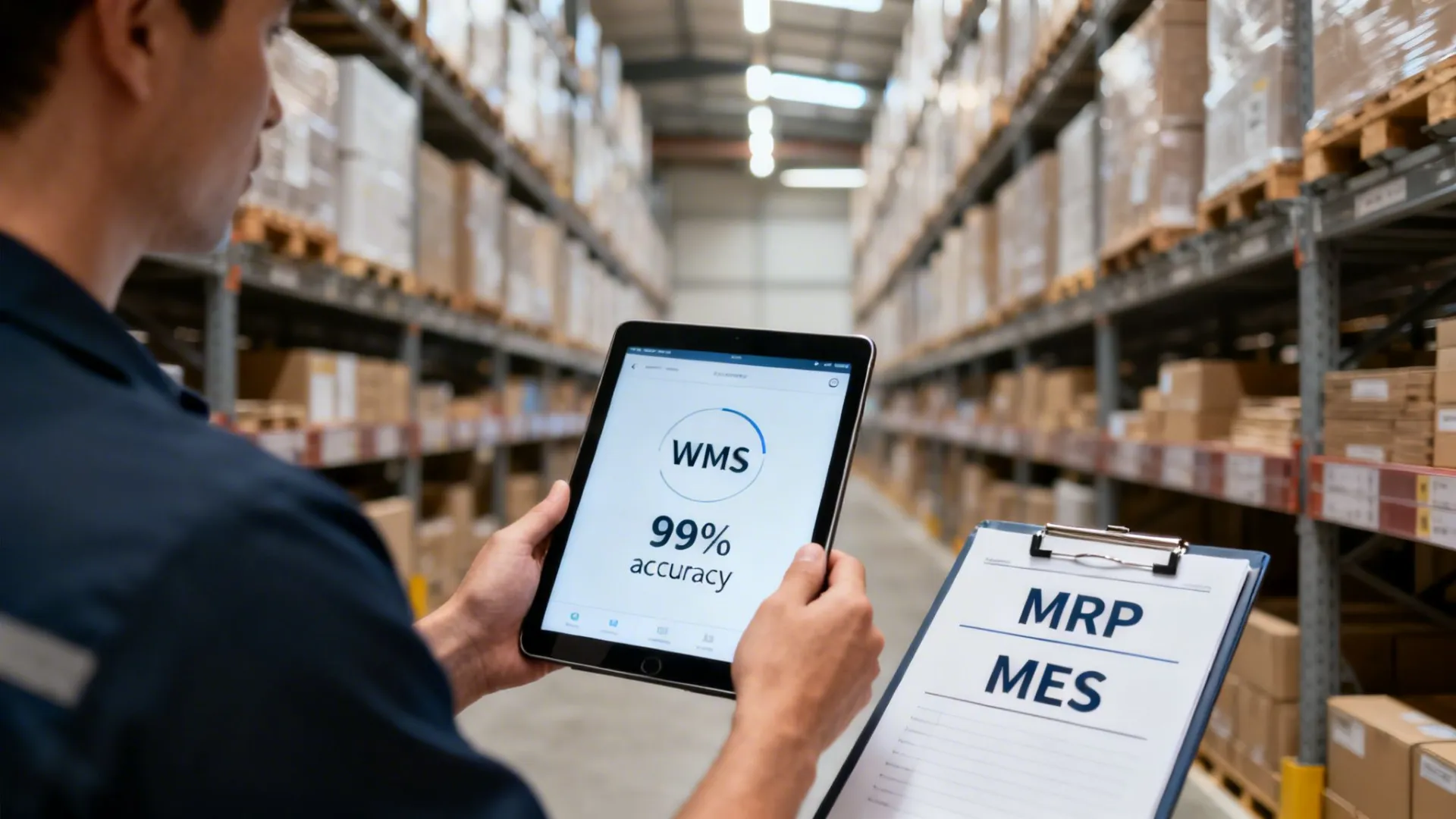
The Three Pillars of Operational Control
Before you can fix anything, you need to understand the moving parts. In a modern ERP, these three systems work together to create a single, unbroken stream of information from the shop floor to the shipping dock.
-
MRP (Material Requirements Planning): Think of this as the brain of your production schedule. MRP analyses your sales orders and forecasts, checks what you have on hand, and then generates a clear plan. It tells you exactly what materials to buy, what parts to make, and when you need to do it all to keep production running without a hitch.
-
MES (Manufacturing Execution System): If MRP is the brain, MES is the central nervous system connecting it to the factory floor. It’s the real-time feed that monitors, tracks, and controls the entire manufacturing process. It answers the critical questions: “What job is running on which machine right now?” and “Are we falling behind schedule?” This is the granular, real-time control that systems like Epicor Kinetic excel at.
-
WMS (Warehouse Management System): This is your warehouse command centre. A WMS optimises every single activity that happens within your four walls, from receiving and put-away to picking, packing, and dispatching. It uses barcode scanning and intelligent rules to drive speed and accuracy, turning a potential bottleneck into a competitive advantage.
Getting these concepts right isn’t just theoretical. A recent IDC report found that 62% of mid-market manufacturing and distribution businesses across AU/NZ saw a 28% ROI boost within 18 months of unifying their systems with cloud ERP. Our own OneKloudX projects with clients using platforms like Epicor Kinetic prove it, where our initial Discovery & Solution Design phase has reduced implementation times by 30% by getting this foundation right from day one.
From Terminology to Tangible Results
Understanding the terms is step one. The real value comes when you see how they connect to solve concrete business problems.
A Melbourne-based distributor, for instance, might integrate their Epicor Kinetic ERP with a specialised WMS. This means when a sales order is created in the ERP, the WMS automatically generates a picklist for the warehouse team. This single integration can be the difference between chaotic fulfilment and achieving 99% inventory accuracy while nearly eliminating shipping errors.
Likewise, a manufacturer in Western Sydney can use their MRP system to automatically trigger purchase orders for raw materials when stock hits a pre-defined minimum. It’s a simple automation that prevents the incredibly expensive problem of a production line grinding to a halt because someone forgot to order a critical component.
The goal is to build a complete, connected ecosystem. This means your ERP doesn’t just hold data; it actively drives your operations, automates decisions, and gives you a real-time view across the entire supply chain.
Even before a full ERP is in place, understanding the fundamentals of your operation is critical. Many businesses start by getting a handle on basic processes, like tracking inventory in Excel, which helps map out the logic that an ERP will eventually automate.
Planning for a Resilient Supply Chain
Beyond the day-to-day, a modern ERP also forces you to think strategically. This is where a concept like Supply Chain Planning (SCP) comes into play.
SCP is about looking ahead. It helps you anticipate future demand, plan your inventory needs, and coordinate with suppliers proactively instead of constantly reacting to crises. Add-on tools from partners like Netstock integrate directly with platforms such as Oracle NetSuite and MYOB Acumatica, using advanced analytics to help you avoid stockouts on your fastest-moving products while ensuring cash isn’t tied up in inventory that just sits there.
For Australian businesses that have felt the sting of supply chain disruptions, building this robust planning function is no longer a luxury, it’s essential for creating a resilient and profitable operation.
To go deeper on how an ERP can be tailored for this environment, look at our guide on ERP for manufacturing.
For any CFO or finance leader, the real test of an ERP isn’t its operational features, it’s whether it delivers financial clarity and bulletproof compliance. Let’s move past the general jargon and talk about the terms that actually impact your bottom line: profit, governance, and strategic financial control.
The foundational concept here is Unified Financials. This isn’t just about having all your numbers in one spot. It’s about creating a single, undisputed source of truth for the entire business.
When your sales, procurement, and warehouse data all flow directly into a single general ledger in a system like Oracle NetSuite or MYOB Acumatica, you kill the endless, error-prone chore of manually reconciling different systems. For an Australian business, this means a real-time, consolidated picture of financial health, not a backward-looking report stitched together from conflicting spreadsheets.
Managing Complexity with Control
As your business grows, especially across states or into New Zealand, financial complexity explodes. This is where Multi-Entity Management becomes a non-negotiable ERP capability for any ambitious company.
It’s the system’s ability to manage the financials of multiple legal entities or business units from one centralised platform.
- For a holding company in Sydney with subsidiaries in Melbourne and Auckland: You can run consolidated financial reports with a click, not after a week of spreadsheet gymnastics.
- It streamlines intercompany transactions: The system automatically balances the books when one entity sells goods or provides services to another, eliminating a notorious source of manual errors.
- It simplifies compliance: Each entity can keep its own chart of accounts and local currency while still rolling up into a unified, group-level view for reporting.
Strengthening Governance and The Bottom Line
Controlling costs is a constant battle. In ERP terms, Spend Control refers to the built-in systems and workflows that enforce purchasing rules, manage expenses, and automate your accounts payable process. This is where governance stops being a policy document and becomes a reality.
Instead of chasing paper invoices and manually approving every expense, you build digital workflows. For instance, a purchase request over $1,000 can be set to automatically require a manager’s approval within the ERP before a purchase order is even created.
This is more than a convenience; it’s about locking down risk. It ensures budgets are followed and every dollar is visible and accounted for, exactly the control a CFO needs to steer the business with confidence.
Integrating your ERP with specialist accounts payable and expense management partners turns a cost centre into a source of strategic insight. Platforms like ProSpend, Medius, Webexpenses, Expensify, Lightyear, and Zudello automate invoice capture and approvals, slashing manual data entry and reinforcing internal controls against fraud. For broader procurement and treasury functions, partners such as Coupa, Blackline, and Kyriba provide further control.
Mastering Australian Compliance
For any business operating here, local compliance is non-negotiable. Modern ERPs like Oracle NetSuite and MYOB Acumatica are built with Australian rules at their core, automating many of the most painful compliance tasks.
This is where your ERP directly cuts your risk profile. Features like automated GST tracking and Business Activity Statement (BAS) reporting are no longer optional add-ons; they are core functions. The system automatically calculates tax obligations from every transaction, making quarterly reporting dramatically simpler and more accurate. Solution partners like Avalara and Zone and Co can further enhance this for complex tax scenarios.
The impact is huge. The 2026 MYOB Business Monitor found that 69% of mid-market growth companies cited ‘Australian compliance’ features; like automated BAS lodgements and superannuation processing; as critical factors in their ERP choice. This focus led to 35% fewer audit penalties and a 27% faster month-end close. You can learn more about how ERP has evolved to meet these business needs.
Likewise, payroll compliance, including Superannuation Guarantee contributions, is handled seamlessly, often with integrated partners like KeyPay or ELMO. By embedding these rules directly into the ERP, you shift compliance from a manual checklist to an automated, system-driven process. This frees up your finance team to focus on analysis, not administration, turning your ERP into a true strategic asset.
Turning Your New ERP Vocabulary Into Action
Knowledge is only powerful when you act on it. Now that you’re fluent in the language of ERP, it’s time to put that new vocabulary to work. This is the moment you move from just learning terms to using them as genuine strategic tools.
A clear command of ERP terminology allows you to articulate your business needs with precision, confidently evaluate potential systems, and ask the tough questions when you’re talking to implementation partners. The conversation shifts from a vague discussion about software to a focused strategy session about your business’s future.
From Vocabulary to Value
So how do you actually use this knowledge to drive your business forward? Here’s a simple framework for turning your understanding into tangible results.
First, use the specific language to build a much stronger business case. Instead of just saying, “We need a new system,” you can now state, “We need a cloud ERP with multi-entity financials to automate our intercompany transactions and give us unified reporting across our Australian and New Zealand operations.” That level of clarity secures buy-in and sets a clear direction from the start.
Next, use the terms to properly vet potential partners. A true expert won’t just throw acronyms at you. A trusted partner like OneKloudX will listen to your specific business challenges and connect them to real capabilities within platforms like Oracle NetSuite, Epicor Kinetic, or MYOB Acumatica. We have extensive experience with businesses across Australia and New Zealand, so we know what works.
Your next step isn’t just to buy software; it’s to start a real conversation about how your business operates. When implemented correctly, a Nucleus Research study shows an ERP system can reduce operational costs by as much as 23% by optimising core processes from the ground up.
Take the Next Step
This newfound fluency is the key to unlocking a project that actually succeeds.
For example, knowing the difference between a basic MRP and a full WMS helps you specify the exact level of inventory control you need for your distribution centre in Sydney. Understanding what change management truly involves helps you plan for the human side of the project; a factor that so many businesses overlook.
If you want to dig deeper into that side of things, we’ve got some practical advice on how to manage internal change for a successful ERP implementation.
Ultimately, your grasp of ERP terminology empowers you to be an active, informed leader in your business’s evolution, not just a bystander. As an experienced ERP partner for Australian and New Zealand businesses, OneKloudX is here to help you translate that knowledge into a real-world solution that drives growth.
We encourage you to reach out for a discovery session to begin your journey.
Answering Your ERP Terminology Questions
When you’re exploring a new ERP, the jargon can feel overwhelming. Let’s cut through the noise and get straight to what these terms actually mean for your business. Here are the plain-English answers to the questions we hear most from business leaders across Australia and New Zealand.
1. What Is the Difference Between ERP and MRP?
Think of it like this: an MRP (Material Requirements Planning) system is your factory floor manager. It’s laser-focused on one job: managing your manufacturing inventory and production schedule. It answers critical questions like, “What do we need to make?” and “What materials do we need to buy to make it?”
An ERP (Enterprise Resource Planning) system is the entire business headquarters. It’s a single, integrated platform that runs everything; finance, HR, sales (CRM), and the supply chain; ensuring every department is working from the same real-time data. An experienced partner like OneKloudX helps you figure out if a dedicated MRP is enough for now, or if a comprehensive platform like Epicor Kinetic, Oracle NetSuite, or MYOB Acumatica is what you need to scale.
2. How Long Does a Typical ERP Implementation Take?
This isn’t a “how long is a piece of string?” question. While every project is different, a well-run implementation has a predictable timeline.
For a typical mid-market business in Australia, you should expect a project to take between 4 to 9 months. A proven methodology, like the FlexSafe approach we use at OneKloudX, is key. It locks in the discovery and solution design phase first, giving you a realistic timeline from the start. This architecture-led process eliminates guesswork and builds confidence across your entire team.
Key Takeaway: The quality of your initial planning dictates the speed and success of your project. A detailed roadmap is the best defence against scope creep and ensures a predictable go-live date.
3. Why Are Integrations With Partners Like Workato So Important?
The reality is no single ERP can be the absolute best at everything. That’s where integrations come in. They act as the essential bridges connecting your core ERP; whether it’s Oracle NetSuite, Epicor Kinetic, or MYOB Acumatica; to the other specialised apps you rely on. This is how you create a single, unified tech ecosystem.
For instance, you’ll want to connect your ERP with:
- HubSpot or Salesforce for seamless sales and marketing automation.
- CartonCloud or 3DLogistiX for sophisticated warehouse and freight management.
- ProSpend, Medius, or Expensify to automate accounts payable and get control over expenses.
Integration platforms (often called iPaaS) from specialists like Workato, Celigo, Boomi, or Jitterbit make these connections robust, scalable, and reliable. This creates a seamless flow of information across the business, maintaining one source of truth without the expense and headaches of fragile, custom-coded connections.
Ready to turn your knowledge of ERP terminology into a clear action plan? The team at OneKloudX is here to translate your business needs into a powerful technology solution. Book a free discovery session with us today.